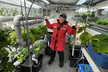
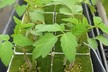
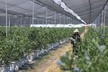
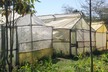
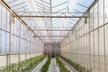
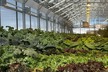
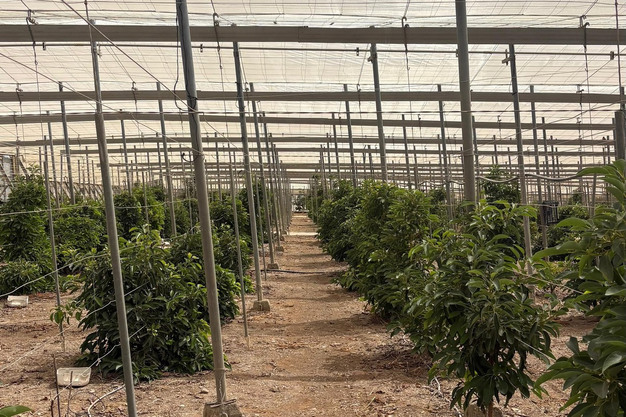
For many years, greenhouses were mainly used for tomatoes, peppers, and cucumbers. Gradually, some growers in the southern part of the peninsula began experimenting with tropical fruit trees, initially with mangoes and, more recently, with avocados.
 © Iberian Avocados
Three or four years ago, nobody believed a fruit tree like the avocado could grow in a greenhouse. Today, we see results that match or surpass those of traditional horticultural crops, both in yield and profitability," stated José Mª Cuadrado Martín, head of Iberian Avocados.
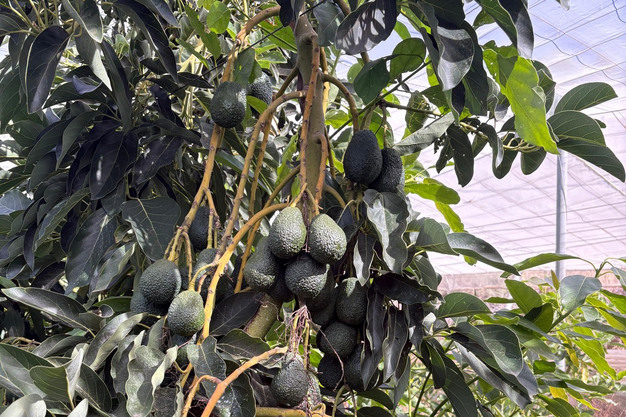
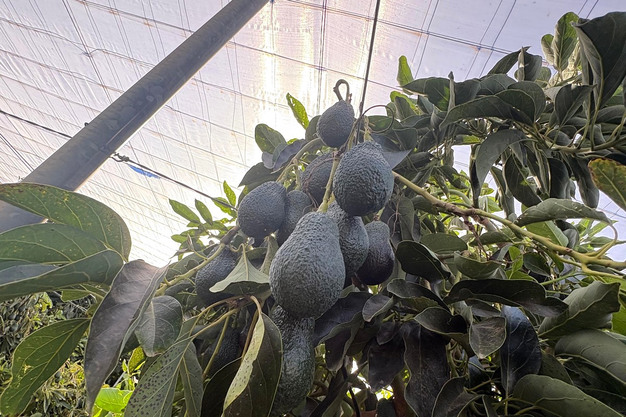
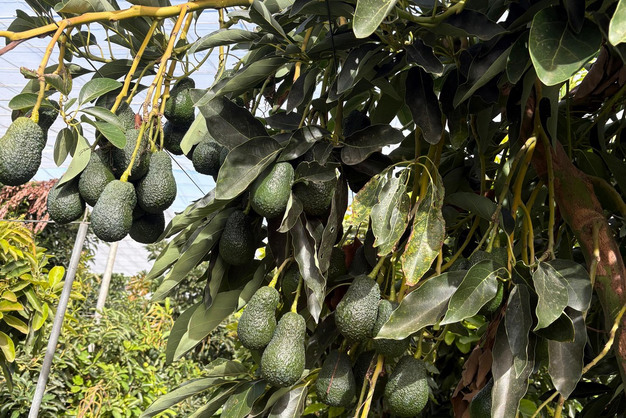
Previous experience with greenhouse mangoes, especially in Malaga's Axarquia region, paved the way. "The mango, a smaller and manageable tree, proved that greenhouses are not just for vegetables," Cuadrado stated. "The Lamb Hass avocado was the turning point. It is very similar to the traditional Hass but more compact, usually no taller than 2 or 3 meters. This makes it ideal for growing inside covered structures."
 © Iberian Avocados
The "more adventurous" growers were among the first to experiment with this crop. "Many came from horticulture, seeking options that were less labor-intensive and more profitable. They succeeded in establishing plantations that yield up to 30 tons per hectare, with average prices of 1.5 to 2 euros per kilo. After deducting costs ranging from 10,000 to 12,000 euros per hectare, these figures remain very appealing."
"Growing Lamb Hass in greenhouses allows us to start harvesting in January".
Growing crops under plastic or netting provides protection against frost, wind, and heat, and can also allow harvesting up to 2 months earlier. Cuadrado notes, "Growing Lamb Hass in greenhouses allows us to start harvesting in January. In contrast, the harvest of the product grown in the open fields usually takes place in March or April. In addition, by managing the temperature during flowering, we can improve cross-pollination, leading to more uniform fruit sizes and higher fat content in the fruit," he stated.
The choice of structure largely depends on the location. "In coastal areas, where winters are mild, I prefer to use shading netting because it allows air to pass through and prevents excess heat. On the other hand, in inland areas with colder winters, plastic helps to maintain the temperature," he said. "The shape of the greenhouse also matters. A high multi-tunnel promotes aeration and thermal control; a flat or low one traps more heat. Everything must be considered in terms of the microclimate."
 © Iberian Avocados
If managed properly, Cuadrado stated, avocados are not highly demanding regarding soil texture. "While loam soils are typically favored, sandy soils in greenhouses are also effective. In fact, they function similarly to a semi-hydroponic system: offering excellent drainage, preventing waterlogging, and allowing precise fertigation adjustments with millimeter accuracy."
However, he warned that water is the crop's Achilles' heel. "Avocado trees are highly sensitive to salinity. Poor-quality water causes immediate stress to the trees. Before planting, it is essential to assess both the volume and electrical conductivity of the water you will use."
In Morocco, where Iberian Avocados also works with local growers, there are even more intensive greenhouse avocado farming systems. "We know of greenhouse avocado plantations where 2,500 trees per hectare are planted in 2 x 2 meter frames, with potted trees. Each plant produces between 15 and 20 kilos, and they reach 20 tons per hectare yields, with short cycles of between 3 and 4 years," he stated.
"This is a technique I hadn't encountered before, but with a favorable price at source and lower labor costs, this short cycle model appears profitable for growers who implement it," he added.
 © Iberian Avocados
"Greenhouses enable avocado cultivation in areas previously unsuitable due to cold or heat"
Growing avocados in greenhouses introduces new challenges, starting with the investment, but the benefits can outweigh the drawbacks. "Greenhouses enable cultivation in areas that were previously unsuitable for this crop due to cold or heat, like inland Granada, Arenas del Rey, Zújar, or Seville. If land isn't costly and water quality is good, the project can be profitable," he stated.
"Agriculture is not a love of art; it is a business that must be efficient. Greenhouse avocado, if well managed, can be as efficient, if not more so, than any traditional horticultural crop," José Mª Cuadrado summed up.
For more information:
Iberian Avocados Consulting
Tel: +34 621 008 533
Email: [email protected]
https://iberianavocados.com