Bell pepper growers have had a tough time in recent years. Following issues with aphid invasions and losses over the last two years, organic breeding company De Bolster stepped in to help with the bell pepper rootstock 'Skyborn F1'.
Growers Paul Moerman and Youri Barendse tested the rootstock and are enthusiastic. Simon van Zanten, account manager at De Bolster, is too, especially now that he saw vigorous crops at the end of the season that could still keep going for a while, especially as several growers also achieved the hoped-for increased production.
 © De Bolster Biologische Zaden
From organic to conventional cultivation
At De Bolster, they're always working to tackle the challenges that organic growers face. Interestingly, many of their solutions also turn out to be useful for conventional production.
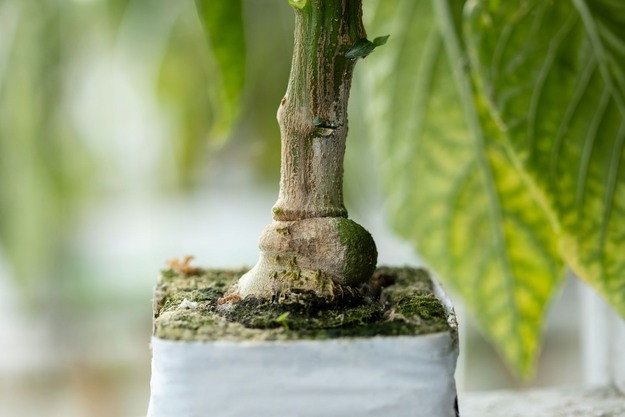
Their productive pepper rootstock Skyborn is the leading variety for organic cultivation, but it also performs exceptionally well in substrate systems with almost any pepper variety. Skyborn develops a vigorous root system that provides strong resistance to the fungal diseases Verticillium and Pyrenochaeta, and offers moderate resistance to root-knot nematodes.
In the meantime, several substrate growers have started grafting their pepper plants onto this rootstock. So far, the results are promising: little to no plant loss, more vigorous growth, and higher yields.
This summer, pepper growers Paul from Dalipa and Youri from Rainbow Growers are sharing their experiences with Skyborn, giving valuable insight into how this rootstock performs under real greenhouse conditions.
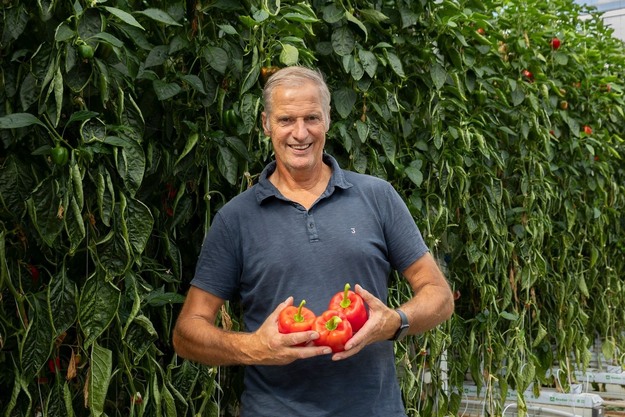 © De Bolster Biologische ZadenPaul Moerman: "My plants can withstand more heat with the Skyborn rootstock"
Loss also takes a mental toll
Paul, the owner of Dalipa, has been growing a single red pepper variety, Alzamora, for years in his 6.4-hectare greenhouse in Bleiswijk. In 2023, however, problems began to appear when the soil fungus Fusarium showed up. This pathogen enters the plant through the roots and can cause them to rot, preventing the plant from taking up water and nutrients. As a result, the plants begin to wilt.
Paul was relatively lucky as plant loss was limited to about 5%. "Still, it caused a lot of anxiety," he explains. "I know growers who had to clear out their entire greenhouse, that kind of loss is unimaginable. When it hits your own crop, you keep asking yourself where it will end. Having that hanging over you really gets to you, not just financially but mentally too."
1,600 m2 trial, zero loss
Paul continues: "When I heard about Skyborn, I decided to run a trial last year on 1,600 square meters. The results were fantastic: zero plant loss, stronger growth, and heavier fruits, which boosted my yield per square meter by around 5%. I noticed that the plants grafted onto this rootstock were visibly stronger than the rest. Normally, as more fruit develops on the plant, its growth tends to slow down. But with this rootstock, the plants kept growing steadily. This year I've grafted all my pepper plants, and I'll definitely keep doing that in the future."
Of course, grafting comes with additional costs, but Paul explains that these are offset by the higher yield and the fact that he no longer needs to apply shading chalk to his greenhouse to protect the crop from the sun. "With the Skyborn rootstock, my plants can tolerate more heat. It also gives me peace of mind knowing I don't have to worry about losing plants, that's worth a lot. I hope other growers will give it a try too. Some are still hesitant because they haven't yet experienced major plant losses. But to me, that's like playing Russian roulette, why take the risk? My advice is simple: run a trial with this rootstock."
 © De Bolster Biologische Zaden
Don't wait until it's too late
Grower Youri, one of the Young Rainbow growers from the Rainbow Growers Group, shares Paul's mindset this summer: better to start testing and gaining experience now than to wait until serious problems arise.
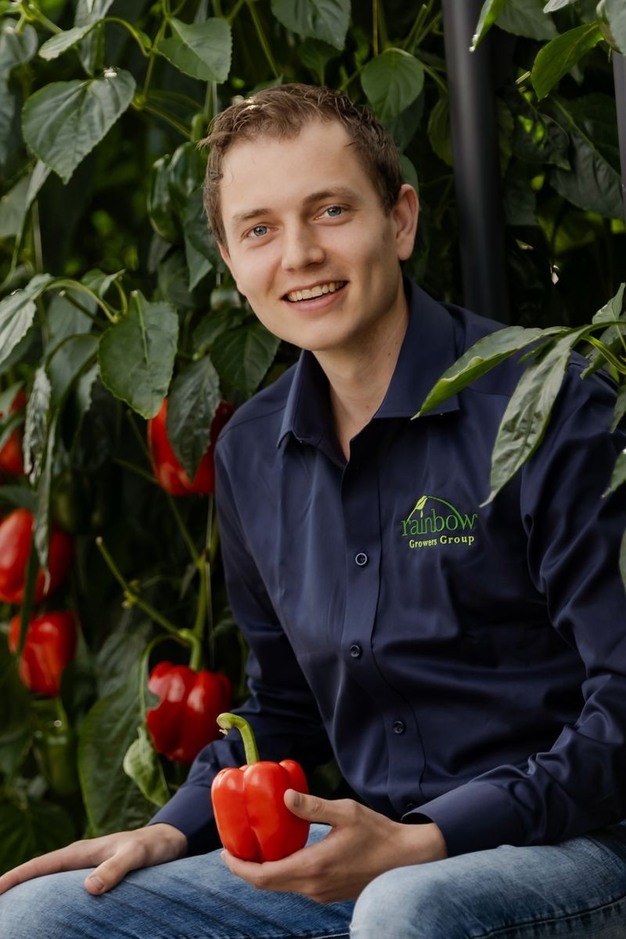
Youri manages a total of 40 hectares of red block pepper production across two locations in North Holland, those being in Middenmeer and Andijk. In 2024, he and his fellow growers noticed a dip in growth and production in two of their greenhouses. "The plants started to wilt," Youri explains, "but we still don't know the exact cause. Luckily, the losses were limited, but we didn't want to wait for a real disaster to happen."
Photo right: Youri Barendse, Rainbow Growers Group, combines Skyborn with the variety Alzamora. "That way you get the best of both worlds."
According to Simon from De Bolster, the stories of plant loss in pepper production in 2024 are well-known. It was a year with very little light, which Simon describes as "terrible weather." "In my view, that lack of light prevented the plants from developing an active root system," he explains. "This season, we've had plenty of light, but what next year will bring, that remains to be seen."
Good fruit setting and strong growth
This season, Youri and his colleagues decided to experiment with two different approaches: growing peppers on the Skyborn rootstock in rockwool, and cultivating their standard variety in organic substrate instead of rockwool.
Youri explains: "Skyborn is the most well-known rootstock at the moment and it combines really well with our variety Alzamora. Alzamora sets fruit easily, but it has a weaker root system and tends to lag behind in vegetative growth. When you combine it with the vigorous roots and strong growth of Skyborn, you really get the best of both worlds. This rootstock has excellent resistance to Verticillium, Pyrenochaeta, and various root-knot nematodes. We're already seeing differences compared to the non-grafted pepper plants growing in rockwool and substrate, the grafted plants are producing about 1.5 kilos more per meter."
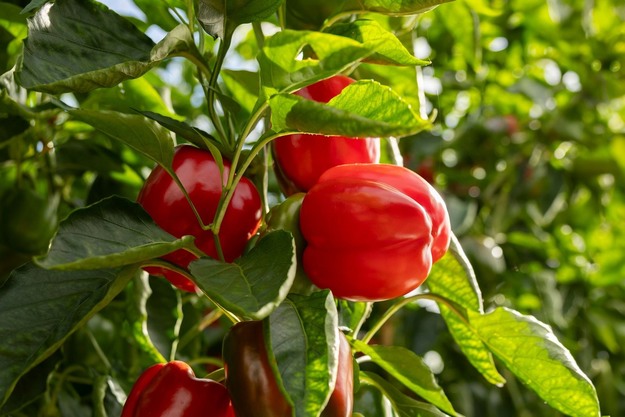
As for fruit size, Youri can't say much yet this summer, but he expects it to improve as well. By week 43, Simon has already seen enough to draw his conclusions: "Non-grafted plants often show smaller fruit towards the end of the season. That's not something I've noticed in plants grafted onto Skyborn. Even in October, the crop still looked strong and healthy."
In response to the recent issues with plant losses, the pepper market seems to be moving in two directions: more growers are switching to grafted cultivation on rootstocks, and there's also a clear rise in the use of organic substrates. However, Simon has also seen examples of growers who had problems in 2024 while growing on rockwool, but who switched to Skyborn on the same rockwool slabs in 2025, without any trouble at all. "They had zero plant loss this season," he says, "and an absolutely excellent crop."
 © De Bolster Biologische Zaden
Expand next year
According to Youri, starting trials before facing major plant losses has already proven its value this summer. The grafted plants showed very strong early growth in spring, which caused slightly less fruit set than would have been ideal. The additional yield mainly appeared toward the end of each flush, when the market was already saturated and prices were lower.
Next year, Youri plans to fine-tune his strategy by providing more heat and water to encourage earlier fruit set and more fruits per plant. "We already see clear differences compared to the peppers growing in rockwool and substrate, the grafted plants are producing about 1.5 kilos more per meter than the rest," he says.
He admits that he hasn't yet covered the cost of the Skyborn rootstock this year. "That's mainly due to the strong early growth and the low average market price for peppers at the moment," he explains.
Tip: do a trial first
Despite that, Youri has no regrets about running the trial, and if it's up to him, the 5 hectares currently grown on rootstock will be expanded next season. "I've seen other growers around me who had to stop early because of major plant losses. For many young plant producers, grafting can be challenging, especially given the limited space available from October to December. But I prefer not to take chances, I want to build knowledge and experience now, before serious problems arise. It really takes a year or two to get the hang of growing on a rootstock, and I want to be ready to adapt quickly if plant loss ever hits."
Youri is confident that with better adjustments next spring, the Skyborn rootstock will deliver a solid return. Like Paul, he advises other growers not to wait until things go wrong, but also not to switch over all at once. "Start with a trial grafting," he says, "so you can fine-tune your approach if needed."
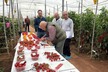
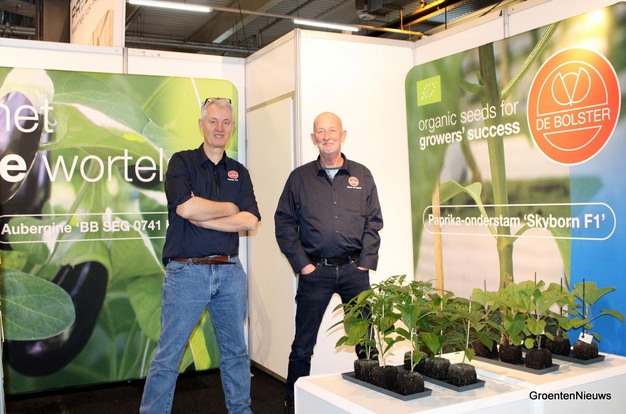 © Thijmen Tiersma | HortiDaily.comMaarten Vrensen and Simon van Zanten (De Bolster) next to their popular rootstock Skyborn at HortiContact 2025.
Strong setting for a good finale
With large-scale cultivation on De Bolster's Skyborn rootstock, growers have gained a wealth of new experience that will be put to good use next season. "The growers who achieved the highest yields this year," Simon notes, "were those who pushed the limits a bit in their rootstock cultivation. They worked with higher temperatures and higher CO₂ levels."
He recalls visiting one grower's greenhouse this summer where it was, as he put it, "extremely hot." "That grower still managed to produce 44 kilos of peppers per square meter. With grafted plants, I think there's less need for shading against the heat. I even know growers who didn't close their shade screens at all this year."
Around the longest day, the yield difference between grafted and non-grafted plants wasn't yet striking, Simon explains. "An extra 500 to 700 grams isn't that special on its own. But when you looked at fruit set, that's where the real differences became visible. At that point, you just know that in July, August, and September, the Skyborn plants will deliver more kilos, and that's exactly what happened."
More than 100 hectares
Over the next few years, Simon expects growers to gain even more experience with grafted plants. At the moment, the most common combination in conventional production is the red main variety Alzamora from Rijk Zwaan grafted onto Skyborn. "That combination lets growers sleep soundly at night," he says. "This season we've seen, on a commercial scale, that an additional yield of 2 to 2.5 kilos per square meter is quite realistic."
At De Bolster, they expect the area of peppers grown on Skyborn to exceed 100 hectares next year, double the current acreage. "Most growers have now made their decision about using a rootstock," Simon concludes. "And in most cases, that rootstock is Skyborn."
 © De Bolster Biologische Zaden
For more information:
De Bolster Organic Seeds
[email protected]
www.bolster.nl