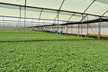
During the opening of Hortivec, visitors got a sneak peek at an exciting new concept for tomato cultivation. The project, called Tom 4.0, focuses on short-cycle tomato production using mobile gutters.
In the greenhouse at Sint-Katelijne-Waver, the plants are being grown for the first time on specially adapted gutters designed for this system. The trial aims to collect data on the production potential, and early crop modeling suggests that yields could increase by as much as 20%.
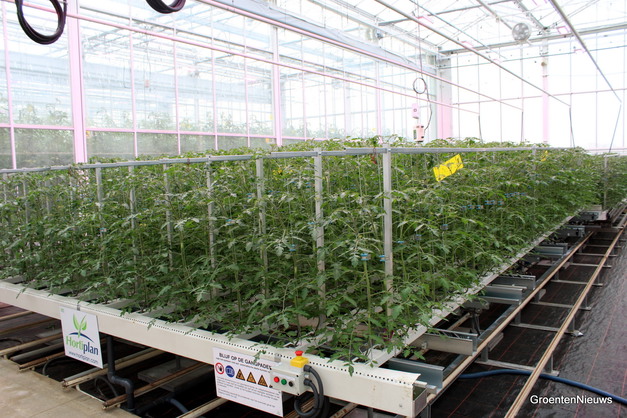 © Thijmen Tiersma | HortiDaily.comThe plants are placed for the first time on gutters specially adapted for this cultivation in Sint-Katelijne-Waver, says Rik Clymans, coordinator of greenhouse cultivations at the Research Station for Vegetable Cultivation. Hortiplan speaks of 'the most advanced version of TOM 4.0'.
Less labor
The Tom 4.0 concept, developed by Ridder in collaboration with several partners, uses Hortiplan's mobile gutter system. This setup was originally designed for lettuce production, but is now being tested with tomatoes. The idea is that, in the future, crop tasks such as pruning and harvesting will be carried out by robots in a central area, while each growth phase will take place in a separate greenhouse section. That's still a vision for the next phase, but the groundwork is being laid.
At the moment, in early October, the plants on the gutters have been growing for about seven weeks. The tops have already been pinched out, and the goal is to harvest two trusses per plant before replanting new ones. Because of the short growing cycle, there's no need for leaf pruning, which saves time and labor. However, clipping, removing side shoots (suckers)—we noticed one had been missed on Thursday—and harvesting are still part of the routine work.
The result is a clever blend of automation and horticultural innovation, paving the way for a more efficient and data-driven approach to tomato production.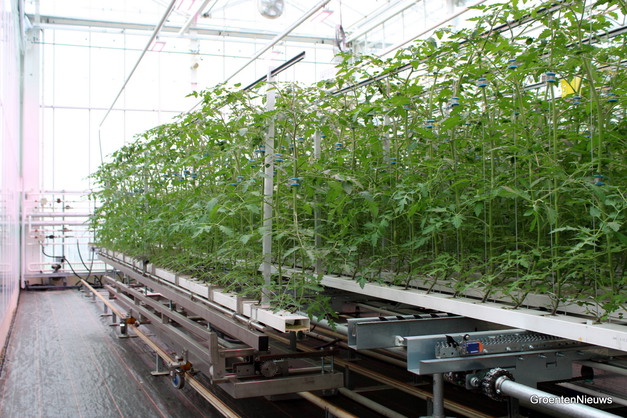 © Thijmen Tiersma | HortiDaily.comOn this scale, a manual shuttle system is still used.
Keeping a regular variety compact
The total growing cycle lasts about 14 weeks. For now, there isn't a tomato variety developed specifically for this short-cycle, mobile-gutter system. The current trial uses a De Ruiter variety that produces medium-sized truss tomatoes with a notably high Brix level, a sign of excellent sweetness and flavor. It's a standard commercial variety, but growers are experimenting with techniques like adding extra blue light to help keep the plants shorter and more compact.
Natural light is also limited during the early growth phase to control stretching. Young plants are raised entirely in climate-controlled growth chambers, where they spend around three weeks before being transferred to the greenhouse. By early October, the crop has been in the greenhouse for only four weeks.
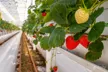
Another way growers keep the plants compact is by raising the EC level (electrical conductivity of the nutrient solution). They've already pushed this to the upper limits, with EC values exceeding 5, which helps restrict vegetative growth and encourages a sturdier, more generative plant structure.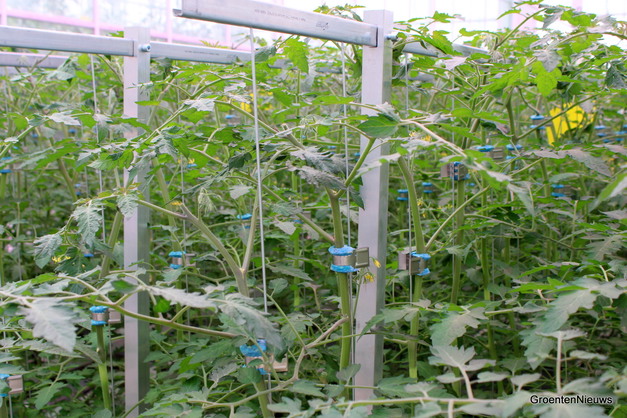 © Thijmen Tiersma | HortiDaily.comAfter two trusses, the top is removed from the plant
More plants per square meter
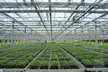
In total, there are 850 plants growing in the 150-square-meter greenhouse, about three times the planting density of a conventional tomato crop, explains Rik Clymans, coordinator of greenhouse crops at the Proefstation voor de Groenteteelt, which also oversees the Hortivec facility.
A similar trial is being conducted at the World Horti Center in Naaldwijk, where the same mobile-gutter system is being tested. The next big step will come once Ridder, Hortiplan, and Van der Hoeven have fully mastered the cultivation process. Only then will robots take over the crop-handling tasks such as pruning and harvesting.
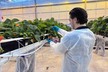
For now, the focus is on perfecting the cultivation system itself, fine-tuning planting density, light strategy, and irrigation, to lay a solid foundation for the future of automated, data-driven tomato production.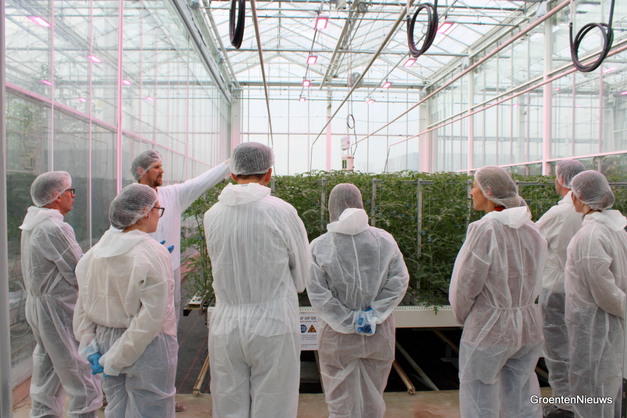 © Thijmen Tiersma | HortiDaily.comBumblebees ensure pollination, but the system is also well-suited for pollination through vibration, as Rik demonstrates by shaking the system.