UbiQD has announced the publication of peer-reviewed results from a landmark greenhouse study funded by the U.S. Department of Agriculture (USDA, through its National Institute of Food and Agriculture (NIFA)), and conducted at the University of California (UC), Davis. The findings, now published in Materials Today Sustainability, demonstrate that UbiQD's luminescent QD-laminated glass significantly enhances plant growth, nutrient uptake, and energy efficiency in controlled-environment agriculture (CEA) settings, without any electricity or mechanical input.
The study marks the first deployment of quantum dot-integrated structural glass in agriculture, representing a new form factor of the UbiGro greenhouse technology, providing compelling evidence that spectrum-optimized glass can enable high-yield, year-round production, particularly in colder climates and energy-constrained regions.
 © CEE Lab, UC Davis
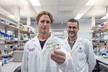
"For glass greenhouse farmers looking to boost output while reducing energy inputs, this is a breakthrough," said Hunter McDaniel, PhD, CEO of UbiQD. "These results prove that the sun can be engineered passively through QD-infused glass to deliver more productive, resilient, and sustainable food systems."
Key findings
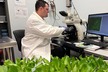
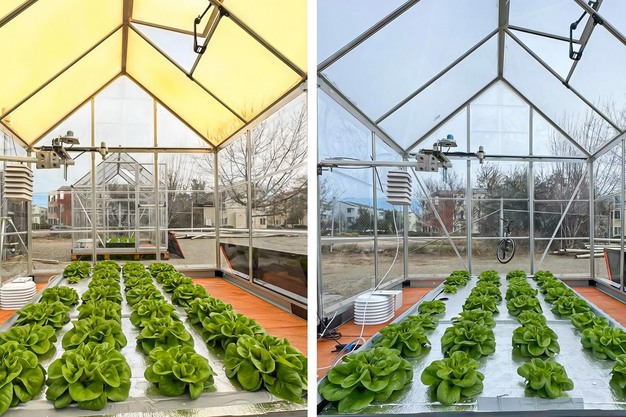
Conducted over a full winter lettuce growing cycle at UC Davis, the study compared matched greenhouses — one equipped with laminated QD-glass and the other with standard greenhouse glass. The greenhouse using UbiGro glass delivered significant improvements in crop performance.
Fresh biomass increased by 37.8%, with plants nearly 40% heavier, indicating substantially more edible yield. Leaf area expanded by 38.0%, providing a larger photosynthetic surface. Root length also increased by 38.0%, resulting in deeper roots that improved water and nutrient uptake, plant resilience, and shelf life.
Light-use efficiency rose by 41.0%, showing that the plants converted sunlight into biomass more effectively, producing more growth per photon of light received. Nutrient concentrations of nitrogen, phosphorus, potassium, magnesium, zinc, and copper were significantly higher, making the crops more nutritious.
Additionally, the spectral red-to-blue light ratio increased by 61.0% without any significant loss of photosynthetically active radiation (PAR), meaning the greenhouse delivered more red light without reducing the total usable light available to the plants.
"It's incredibly validating to see these spectral shifts result in measurable improvements in plant performance," said Eric Moody, Vice President of Sales and Marketing at UbiQD. "Our film products are already delivering strong results in commercial greenhouses around the world, and this new data supports our broader vision for integrating light-optimizing technologies—like our upcoming glass innovations—into agriculture at scale."
A solution for the global food-energy-water crisis
Global food production faces a perfect storm of pressures: rising demand, land and water scarcity, and worsening climate volatility. Agriculture already consumes over half of all habitable land, draws down ~72% of global freshwater withdrawals, and contributes nearly 25% of global greenhouse gas emissions. As the world races toward a population of 10 billion by 2050, growers need solutions that maximize yield while minimizing resource use.
In that context, the UC Davis study provides timely and powerful validation for spectral engineering as a tool for sustainable intensification. The peer-reviewed results describe UbiGro glass as "a promising pathway toward climate-smart greenhouse envelopes that integrate photonics with sustainable food and energy strategies."
For more information:
UbiQD
[email protected]
www.ubiqd.com