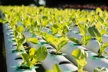
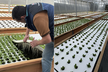
In just six years, the privately held Haoyu Group has entered greenhouse growing, begun constructing its own glasshouses and implemented new ways to assure profitable, sustainable year-round growing in its Venlo and semi-closed greenhouses. Now it is working with Svensson to implement advanced algorithmic screen control at a 7 hectare greenhouse in Shandong Province in China.
Haoyu Group's operational projects now include 23 hectares of "Dutch" high-tech glass greenhouses for tomato production, and 30 hectares of multi-span plastic greenhouse for rose cultivation. The projects provide a premium product to the Chinese market under the well-known 'Tomato's Home' and 'Ruyi' brands.
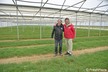
 © Ludvig SvenssonHaoyu's Greenhouse #3: built in just 120 days by their own team, setting a new standard for modern greenhouse construction.
In March 2025, Haoyu Group's installation company completed its first independently constructed glass greenhouse. Greenhouse #3 is the third tomato greenhouse Haoyu operates at the Zhaoxian Wucai Agricultural Park and features a semi-closed design. To further enhance tomato yield and quality during hot summers, light and temperature control were taken into account during screen selection.
Meanwhile in Greenhouse #1, a venlo greenhouse, the company has been testing new screening strategies with guidance from Svensson's Energy Monitor, a module in the LetsGrow.com platform.
Exploring the potential of screens
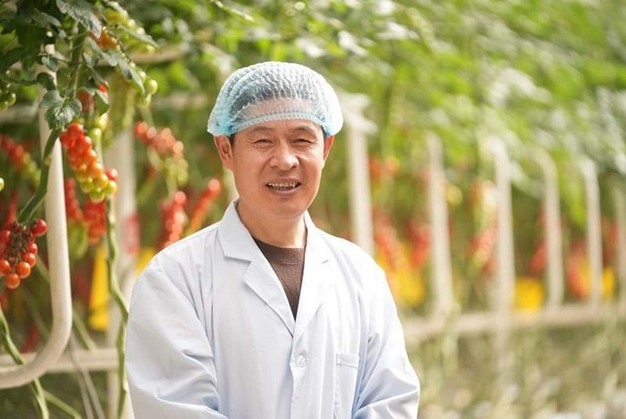
"Since our first tomato greenhouse project in 2019, Svensson has provided technical support in climate screen selection," says Zhao Shanxing, Chief Engineer at Zhaoxian Wucai. "While our project utilizes waste heat from the group's power plant as an energy resource, this relatively passive 'low-temperature water' heating system also presents challenges for greenhouse climate control. Svensson's double-layer energy saving screen solution has played a vital buffering role in stabilizing our greenhouse environment."
"Through summer production, we've gained valuable experience – shading and diffused light are essential for healthy crop growth in hot seasons. Currently, we're collaborating with Svensson to explore whether advanced shading strategies could further reduce cooling energy consumption during summer," he adds.
Hardware software connectivity
To help growers optimize energy savings through screen usage, Svensson has launched Energy Monitor in the LetsGrow.com data platform. This tool visually displays real-time energy savings, and potential additional savings, that are or can be achieved by the screens. It enables growers to better understand the relationship between energy supply and screen deployment in greenhouses.
Using Energy Monitor, Svensson's climate experts and Haoyu's technical team regularly analyze and discuss climate data to fine-tune strategies for improved screen performance.
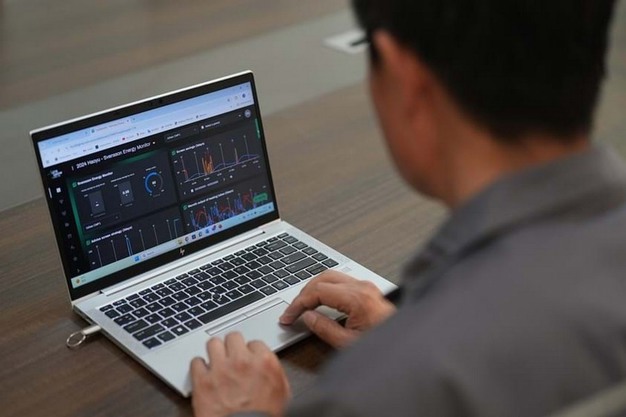 © Ludvig SvenssonHaoyu uses Energy Monitor to optimize screen strategies, with expert guidance from Svensson's climate team.
"Last November, we started using HPS lamps in our 1st tomato greenhouse," explains Mr. Zhao. The resulting high night temperature and humidity levels led to frequent screen gaps in the double-layer screens. Based on automatically generated screen strategy advice from the Energy Monitor module, we conducted in-depth discussions with Svensson's climate experts.
"This collaboration resulted in a moderated gap strategy that effectively balances humidity control and temperature reduction while maintaining optimal greenhouse climate stability."
 © Ludvig Svensson
Key profitability drivers
For the domestic market, achieving profitability in high-tech greenhouse tomato cultivation remains an area of active exploration, says Mr Zhao.
"First, we implement standardized, industrial-style thinking into the production process—details make all the difference," he explains.
"Second, product quality is the top priority, backed by precise environmental control and strict quality management. Most importantly, our team continuously learns and adopts new technologies and products, applying them effectively to enhance efficiency and solve real-world challenges. We hope future partners can provide strong technical and service support to help us in sustainable growing!"
For more information:
Ludvig Svensson
[email protected]
www.ludvigsvensson.com