Five years ago, growing pointed peppers was something completely new for Marcel Rohrborn at Frutura in Austria. The grower before had only spent two years cultivating bell peppers. Today, Marcel has really found his way with pointed pepper production. A big help along the way has been ProJoules, the crop-planning platform he was one of the very first to use. "Light has a much bigger influence on cultivation than we ever imagined," Marcel explains.
By early September, Marcel expects to continue harvesting pointed peppers for another ten weeks. The hot summer in the Styrian region is more or less behind them. Sunshine is nothing unusual here, though. High radiation levels, often topping 2,500 joules per day in late spring, are practically the norm rather than the exception. Growers in the area can see it clearly in their climate measurements.
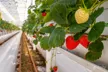
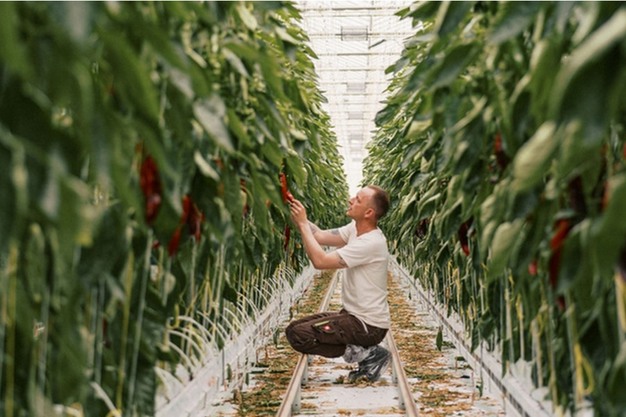 © ProJoulesMarcel Rohrbon in his greenhouse with sweet pointed peppers
Measuring light in the greenhouse
On the five-hectare pointed pepper greenhouse in Bad Blumau, a Kipp Solar meter has long been in place to measure sunlight outside the greenhouse. But when Frutura first started with pointed peppers, they weren't measuring light inside the greenhouse at all. That changed in the summer of 2023, when PAR meters were installed, both outside and inside the greenhouse. The reason? Blossom end rot was showing up in the crop, and the team suspected excess light might be to blame.
ProJoules makes it easy for growers to track light levels, expressed in joules. The platform shows how much light is coming in from outside, as well as how much the crop actually needs. If the plant is receiving more joules of light than it can handle, the platform makes it clear with a little "red cloud" on the screen.
On Wednesday, September 10, during a ProJoules webinar where Marcel shared his own experiences, founder Wim van Wingerden explained more about the platform, highlighting Frutura as a success story. Growers who use ProJoules gain new insights into light management, particularly in areas like applying coatings and using shading screens effectively.
Use of coatings
These days, Marcel relies on two different coatings for his pointed peppers. For the past two seasons, he applied ReduFuse IR around week 14, followed by ReduSol in week 18. Still, despite coatings and shading screens, blossom end rot made a return in 2024. Heavy rainfall had washed part of the coating off the roof, allowing too much light to pour back in.
This season, Marcel and his team adjusted their strategy. After the usual applications of ReduFuse IR and ReduSol, they added an extra layer of ReduSol in June. That extra step has made a big difference. By early September, Marcel reports that blossom end rot is at an absolute minimum. "You always get a bit of it, but this year it's really minor. Our harvest and fruit quality are the best they've been in five years," he says with satisfaction.
Light: A universal challenge
In Austria, growers produce a wide range of fruiting vegetables, including eggplants. From experience, eggplants seem more tolerant of higher light levels. Cucumbers and tomatoes also cope fairly well, although not quite to the same degree.
Wim sees the same pattern in other regions. Supporting ProJoules users in North America, Canada, Mexico, and other high-light areas, he hears the same story again and again. "Everywhere, growers are facing the same challenge, and that's light. More light doesn't automatically mean better," he explains.
Too much light, especially combined with higher greenhouse temperatures, can stress plants and cause problems. The limit varies by crop and even by variety, but every plant has a threshold for how much light it can handle.
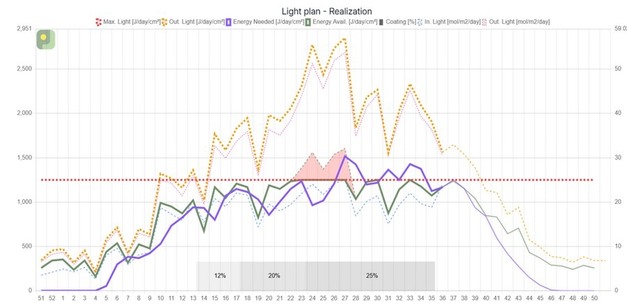 © ProJoulesRealization of the light plan at Frutura, sweet pointed peppers cultivation 2025
Reduce the red cloud
At Frutura, Marcel grows the red Palermo pointed pepper and the very generative yellow variety Yosemite. With both, the impact of applying greenhouse coatings at just the right moment was clearly visible. Even with average daily temperatures climbing to 25°C this summer, the crops kept developing steadily. ProJoules supports growers by showing the maximum light load, in joules, that a variety can handle. The platform even comes with pre-filled crop profiles. Since growers can duplicate and adjust these profiles, they can add their own experience and fine-tune the settings for their specific varieties.
Eggplants, for example, are known to tolerate higher light levels, largely because they can also handle higher temperatures. But even here, there's a limit. ProJoules helps make that limit visible by combining light measurements with crop data. Marcel admits that he can no longer imagine working without a PAR meter, especially now that he sees the results of combining light measurements, ProJoules insights, and additional coatings on the greenhouse roof.
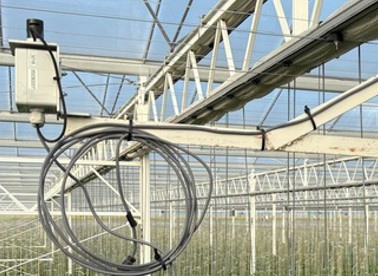 © ProJoulesWim notes that more and more growers are starting to use PAR meters, and with that, the number of ProJoules users continues to grow. As a result, more growers are becoming familiar with the so-called "red cloud." For newcomers, and even for experienced users, Wim offers one piece of advice: don't try to eliminate the entire red cloud. Leave a little margin. That way, during the season, you still have flexibility to apply extra coating or shading when it's really needed. ProJoules helps growers pinpoint exactly the right moment to do so.
Photo right: PAR meter in the greenhouse at Frutura
For more information:
ProJoules
[email protected]
www.projoules.com
Frutura
www.frutura.com