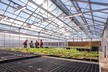
Rising energy costs and sustainability pressures in agriculture are currently leading to colocation (the integration of greenhouses with other infrastructure like data centers and energy systems) being a strategic solution. Resource Innovation Institute's (RII) recent webinar brought together some bright minds in CEA infrastructure to explore the engineering realities and economic potential of colocation.
 © Resource Innovation InstituteA reality check and a wake-up call
"This wasn't just a blue-sky conversation," says webinar host Rob Eddy of RII. "Our panelists delivered a practical reality check: the technology is ready, but success hinges on economics and partnerships."
Photo right: Rob Eddy
Strong attendance from engineers, utility consultants, and energy experts reflected a growing appetite for actionable insights. Among the standout voices was Kurt Parbst of Borlaug, who emphasized that combined heat and power (CHP) systems must run year-round to remain financially viable. His case study of an Ohio landfill project illustrated how creative approaches can solve the mismatch between energy supply and greenhouse demand which is a common barrier to one-to-one partnerships.
Innovating the infrastructure: A technical deep dive
Webinar topics ranged from 90% efficient CHP system design to 130°F hot water distribution, thermal storage, centralized water treatment, and shared CO₂ capture.
Jim Rearden of BioTherm Solutions drew on decades of experience to showcase how engineering-intensive greenhouse systems are becoming, and why they require thoughtful integration from day one. "These aren't systems you bolt on after the fact," Rob notes. "Planning for colocation has to be baked in from the start if it's going to work economically."
Ownership models that could change everything
Perhaps the most surprising insight came from Lauren Eagan of Evergreen Energy Partners, who suggested that utilities could eventually own geothermal loops, therefore removing the infrastructure burden from individual facilities. "That's a game-changer," says Rob. "If utilities step in as infrastructure providers, it opens the door to wider adoption and more flexible financing models."
Lauren also highlighted how federal incentives, domestic manufacturing priorities, and clean energy policy are converging to make colocation more attractive and more feasible.
Why now? Timing, technology, and opportunity
When asked why colocation is gaining traction now, Rob points to a perfect storm of challenges and opportunities. "Energy costs are crushing greenhouse operators, CO₂ prices are spiking, and data centers are popping up everywhere generating massive waste heat," he explains. "The synergies are impossible to ignore."
He also noted that regions like the Netherlands have long demonstrated colocation's viability. "North America has been building greenhouses in isolation. It's time to catch up."
Opportunities and real barriers
The panel didn't sugarcoat the challenges. Mismatched load profiles, high upfront engineering costs, and a lack of matchmaking tools to connect compatible facilities remain major obstacles.
Nick Long of Livic Civil emphasized that even the best-laid plans can falter without utility support. "You can have the perfect site, but if power isn't available, you're dead in the water," Rob summarizes.
Still, the opportunity is immense. Shared infrastructure allows growers to access systems like centralized water treatment and CHP that would be prohibitively expensive on their own. As Rob puts it: "This is how we bring cutting-edge technology within reach for CEA operations."
From niche to norm
Will colocation become standard practice? "It won't be universal," he acknowledges. "But in the right regions, with supportive policies, utilities on board, and energy-intensive neighbors, it's going to become the preferred approach."
He predicts the rise of Farm Park-style developments, especially in data center corridors and industrial zones, where infrastructure needs align. "The economics are too compelling when the stars align."
Perhaps the most telling sign of change was the engagement from the audience itself. Cannabis growers asked how energy modeling and colocation principles could apply to their operations, a clear indicator that interest is spreading across agricultural sectors.
"There's growing excitement, and healthy skepticism," Rob concludes. "But with the right planning, partnerships, and policy support, colocation is inevitable."
For more information:
Resource Innovation Institute
Elyse Greenberg, Director: Programs + Communications
[email protected]
[email protected]
www.resourceinnovation.org