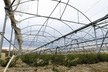
Today, the cultivation of various fruits, vegetables or flowers is commonly associated with macrotunnel-type greenhouses, and many of us will immediately think of Huelva, where they are inseparable from berry production.
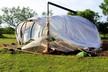
But the origin of macrotunnels in Spain, and in the world, is not exactly there, but in Cabra: a town in southern Córdoba set in a sea of olive trees where Antonio González designed and patented, decades ago, the first macrotunnel structure for strawberry cultivatio
"The patent expired years ago, but we can say with pride that my father's invention, although many people don't know it, helped the strawberry industry expand the way it did in Huelva," says his son Antonio J. González, now CEO of Inveurop. "The macrotunnel was successful in Spain from the start, and even in the period when my father was working he exported greenhouses to Greece, Poland and the Dominican Republic."
 © Inveurop
"Since then growth has been unstoppable. Thanks to feedback from customers, distributors and partners from different parts of the world, such as Eduardo Barlocco of the Uruguayan company Aguas Uruguay, we have been refining our structures to adapt them to the different climates and growing conditions on the planet; many of them in warm regions where years ago we already identified a lack of mid-range but quality technology."
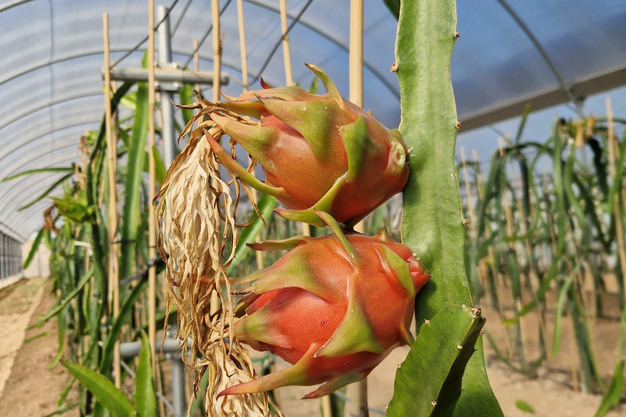
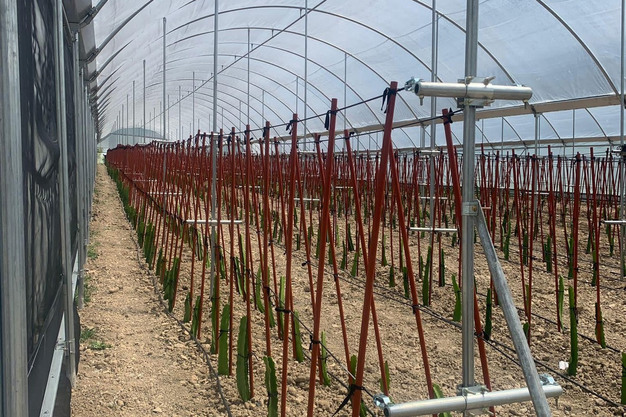
"That led us to create a new greenhouse concept, based on the macrotunnel my father had invented, but increasing the diameter of the tubing to raise height and width, allowing greater interior volume and improved ventilation: the Macrotúnel Plus. In addition, we are about to launch a new automatic system to roll up the plastic roof covering so the greenhouse can run only with mesh in the hottest periods."
"One of the places where we see the greatest potential, and where we have already undertaken several projects, is sub-Saharan Africa"
"This new concept has been a market success and we have sold many hectares of Macrotúnel Plus from Hungary to Uruguay. There is still great expansion potential in the United Arab Emirates and other parts of the Middle East," Antonio stresses, "but one of the places where we see the greatest potential, and where we have already started several projects, is sub-Saharan Africa, specifically, Senegal."
 © Inveurop
"It is expected that by 2100 it will be the continent with the largest population on the planet, and it still has an agricultural sector to develop. Northern countries, like Morocco or Tunisia, have already begun to exploit their potential, but the rest of Africa still must do so. For Spain and for our sector, horticultural technologies, it is a unique opportunity in history: because of proximity and because of our specialization in low- and mid-tech for agriculture in temperate climates; and, although it is a somewhat taboo subject, because Spain lacks the colonizing stigma in sub-Saharan Africa."
"At Inveurop, in fact, we have already invested there with the installation of a greenhouse construction plant, and the country's first professional vegetable nursery, Fertilis, which we have launched together with our partner Mamé Diagne. With all this, we want to carry out a vertical integration of turnkey projects; with an economic and social contribution and a transfer of knowledge that is fundamental for the region, giving the possibility of out-of-season exporting of all kinds of horticultural products: from watermelons to pitahayas, a crop in which we are specialized."
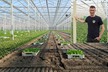
Specialists in pitahaya greenhouses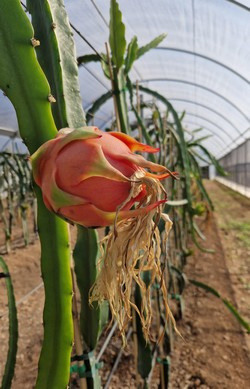 © InveuropIn 2016, after pitahaya made a timid arrival in Spanish markets, a producing company asked Inveurop for a greenhouse to grow pitahaya in Almayate, Málaga. "Pitahaya was a new product for us, and in the first trials we already saw all the problems that arose when cultivating it in conventional macrotunnels: roots tend to suffer rot from excess water if grown only under mesh, flowers abort from excess heat under plastic during heat waves… We had to modify our initial macrotunnel design without moving to a multitunnel structure, so that the farmer could recover the investment more quickly."
"Therefore we decided to enlarge our structures: we moved from 35 posts to 50 tubing, which allowed a 10-metre width and a canal height of 2.5 m. The interior volume of that macrotunnel increased dramatically, making plants much more comfortable with optimal ventilation during heat waves."
"That was exactly how the Macrotúnel Plus came about," shares Antonio J. González, "and that is why today we can say we are specialists in manufacturing greenhouses for this fruit."
"It should be noted that in these years of the pitahaya boom many farmers were carried away by profitability stories that were not entirely true, and chose the wrong technology or greenhouses for their crop, so some companies have stopped production; but with self-pollinating varieties, which save considerable labor costs, and with greenhouses designed specifically for pitahaya, we are confident a new expansion of this crop will be seen again."
 For more information, please contact
Inveurop
Plaza de España 13 2 planta Cp: 14940 Cabra (Córdoba)
Tel: +34 957 74 60 67
[email protected]
www.inveurop.com