After sharing early results from their gravity simulator, Gravilab, French biotech company Orius has scaled its research from single plants to full cultivation systems designed to provide more than half of a crew's daily calories in space habitats. In collaboration with the French space agency CNES, the company is working to prove that controlled environment agriculture can achieve self-sufficiency through integrated crop production, resource recycling, and advanced monitoring.
"Our system has the capability to provide more than 50 per cent of the necessary calories for the diet of four astronauts on an 80 square meter surface area," the Orius R&D team says. "This is a major step in designing deployable greenhouses that meet the specific requirements of space missions."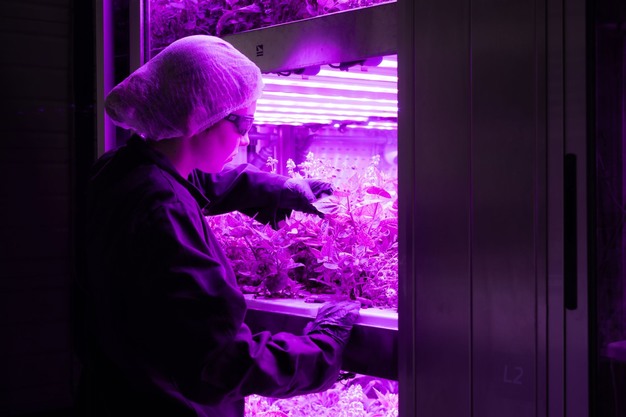 © Orius
Moving beyond leafy greens
While leafy greens remain a cornerstone of controlled environment agriculture, Orius and CNES are expanding their crop portfolio to include cereals, legumes, and fruiting plants. Trials with wheat, kidney beans, and millet have already been conducted in the company's Biomecell chambers.
Wheat reached 4.4 to 4.6 kilograms per square meter per year, kidney beans produced 1.63 kilograms per square meter per year, and millet yielded 0.40 kilograms per square meter per year. These results may be modest compared to conventional field agriculture, but they demonstrate the technical feasibility of cultivating staple crops indoors at scale.
"The journey from leafy greens to fruit production represents an important step in our research trajectory. We are especially keen to work with the Micro-Tom tomato, a dwarf variety that combines practical size constraints with significant agricultural relevance."
Creating circular systems
A distinctive feature of Orius's approach is the valorization of crop residues. Stems, pods, and bran left over from cereal and legume cultivation are being tested as substrates for mushroom production. By feeding this biomass back into the system, the modules reduce waste while generating additional protein-rich food. This strategy strengthens circularity in space habitats and also offers lessons for vertical farms on Earth that want to diversify their output and reduce disposal costs.
Orius is designing its systems to interface with Environmental Control and Life Support Systems. "According to our calculations, our production modules could scrub all the CO₂ emitted by the number of crew members they're intended to feed," the team says. Plants become active participants in the life support cycle, reducing reliance on mechanical scrubbers while improving overall efficiency.
To validate these designs, Orius is running 12-square-meter wheat trials inside Biomecell that measure evapotranspiration, carbon dioxide uptake, and energy demand in real time. "Advanced monitoring systems for matter and energy flux are essential for understanding how these systems can be integrated into a space base." All data is collected through BiomeOS, the company's proprietary software platform.
Lessons for vertical farming
Although these projects are designed for space, Orius emphasizes that the underlying innovations can be applied on Earth. "All these developments have strong potential to create innovative solutions for Earth-based CEA, building efficient recycling loops to grow crops in the most effective way while minimizing energy and resource consumption."
For vertical farms, the immediate lessons include treating crop residues as a resource rather than waste, implementing gas management to reduce quality loss, and applying matter and energy flow monitoring to sharpen KPIs such as yield per kilowatt-hour and liters of water per kilogram. The inclusion of cereals, legumes, and mushrooms points to opportunities for product diversification that can strengthen business models.
As Orius extends its crop range and refines its modules, the implications go well beyond future lunar or Martian bases. Systems that capture every gram of carbon and recycle every liter of water are just as relevant in urban farms as they are in space.
For more information:
Orius
Elodie Rallo, Marketing and Communications
[email protected]
www.orius.co