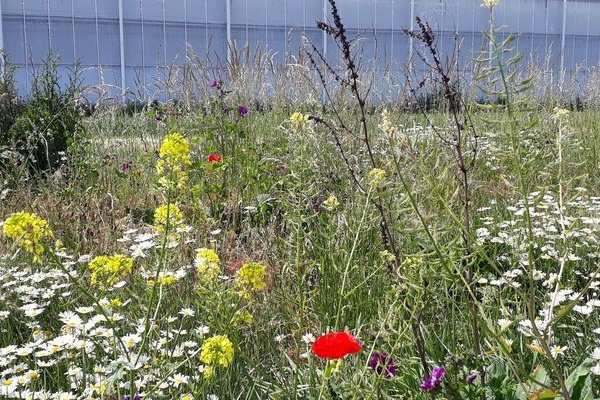
At the end of 2024, twenty greenhouse growers across the Netherlands began creating 250 m² biodiversity strips right next to their greenhouses. These trial fields are part of the project Biodiversity in and around the Greenhouse. For two consecutive summers, researchers are monitoring the strips to track insect populations and plant development. By now, four of the six planned monitoring rounds for 2025 have been completed, with the final observations scheduled for the first week of September. Kyra Vervoorn of Wageningen University & Research (WUR) shares the latest updates with Glastuinbouw Nederland.
 © Glastuinbouw Nederland
Current situation in the field
By July, the biodiversity strips presented a varied picture. Aphids, which were still present until late June, had largely disappeared and remained absent. The ladybirds that were abundant earlier in the season had pupated and flown off.
Late June and July saw an increase in thrips, though their numbers now seem to be declining again. Earlier research (2022) showed that as many as 15 different thrips species can be found in outdoor flowers, with only a small fraction being the well-known Western flower thrips (Frankliniella occidentalis). In this project too, researchers are identifying which species occur, in order to better understand potential risks for virus transmission.
After the period of higher thrips pressure, researchers recorded a clear rise in thrips predators, especially predatory bugs of the genus Orius. These highly effective predators are often found on yarrow (Achillea). Green lacewings are active as well: in July, many eggs were spotted on carrot, and by late July the first larvae had appeared. In addition, numbers of leafhoppers increased, while soldier beetles, hoverflies, and various other bug species were also abundant.
Vegetation development
Most of the strips are now well established. Chamomile has largely finished flowering, while in many locations carrot and/or yarrow are starting to dominate. Interestingly, some plots that lagged behind earlier in the season have now caught up and are looking strong. Across many strips, attractive rosettes of teasel, viper's bugloss, and parsnip are becoming visible — plants expected to deliver a rich second-year flowering in 2026.
Project biodiversity in and around the greenhouse
The project tests two specially designed flower mixes containing annuals, biennials, and perennials. The goal is to strengthen biodiversity and attract natural enemies of greenhouse pests. At the same time, researchers are monitoring whether these strips also influence the immigration of harmful pests. The challenge is to strike the right balance: attracting as many beneficials as possible without increasing pest pressure.
Collaboration and Funding
Biodiversity in and around the Greenhouse is a collaborative effort between Glastuinbouw Nederland, Wageningen University & Research, and Leiden University. Funding comes from the Dutch Ministry of Agriculture, Nature and Food Quality (LNV), Kennis in je Kas (KijK – The New Approach to Plant Health), Innovatiefonds Hagelunie, the province of South Holland (via Greenport West-Holland), the municipality of Westland, Glastuinbouwpact Bommelerwaard & Tielerwaard, and the Delfland Water Authority. Additional in-kind support is provided by Biobest, ECW Energy, and the Federation of Fruiting Vegetable Organisations. Together, growers and researchers are taking a step toward more sustainable and resilient greenhouse production systems.
Source: Glastuinbouw Nederland