Over the past decade, Ricardo Hernandez has blazed scientific trails aimed at making indoor farming higher yielding, more environmentally sustainable and more profitable. Determined to see his breakthroughs benefit farmers, he's now forging a new path as an entrepreneur.
In December 2024, the NC State University horticultural scientist launched Rooted-in-tech, a plant propagation company that will use the recipes he's developed for altering a range of indoor growing conditions to create seedlings that meet farmers' specific needs.
"The goal," says Hernandez, an associate professor in the Department of Horticultural Science, "is to provide higher-quality plants to U.S. growers of multiple horticultural crops, helping them with their bottom line, either by reducing their risk or by increasing their yield or by reducing the potential for infections and diseases.
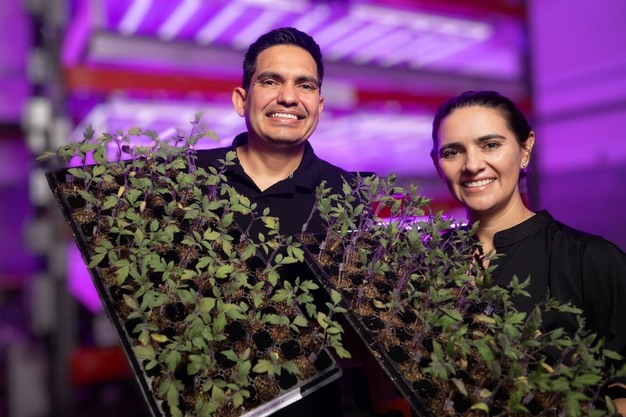 © North Carolina State UniversityRicardo Hernandez founded his plant propagation startup Rooted-in-tech with his wife, Liliana.
"Through many years of study, we've learned which combination of levers to pull — whether that's light intensity, light color, carbon dioxide concentration, temperature, air flow, irrigation or nutrition — to deliver the perfect environment for producing high-quality plants that are more affordable," he adds.
Growers will tell Rooted-in-tech what they want — for example, tomato seedlings that will bear fruit faster, disease-free strawberry plants or lettuce plants that tolerate flower initiation or bolting. The company will then grow and deliver seedlings to produce those results in commercial greenhouses, farm fields and gardens.
Joining Seed2Grow
Hernandez is starting small in his home garage in Apex, with hopes of expanding into warehouse space in North Carolina before setting up additional indoor propagation facilities across the country.
Soon after starting Rooted-in-tech in December 2024, Hernandez joined the N.C. Plant Sciences Initiative's Seed2Grow program. The entrepreneurship program helps university faculty, students, young alumni and others bring NC State plant sciences discoveries into the marketplace in ways that advance agriculture.
Hernandez recently shared his motivation for starting Rooted-in-tech, his goals for the company and the steps he's taking to ensure entrepreneurial success.
 © North Carolina State University
Why did you decided to launch a startup company?
Since I was doing my Ph.D. in controlled environment agriculture at the University of Arizona (from 2009 to 2013), my goal has been to translate the research output into tangible benefits to the community.
We do a lot of nice scientific work, publish it and present it, and sometimes it seems it will just sit on a shelf, even though we know it can have an impact. I thought that one way to bridge the gap between discovery and adoption is by generating income out of this and showing, through improvements in dollars and cents, that it matters.
What stage are you at with your company?
We are at a very early stage, building on both the environmental recipes that we've developed at the university to create better plants and the system we've patented to deploy those recipes.
I have a large two-car garage at home, and I installed a computer-controlled system for air conditioning and irrigation. Then I got the garage certified as a farm by the U.S. Department of Agriculture and licensed by the state as a nursery. We can do both certified organic and conventional production.
Right now, we can create five different designs on the same plant. We're sending these designs to growers, asking them to plant them next to current plants and give us feedback and data on which of them is best. Are we able to outproduce? Are we cheaper? If we're not, can we tweak the design so it will be?
We got our first order in January and have sold around 25,000 plants. We are working with two of the largest greenhouse tomato producers in the United States to test the product designs. Then we have smaller customers who may not be in a position to test multiple designs.
We also have a trial with Extension Master Gardeners around the state who are testing different designs of plants in different counties and providing us with feedback from the gardener's point of view.
What are your current goals?
The number one need right now is to open the first warehouse. It will be here in North Carolina for multiple reasons. I'm here, of course, but more important, North Carolina is one of the most diverse states in terms of horticultural production in the United States.
We have very vibrant strawberry, tomato and sweetpotato production, and all these crops, and others, require young transplants. So we are in a good place to develop and test the product market fit before expanding to other states.
Why did you decide to join the N.C. PSI's Seed2Grow program?
In past entrepreneurship endeavors and training, I was always the technical guy, the science guy. When my wife and I decided to spend all our savings on this, and as I built relationships with professional growers willing to trust us and open a small window for us to try our plants, I knew I needed to build my knowledge and experience on the business side.
I started by reaching out to some business owners that were able to scale up companies, and I asked them to recommend three books. I got a list of 12 books, and when I got through them, I felt I had a better foundation of what entrepreneurship would require from me and what mindsets I'd have to change.
I discussed it with my wife and said, "This is what I want to do. This is my path now. This is my second phase."
And then I said to myself, "I have a very strong science network, a strong technical network. But I have a very weak business and entrepreneurship network. I need to be talking to people that are funding startups. I need to be in this community, learning how to speak that language and how to be successful."
I knew Seed2Grow would give me that exposure.
I've just started in the program, but I've already gotten introductions to potential investors, and thanks to those introductions, I was able to pitch to investors specifically interested in agricultural innovation. Through these interactions, I've gained so much.
Where did this path toward becoming an ag tech entrepreneur begin?
I have no idea! I grew up in a city in Mexico, and my backyard was a 5-foot-by-5-foot block of cement. There were no plants, just desert, plus desert, plus a concrete jungle.
I started my undergraduate degree in mechanical engineering, but I always had this intrinsic curiosity about producing food and seeing the cycle of plant growth.
When I told my mom that I was switching from mechanical engineering to agronomy, she cried. But my dad was very, "Yeah, go do it! You don't want to spend many hours in a garage building an airplane when you can be outside."
I decided to transfer to another school for an agronomy degree. There, my favorite class was entomology, so I went on and got my master's in entomology. For my Ph.D., I gravitated back more to technology and specialized in plant physiology and controlled environment technology — and look at me now! I'm spending hours in the garage building a growing system.
I have the perfect fusion of plant science, technology and engineering. And that's my happy place, knowing that my research can have a big impact on agriculture.
Source: North Carolina State University