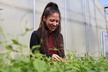
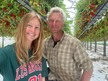
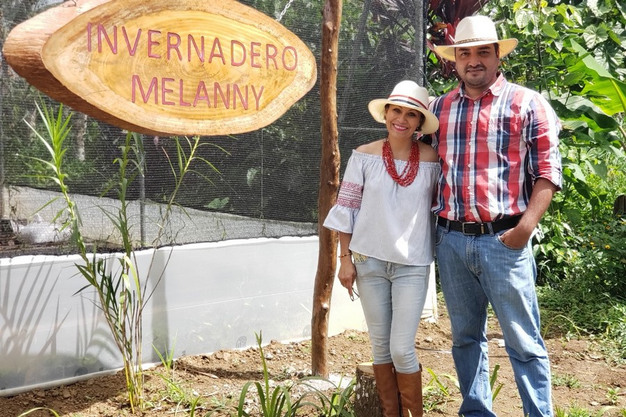
In the Amazon region of Ecuador, in the canton of Morona, part of the Morona Santiago province, an agricultural project has been launched which has an aroma of history, biodiversity and future: Villa Vainilla. The initiative, led by Noya Bustamante and Christian Jaramillo, is intended to allow the cultivation of one of the world's most appreciated species, and will also serve to bring back native vanilla varieties (Vanilla odorata, Vanilla Karen-Christianae, Vanilla pompona, Vanilla cribbiana) from their wild environment and transform them into a sustainable, technical enterprise with international projection.
 © Villa Vainilla
Vanilla, a climbing orchid native to Mesoamerica, is the second most expensive spice in the world after saffron. Its cultivation is demanding; each flower must be hand-pollinated and the whole process - from flowering to marketing of the dried fruit - can take more than a year. However, its economic and aromatic value justifies the effort.
 © Villa Vainilla
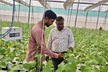
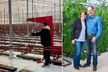
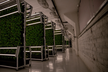
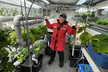
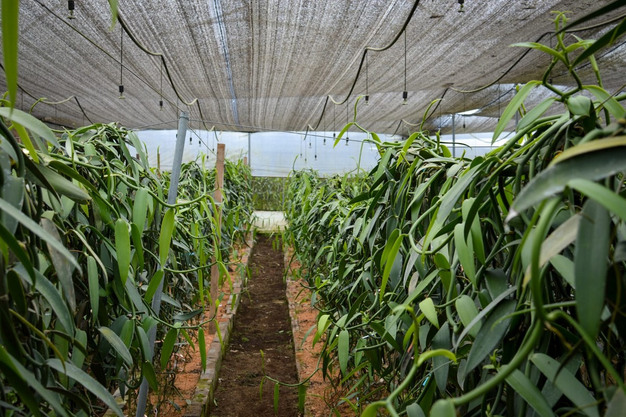
"We started looking for wild vanilla near the Upano River. We were literally rescuing it plant by plant and adapting it to our land," says Christian. After starting out in an agroforestry system with live tutors such as ajulemo, the project took a leap towards technification with the setting up of a 1,000 m² greenhouse that houses around 1,750 plants. "The reason for the change was clear: under glass, no flowers are lost due to the rain, which hugely facilitates growth. We went from one centimeter every 15 days in the open ground to one centimeter a day in the greenhouse," he says.
 © Villa Vainilla
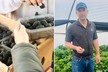
The difference in terms of yield is remarkable. While more than 70% of the flowers can be lost with the traditional system, in the greenhouse the percentage of usable blossom reaches 99%. In a single day, in fact, we have registered up to 2,430 open flowers, all of which had to be pollinated by hand one by one. "Vanilla is a very special orchid. This species does not self-pollinate, and although the green bee Euglossa viridissima can act as a natural pollinator, its colonies are very small, and for commercial plantations such as ours, pollination must be done by hand," says Noya, who also highlights the role of women in their daily work, especially in pollination.
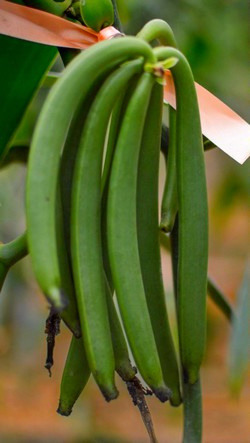 © Villa Vainilla
Villa Vainilla grows seven varieties of vanilla. Five of them are native (like the Vanilla odorata) and two have been introduced (namely the planifolia and tahitensis). The firm has been a pioneer in the province in obtaining the compulsory patent from the Ecuadorian Ministry of the Environment for the cultivation and reproduction of orchids. Under a protected structure, the plants are tutored with similar systems to those used with tomatoes, using thin rope or raffia until they reach their productive height. Nutrition is managed with precision, using drip irrigation and misting systems during the hottest months, which allows for year-round flowering - "something unusual even in countries with a tradition of vanilla growing," says Christian.
The second most expensive spice in the world
Despite the activity's complexity, the crop's profitability is remarkable. "Each plant can produce up to 800 grams per year. When green, the price is USD 35 per kilo, but if you go through the whole process of production, curing and drying, prices rise to very attractive levels: odorata can reach USD 350/kg and tahitensis USD 180-200/kg," they say.
However, the post-harvest process requires patience. "Once pollinated, the ripe pod must be left in the plant for 9 months, and then undergoes a curing and drying process that takes an additional 3-5 months. Only then is it ready for consumption; however, the good thing is that once processed, vanilla has a shelf life of at least 730 days, according to laboratory tests, and probably longer if vacuum packed," says Christian.
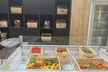
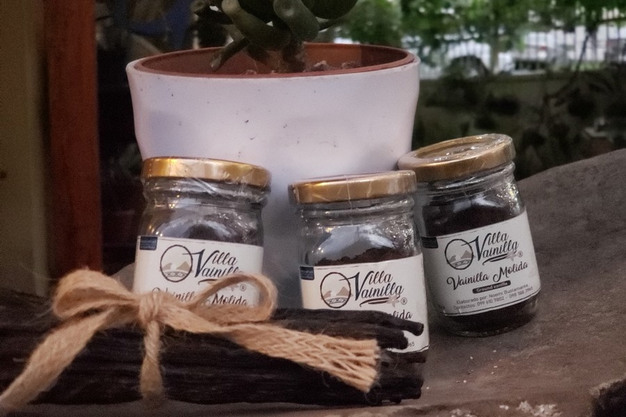
On a commercial level, the main challenges are producing enough volume and market access. "We are still unable to supply supermarkets because of the quantities we handle. We remain mostly focused on pastry shops and gourmet restaurants," they say. Besides the pods, Villa Vainilla has diversified its production with handcrafted extract, ground vanilla and even a whisky cream with vanilla caviar - a Noya creation. Agrotourism has also been incorporated into the project; they receive visits so that tourists can participate in the pollination and learn about the entire process. "It's a complete sensory experience. We have seen visitors get excited when they smell natural vanilla for the first time."
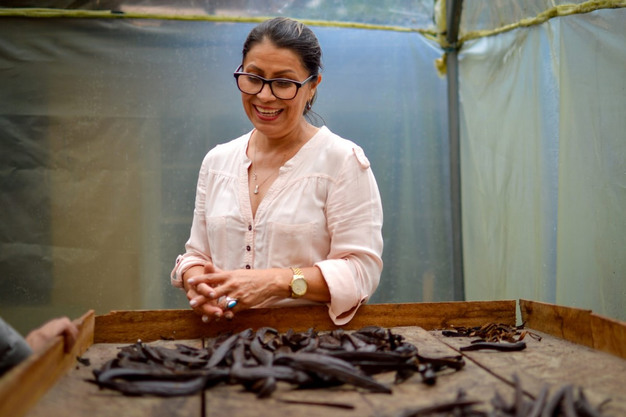 © Villa Vainilla
While synthetic vanillin - present in more than 2,800 industrial products - clearly dominates, Christian and Noya stress the benefits and complexity of the natural flavoring, which is made up of more than 169 different compounds. "Many people still confuse an artificial flavoring with real vanilla. Our job is also to educate," they say.
 © Villa Vainilla
"The project is also an example of agriculture with a low environmental impact. We have an efficient plantation on 2,300 m², with no need to deforest or expand beyond certain boundaries. It is a perfect option for the Amazon," says Christian, who doesn't rule out forming producer associations in the future to scale up production and make this noble and resilient crop more visible. "Villa Vainilla is showing that, with passion, technique and commitment to biodiversity, it is possible to transform a wild orchid into a future-proof agriculture model with aroma and purpose."
 © Villa VainillaFor more information:
Villa Vainilla
Tel.: +593 99 610 7802
https://linktr.ee/Villa_Vainilla