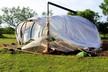
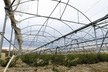
When a tornado swept through southeast Minnesota in June, Owl Bluff Farm in Houston County took a hit. The storm peeled the roof off a storage shed, destroyed two high tunnels growing peppers, melons, and cucumbers, and brought down trees across a deer fence.
Yet, a brand new farm-scale deep winter greenhouse built in partnership with the University of Minnesota Extension Regional Sustainable Development Partnerships (RSDP) was left nearly untouched. By sheer luck, the greenhouse escaped with only minor trim damage. It's something Owl Bluff's owner and operator, Carrie Calvo, doesn't take for granted.
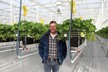
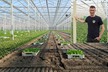
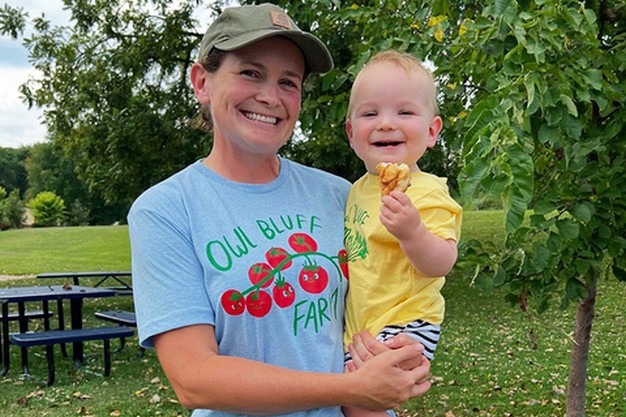 © University of Minnesota ExtensionCarrie Calvo owns and operates Owl Bluff Farm, where she lives with her family.
"We're so grateful we're all safe," she shared in a community update after the storm, "and incredibly thankful for the neighbors who showed up with hugs, chainsaws, tractors, and food."
For farmers like Calvo, the experience underscores just how vulnerable Minnesota farms can be to severe weather, and how valuable it is to have tools that offer stability when the unexpected happens.
Growing through uncertainty
Tucked into a scenic valley in Houston County, Owl Bluff Farm is a small but mighty organic vegetable operation. Living on a homestead with her young family, Calvo leads the growing efforts with a modest support crew. Together, they cultivate a vibrant variety of produce on less than an acre of land.
"We started with selling at a small farmers market and a small, local grocery store," she recalls. "Then slowly, we happened to find other opportunities in restaurants and things like that. It's been great to expand and help people who are looking for local ingredients."
Now in its sixth season, Owl Bluff's customer base has grown significantly, but not without struggle. Like many Minnesota farmers, Calvo has learned to navigate long days, cold winters, and unpredictable conditions.
This is especially true in southeast Minnesota. It's a place where January temperatures often plunge well below zero, and summer storms serve as a reminder that the region sits at the edge of "Tornado Alley," a stretch of the country where tornadoes frequently pop up.
Faced with Mother Nature's unpredictability, farmers like Calvo are turning to deep winter greenhouses to hold their ground.
Sunlight stored, resilience released
Designed with resilience in mind, the farm-scale deep winter greenhouses' unique design harnesses solar power for heating. Sunlight warms the air during the day, which is then stored underground in thermal mass materials like soil or rock. The energy is released slowly to keep the space warm, even on the coldest winter nights.
"There are other types of technology out there," explains Greg Schweser, RSDP statewide sustainable agriculture and food systems director, "but a deep winter greenhouse is something entirely different."
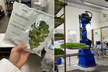
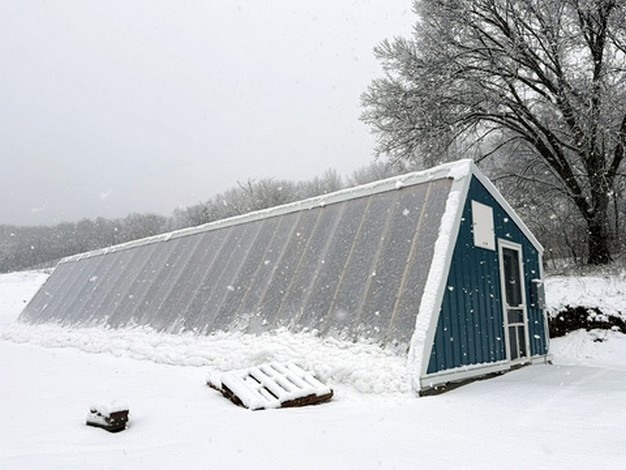 © University of Minnesota ExtensionOwl Bluff Farm's deep winter greenhouse
Born from farmer innovation, deep winter greenhouses offer an alternative to traditional farming and conventional greenhouses. Instead of relying on one growing season or paying high energy costs to heat a greenhouse, farmers can afford to grow year-round. With climate uncertainty on the rise, deep winter greenhouses add resilience for farmers and food systems.
Since 2017, RSDP has worked with Minnesota growers to test and refine the design, while also drawing on University expertise in horticultural, economic, architectural and data science research. While the design documents are free to access, Schweser emphasizes that the project's aim isn't to encourage every farmer to build one.
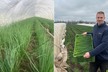
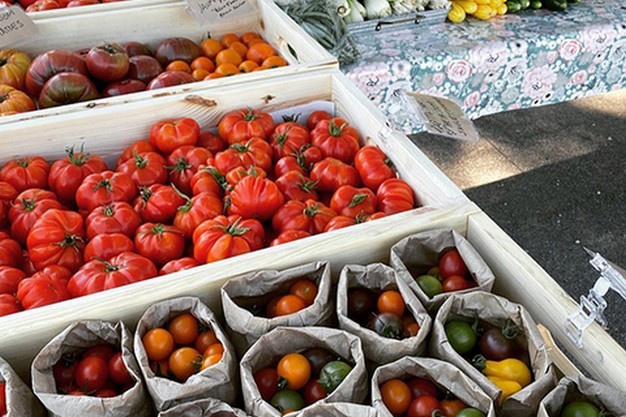 © University of Minnesota ExtensionOwl Bluff sells produce at local farmers markets.
"We approach this work with caution and realism. In the world of sustainable agriculture, it's easy to get swept up in the next big idea. But too often, those ideas don't pan out, and farmers are the ones who pay the price. Our goal is to avoid that by thoroughly testing deep winter greenhouses with real farmers on real farms."
With support from the Minnesota Department of Agriculture through the Agriculture Research, Education, Extension and Technology Transfer (AGREETT) program, the latest phase of research includes Owl Bluff's greenhouse along with four more currently under construction. With the help of the University of Minnesota's GEMS Informatics Center, each structure will be equipped with continuous monitoring systems to gather data on its performance. With this information, researchers can better understand how the design performs and determine the production potential.
"Our role at the University is to research and test this emerging technology to 'de-risk' it," Schweser says. "If we can show these projects add value, whether in dollars, time saved, or community impact, then farmers can make an informed decision about whether it fits into their operation."
While Schweser acknowledges that risk may always be a part of the farming landscape, he contends that community-based projects like deep winter greenhouses bring significant strength to Minnesota's local food systems. For farmers like Carrie Calvo of Owl Bluff, even one less unknown can make a difference in weathering the storm.