While the strawberry harvest in open fields is already coming to an end, greenhouse operations are just entering the second half. German greenhouse strawberries will continue to be available to retailers until December. The Janssen family business in the Lower Rhine region has been one of the main suppliers to German food retailers for many years and markets its produce exclusively through the Landgard producer cooperative. "We had a very early start to the season this year and were able to harvest the first Fandango strawberries on March 15. What benefited us, of course, was that there was little pressure on volumes from Spain this year, so we found a receptive market and good prices early on," report Volker Janssen and his son Dominik, who jointly manage the company.
 © Hugo Huijbers | HortiDaily.com
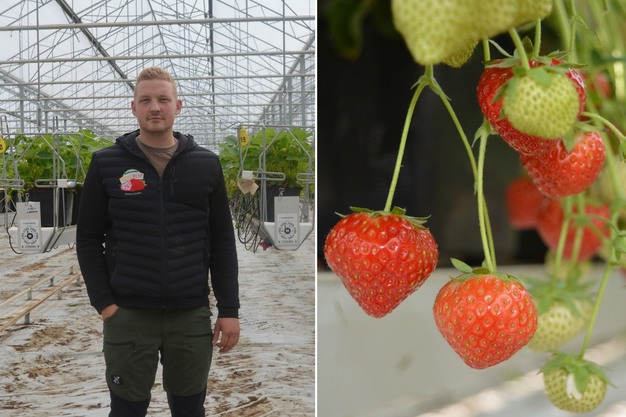
Dominik Janssen runs the business together with his father, Volker. Right: Summer strawberries of the Opera variety.
"A few years ago, we switched to growing three crops a year instead of two because we noticed that prices for summer strawberries tend to be better, which in turn is due to the decline in outdoor production," says Volker Janssen, who grows strawberries in greenhouses on around five hectares. Prices are currently slightly above last year's level. "From the perspective of food retailers, the focus is on the security of supply. Demand is currently higher than the quantity available on the market, which in turn has a positive effect on prices."
 © Hugo Huijbers | HortiDaily.com
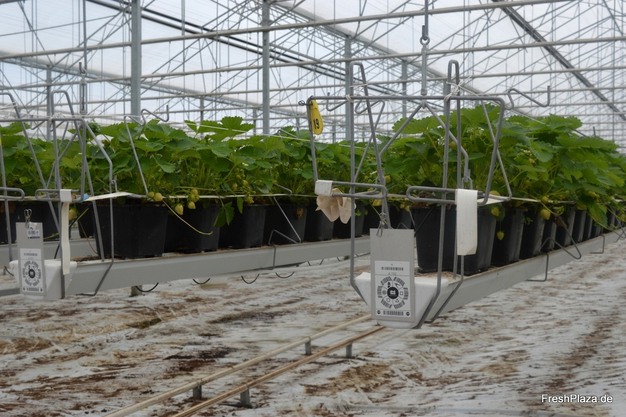
A look inside the greenhouse
Opera establishes itself as a summer strawberry
The Opera variety currently predominates and will be harvested until the end of July. "Opera is one of the few varieties that can cope with temperatures above 30 degrees, and we are now growing it for the second year," explains Volker Janssen. Sales are usually high and stable until the summer holidays, adds junior manager Dominik Janssen. "Compared to spring, harvest volumes are lower in autumn but still adequate for the lower demand. We can usually sell the volumes through our programs, although strawberries are not as popular at the point of sale as they were in the first phase of the season."
 © Hugo Huijbers | HortiDaily.com
Around a dozen varieties grow and thrive in the Janssen family's greenhouse.
Redefining the range of varieties
In the shadow of the new, modern varieties, the tried-and-tested Elsanta, once the flagship of German strawberry production, can still be found. However, its cultivation capacity has been gradually reduced in recent years. "Until a few years ago, more than half of our greenhouse facilities were planted with Elsanta. However, rising labor costs are making it less attractive for us, as the picking yield is significantly lower than other varieties. However, it turns out that it retains its beautiful color well into November, so it still has a place as an autumn strawberry." Accordingly, Elsanta will continue to be grown on two hectares and picked from the beginning of October until the end of the season. In addition to Elsanta, Malling Centenary is also produced as a late variety.
In the early season, the two-person management team sees particular future potential for the two varieties, Parlango and Fandango. Dominik Janssen: "We want to expand the latter variety somewhat in the medium term. We are also focusing on growing the Florice variety, a summer strawberry that, according to colleagues, is also said to produce very good results."
 © Hugo Huijbers | HortiDaily.com
One of the major challenges in strawberry cultivation is the further restriction of approved plant protection products. To continue producing high-quality strawberries, the company relies, among other things, on the use of beneficial insects and UV robots.
German strawberries still in vogue
In strawberry cultivation, too, the ongoing minimum wage issue hangs like a sword of Damocles over everyday practice. "Labor costs have risen steadily in recent years and must somehow be factored into the product price. Neighboring countries such as the Netherlands and Belgium are struggling with the same problems. The situation is different in low-cost production countries such as Spain. To remain competitive in the very early season, i.e., March/April, and justify the higher price, we have to offer high-quality, tasty fruit. Even in times of inflation and increased price sensitivity, there are still many consumers who are willing to pay for high-quality strawberries. However, offering domestic strawberries at bargain prices is simply no longer possible today," concludes Dominik Janssen.
 © Hugo Huijbers | HortiDaily.comIn addition to growing strawberries in greenhouses, EDELROT GmbH is also dedicated to producing young plants for its own use.
For more information:
Volker & Dominik Janssen
EDELROT GmbH © Hugo Huijbers | HortiDaily.com
Rheindahlener Str. 321
41751 Viersen
Phone: +49 (0) 21 62 - 55 69 6
[email protected]
www.edelrot.eu
www.landgard.de