The following research article is shared by Joseph Devitt: BSc Plant Science, MRes Student in Crop Resource & Environmental Optimisation, Edge Hill University.
It is often assumed that greenhouses provide total control over growing conditions—stable temperature, uniform humidity, and predictable light. But after months inside a commercial tomato greenhouse, I can say that's not always the case. Despite the appearance of overall control, small environmental inconsistencies creep in, and those subtle differences can affect plant health in ways that aren't obvious until you start measuring them.
As Dr. Sven Batke recently pointed out, "around 70% of greenhouses in the UK were built over 40 years ago," often using materials and infrastructure that now face growing pressure under today's climate and productivity demands. However, variability can persist even in modern facilities with cutting-edge systems and environmental controls. This project builds on that insight, not by asking how greenhouses should function in theory, but how they behave in practice, and how subtle microclimate shifts can influence plant response in ways we often overlook.
What we're doing and why
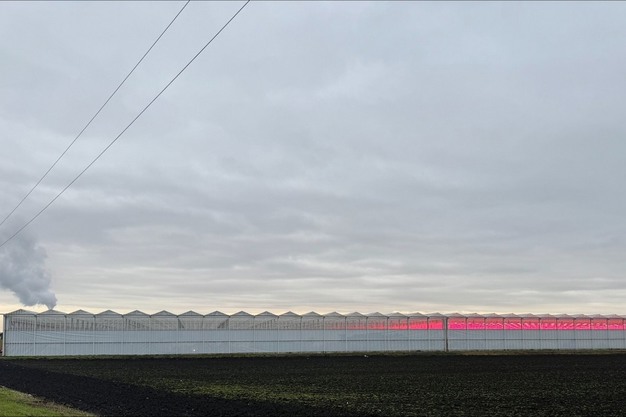
The Edge Hill University study is in a large modern 12,000 m² commercial tomato greenhouse at FlavourFresh Salads Ltd, West Lancashire, U.K. The greenhouse is split into two halves, one with artificial LED lighting, one without.
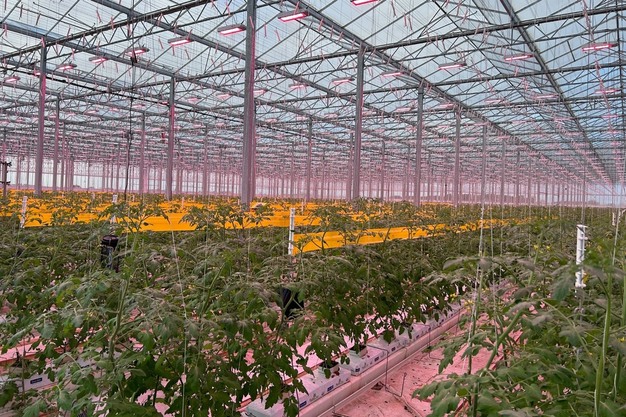 © Edge Hill UniversityLayout of the greenhouse. Divided into two compartments: an LED-lit section and a non-lit section
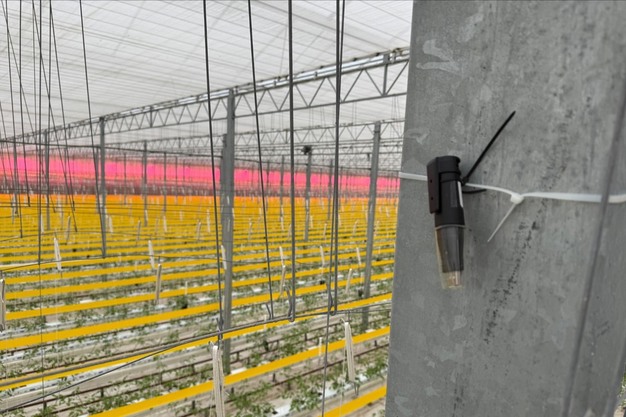
This project focuses on the naturally lit side of the greenhouse. To capture environmental variation across the space, we installed temperature and humidity sensors in a structured grid that spans the full width and length of the unlit section.
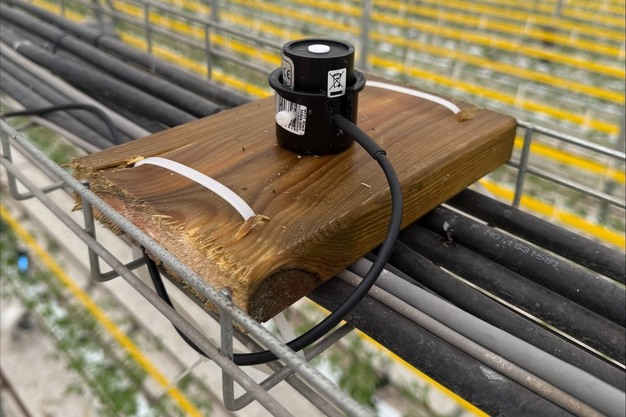
These sensors record data every 15 minutes and allow us to calculate vapor pressure deficit (VPD). Alongside this grid, we placed radiation sensors in a diagonal layout: one set along the upper right-hand side of the greenhouse, one through the center, and one on the lower left. This setup allows us to track how light distribution changes across the growth space.
The aim is to show how growing conditions shift across space, not just daily or seasonally, but from one greenhouse zone to another. As it turns out, those shifts are meaningful. Some bays are consistently warmer, drier, or more variable than others, even though, on paper, they're supposed to be identical. The first phase of our research was to identify those zones. The second phase is to understand whether those microclimatic differences translate into changes in plant physiology.
Connecting environment to plant function
Once the environmental data was analysed, we categorised zones of high, mid, and low VPD levels, depending on expected metrics for each stage of the crop cycle, from early vegetative growth, through flowering, to fruit expansion. Out of each group (n=3), we statistically compared and selected two representative sensors for the day and two for the night (n=12). These became the sampling zones where we began taking physiological measurements from nearby tomato plants (n=12x20).
 © Edge Hill University
 © Edge Hill University
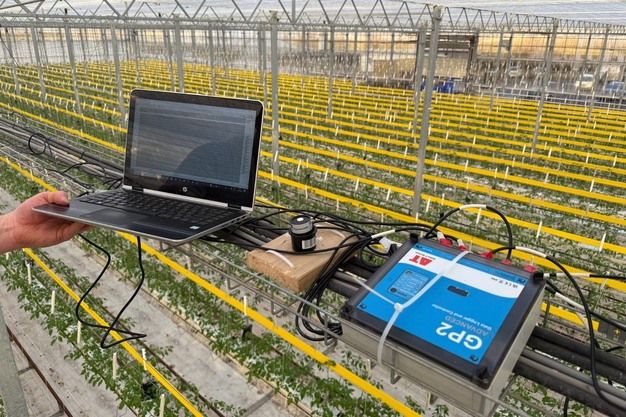 © Edge Hill UniversityEnvironmental monitoring setup in the greenhouse. Top to bottom: Temperature and humidity sensors, pyranometers, GP2 data loggers
We're measuring stomatal conductance (how well the plants control water loss) and chlorophyll fluorescence (which tells us how efficiently they convert light into energy through photosynthesis). These readings help connect what's happening in the environment to how the plants function in real time. This part of the project marks the shift from simply monitoring conditions to understanding their consequences.
If plants growing in consistently high-VPD zones show reduced stomatal conductance or lower fluorescence, it would suggest that even subtle environmental differences, just a few meters apart, can affect how well the crop performs. These tools give us a way to catch early signs of stress, long before they become visible, giving scientists (and growers) a chance to respond before that stress begins to affect growth and ultimately productivity.
But this work doesn't stop at plant health and environmental monitoring. Our physiological measurements taken across high, mid, and low VPD zones will be linked to yield and fruit quality, including Brix levels at harvest. By connecting early stress signals to the final crop results, we're aiming to build a full picture of how microclimate variation translates into economic impact. In commercial settings, even a small drop in sugar content or a few percent difference in yield can make a noticeable difference to profitability.
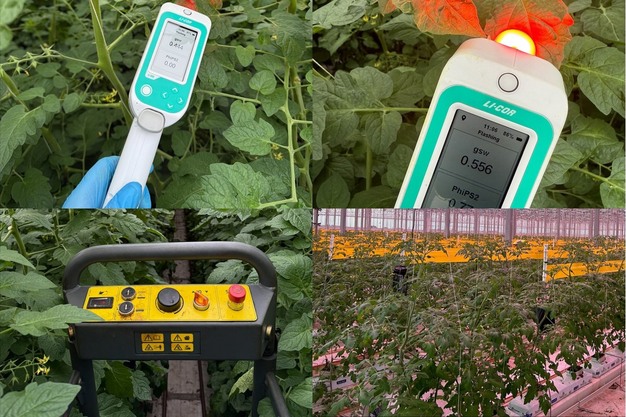 © Edge Hill UniversityPhysiological measurements and plant sampling in the greenhouse. Measuring stomatal conductance (gsw) and chlorophyll fluorescence (PhiPSII) using a Li-Cor Li 600 Porometer and fluorometer
It also raises a bigger question: if these kinds of environmental inconsistencies are influencing performance, how many of them are going unnoticed in day-to-day operations around the country? Finding those weak spots and learning how to act on them is the first step toward making these growing systems work smarter, not just harder.
Why this research matters
Our project is just one season, in one compartment of one greenhouse. Yet, the questions we're asking apply far more broadly. The UK still imports most of its tomatoes, and if we're serious about producing more food at home, with less water, less energy, and fewer chemicals, then we need to understand how greenhouse environments are working, not just how they're designed to.
Precision doesn't always require automation. It sometimes starts with better awareness, pinpointing problem areas, or identifying where plants are underperforming due to small but consistent levels of environmental stress. It is that knowledge which can lead to practical changes, whether that be improving airflow in a hot zone, tweaking irrigation in a dry one, rethinking where high-value crops are placed, or making use of technical innovations to harness specific light spectra from engineered glass. The tools exist: sensors, data loggers, and mapping software. What we need is more integration into day-to-day decision-making and collaborative, fruitful relationships between growers and scientists. My project aims to show how that can work, using plant responses as the guide.
Looking ahead
This work doesn't claim to fix greenhouse production. It's part of a broader push to understand the hidden dynamics that explain plant outcomes in these complex spaces. It's about asking—what if we stopped assuming greenhouses are uniform? What could we learn, and what could we change, if we started listening to the plants? That shift in mindset might sound small, but it will make a big difference, especially if we want to get more from our protected cropping systems without pushing them harder than they can manage. With the right data and a better understanding of what's happening inside the structure at every scale, we can start to build smarter, more sustainable, and more resilient ways of growing food.
 © Edge Hill University
This work is also in collaboration with the Greenhouse Innovation Consortium (GIC), founded by Edge Hill University and Dr Sven Batke.
For more information:
Dr. Sven Batke, Chair of the Greenhouse Innovation Consortium
[email protected]
edgehill.ac.uk/person/sven-batke/staff/
Joseph Devitt
[email protected]
[email protected]