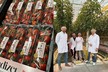
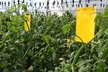
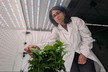
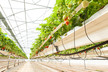
A temperature of 21 degrees Celsius results in fewer but longer internodes than at 24 degrees. This was revealed in a trial by Plant Lighting in which two pepper varieties were tested over five months with two temperatures (21 and 24°C) and two spectra of supplementary lighting. The trial was conducted in partnership with the Ministry of Agriculture, Nature and Food Quality, and Glastuinbouw Nederland within the framework of the Greenhouse as Energy Source program. Previous trials have shown that far-red light is beneficial for stem elongation and possibly also for the yield of illuminated peppers in winter. This study looked, among other things, into how to achieve sufficient internode elongation and production with as little far-red light as possible.
With lighting at a PSS value of 0.79, the internodes stretched more than with a PSS value of 0.84. The PSS measures the proportion of far-red light in the lighting. The Guintoli variety had longer internodes in all cases than the Alzamora. The decline in photosynthesis rate in pepper cultivation is lower at 21°C. This is due to the closure of the stomata in leaves 5 to 7 internodes below the top of the crop. However, there was more evaporation and, possibly, as a result, less leaf chlorosis at the higher temperatures.
With more far-red light (PSS 0.79), the yield is slightly higher. Temperature did not have a consistent effect on yield. At a lower temperature of 21°C, there is significantly less end rot than at the higher 24°C. In the trial, 20% of fruits had some degree of end rot. It seems that a lower temperature is better, although the mat temporarily had a high EC.
Growing at a lower temperature (21°C) seems to be possible without problems. The concern that a low-temperature result in insufficient internode elongation turns out to be unfounded. At a higher temperature, the average fruit weight is lower, and the number of harvested fruits is higher. Depending on the market segment, fruits could become too heavy at a lower temperature. The use of additional far-red light involves investments and extra electricity consumption. This can improve workability with varieties that don't stretch easily, but the additional cost is not offset by the additional production. Illumination with separately controllable far-red is an additional solution.
For more information:
Plant Lighting
Doordraai 1. 3981 PE
Bunnik, the Netherlands
Tel.: +31(0)30 7512069
[email protected]
www.plantlighting.nl