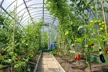
A new study has found that greenhouse vegetable production (GVP) systems are major sources of nitrous oxide (N2O) emissions, a potent greenhouse gas.
The study, conducted by a team of researchers from the Institute of Applied Ecology of the Chinese Academy of Sciences, used a high-frequency continuous automatic monitoring system to measure the soil N2O emissions from a typical GVP area in Shouguang, a major vegetable-producing region in Shandong Province, for a year.
The researchers found that the annual soil N2O emission from the GVP system was about 100 kg nitrogen (N) per hectare. This was much higher than previous reports, which used low-frequency manual sampling methods that may have underestimated the emissions by 8–17%.
The study, published in the journal Atmospheric Environment, showed that the soil N2O emissions from the furrows, where irrigation water and fertilizer were applied, were significantly higher than those from the ridges, where the vegetables were planted.
Moreover, irrigation caused multiple pulses of N2O emissions throughout the growing season, increasing the emission rate by 12%–396%.
Read more at phys.org