Is the sole focus on achieving high accuracy the right approach in yield prediction? According to the team at WayBeyond it isn't - which is a remarkable statement coming from a company that provides yield prediction services. In a recently held webinar, the team explained their latest research and why they prefer to focus on a holistic approach to planning and forecasting. Team members Daniel Than, Lee Kirsopp, and Dr. Tharindu Weeraratne, shared their insights.
Yield prediction
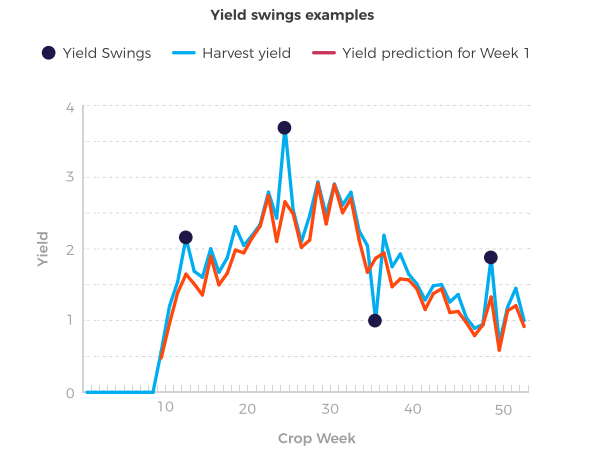
Modern yield prediction is often accomplished using AI modelling. The model is fed historical data to find patterns so it can more accurately predict future yields. However, there are some challenges with using AI. Firstly, the method requires years of historical data (typically 2 to 3) which is not always available. If the data is available, recent changes in climate and weather may also complicate things, as data patterns established from previous years may now not reflect the current situation. Lastly, yield prediction varies in accuracy in across the board e.g. grower may achieve an average of 85% accuracy overall but experience a week-on-week variation between 65% and 95% accuracy. Such variances – seen as sudden spikes or dips in actual yield – have be named “yield swings” by WayBeyond’s researchers. These swings can be the result of biological, environmental, or other external factors that traditional yield prediction modeling may not account for.
Holistic method
“We need to consider whether chasing the ‘holy grail’ of high accuracy yield prediction is the right approach. If it isn’t, then can we identify and describe biological and environmental events leading up to yield swings? And to what degree does adopting a more holistic approach improve confidence in said prediction?” Dr. Tharindu Weeraratne, WayBeyond’s Director of Crop Science and Agronomy, writes in his research.
During the research, WayBeyond’s data science team worked closely with their crop science team and a case was made for a holistic approach to yield forecasting. This approach involved using yield prediction as one of the tools and additionally introducing a contextual layer of data from events in the growing environment, the plant, and management practices.
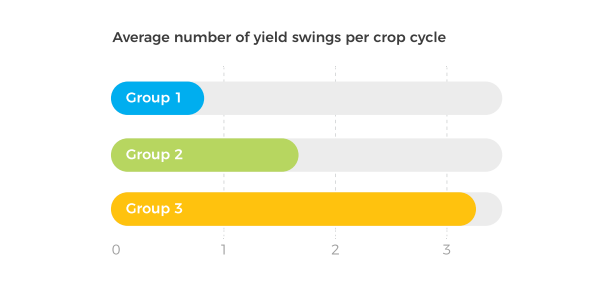
To create a better understanding of this, the WayBeyond team took a closer look at the probable causes of week-to-week variability in yield accuracy. To do this they analyzed 20 cycles of tomato harvest data, as well as environment and plant data, and ran yield prediction on all 20 cycles, noting the average accuracy of each cycle. The data was then divided into three groups based on accuracy: 89-95%, 85-89%, and 80-85%. Looking at the number of swings in each group they confirmed that a higher frequency of yield swings result in a lower accuracy in the prediction.
Swing weeks
What factors influenced these yield swings? Researchers examined common patterns in an 8-week period before the occurrence of both low swing and high swing weeks and analyzed what happened in the growing environment at that time.
“For the low swing weeks, what we found was the most common environmental factor in those periods was low outside night temperature. This was interesting as a greenhouse is a protected indoor environment, so you’d think that outside temperature wouldn’t have much of an effect – yet this was the most common factor found in the data. The second being low total light, and the third was a low internal day/night temperature difference,” Product Manager, Lee Kirsopp shared during the webinar.
“In the high swing week analysis, the biggest factor was high difference between internal day and night temperatures, followed by high outside night temperature (again outside temperature was a factor), and third was high total light.”, he added.
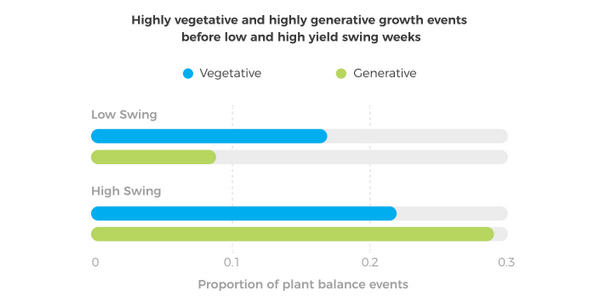
For the plant data, the measurements analyzed were: truss height, weekly growth, leaf length, stem width, and leaf numbers. This allowed the research team to determine whether the plants were in a vegetative state or a generative state. In the vegetative state, plants spend most of their energy on growing leaves and strong stems, while the generative state indicates more energy going towards flowering and growing fruit.
“We found that before a low swing week, the plant spent most of its time in a vegetative state, while before a high swing week, it was in a generative state. This seems obvious when taking into account the data, but it is still important to know and understand so it can be combined with the environmental data,” Lee continues.
What does this mean for tomato growers?
The research concluded that yield prediction is more effective when supported by relevant local insights such as environmental and plant data but is nonetheless a useful tool. It also surmised that a sole focus on achieving 95-100% yield prediction accuracy should be reconsidered in favour of a broader view which includes additional focus on context – as understanding the whole picture is a more beneficial use of time. Lastly, investigating yield swings in the greenhouse is recommended so growers can uncover the causes and what to anticipate. WayBeyond’s parting advice was to monitor plant balance as it was a good indicator of potential swings.
Watch the full webinar below:
For more information:
WayBeyond Ltd.
Candida Office Park, 61 Constellation Drive
Auckland 0632, New-Zealand
Tel.: +64 9 415 2380
Email: [email protected]
https://www.waybeyond.io/