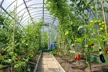
The solar greenhouse is a common protected structure for crop production when ambient temperatures are low. In the North China Plain (NCP) winter temperatures are very low and an improved solar greenhouse with a lowered soil surface (0.5–1.5 m deep), referred to as a sunken solar greenhouse (SSG), is used.
A four-season experiment was conducted in a commercial SSG with tomato crops to characterize internal microclimate, sap flow (SF), and crop coefficients. Results show that the temperature inside the SSG could be more than 20 °C higher than outside in winter, which favors tomato growth and resulted in acceptable yields. Daily total SF was related to solar radiation, vapor pressure deficit (VPD), and temperature, in that order, both in winter and summer.
The decoupling coefficient (which is the ratio of radiative to aerodynamic influences on evapotranspiration) in the daytime was 0.76 in winter and 0.84 in summer, indicating strong decoupling (i.e., the predominance of radiative influences) of the internal environment where the wind speed was low. Basal crop coefficients at the mid-stage of crop growth averaged 1.15–1.43 in winter and 0.91–0.92 in spring and summer. Thus, in the SSG, for similar climatic conditions sap flow in winter was higher than that in summer, which should be considered in irrigation scheduling.
Read the complete research at www.researchgate.net.
Yang, Li & Liu, Hai-Jun & Cohen, Shabtai & Gao, Zhuangzhuang. (2022). Microclimate and Plant Transpiration of Tomato (Solanum lycopersicum L.) in a Sunken Solar Greenhouse in North China. Agriculture. 12. 260. 10.3390/agriculture12020260.