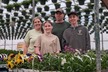
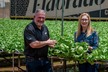
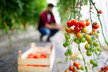
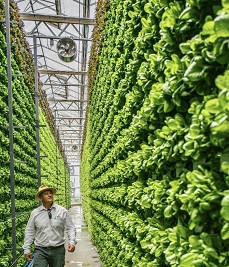
 Glasshouses are not usual in South Africa, but to former architect Francois van der Merwe (right), glasshouses, with a lifespan of more than 20 years, in one stroke solve a perennial problem of vertical farming: the high energy costs.
He puts forth that CAN-Agri's innovative and patented system offers several advantages over other farming methods.
"Our system produces the highest quality salad and leafy greens, completely free of pesticides and herbicides, yet it's sustainable with no negative environmental impact."
"It's a mistake to rely completely on artificial light"
"We realised early on that sustainability and scalability is the key. Unless we resolve the sustainability issue, vertical farms will keep on looking like a cool window into the future and a niche phenomenon."
"It’s a mistake to rely completely on artificial light and to produce inside a closed building. Natural light allows us to grow bulk product like lettuce as well as niche products, like herbs,” he maintains.
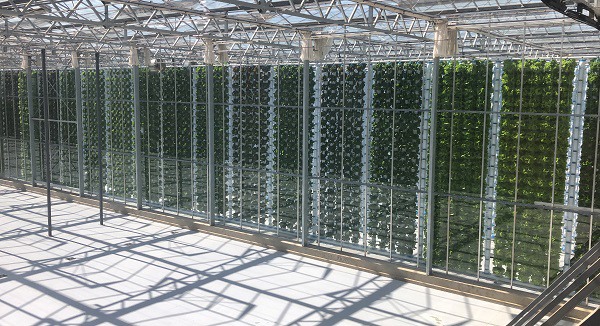 CAN-Agri's system will be used in future projects in Namibia and the United Arab Emirates (photos supplied by CAN-Agri)
CAN-Agri, situated at Klipkop in the Bronberg, east of Pretoria, currently grows fancy leaf lettuce for retailers including PicknPay. They also supply the food services industry and several Gauteng fast food outlets such as Wimpy and Mugg & Bean.
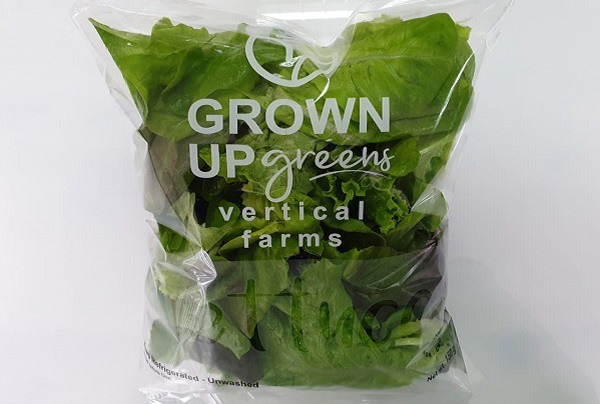 CAN-Agri's brand GrownUp Greens, supplied to the food services industry
"I don't have to search for the perfect part of the light spectrum"
“Indoor farming operating cost is too high to be sustainable due to running cost of artificial light, artificial climate, and ventilation systems. The high energy usage forces them to grow products for niche markets at a premium. We stay with natural principles. I don’t have to search for the perfect part of the light spectrum for my plants.”
The best LED lights provide 230 micro mol light per m2 per hour, he says. “Compare this to natural sunlight which provides 1,400 micro mol / m2 at solar noon. Our approach differs from other vertical farming methods because from the start we decided to find solutions for the high-cost drivers. Energy is the one thing where we can really make a difference, which is why we had to find a way to use natural light.”
Their average energy usage is 0,59 kW/h per kg of produce.
Growing columns also function as radiators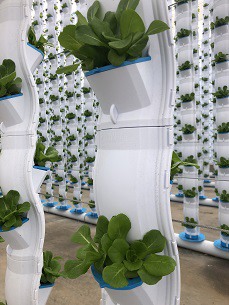 Growing in a greenhouse does have its challenges, he observes, and they have had to find a solution to their biggest issue: maintaining an even climate in a glass box. “Our answer to this was to make use of our planting system to heat and cool the plants.”
In CAN-Agri’s glasshouse plants are placed in a vertical stack, 80 plants to a stack in their current modular configuration.
There are 4,500 six-meter-high stacks in the greenhouse. The stacks are used as a planting system as well as a climate control device.
The sum of 27km 'pipes' serve as a giant radiator. Water is cooled or, less frequently, heated to a desired temperature and pumped throughout, cooling off the temperature right where it counts.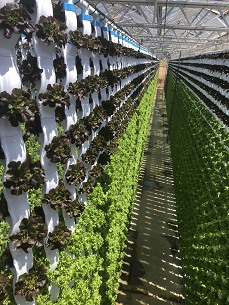 “What makes our growing system unique is that it helps to modulate the climate inside the greenhouse through the water flowing down the pipes to the plants. The temperature is controlled right where it’s needed: at the plants. You don’t get a better or more efficient greenhouse climate control device than this,” he continues.
Right: The colour of dark-leafed lettuce intensifies closer to the roof
“It allows a uniform temperature throughout the greenhouse, enabling the system to function whether it’s snowing outside or in the middle of the desert.”
In fact, CAN-Agri will be setting up their patented system in Namibia and in the United Arab Emirates in the near future.
The Klipkop greenhouse consists of four 800 m2 compartmentalised bays, a seedling nursery, and a packhouse. The equipment deployed to can sustain up to 16 compartmentalised bays, bringing down operating costs as yields increase.
The glasshouse was imported from the Netherlands through South African company Dynatrade and erected by Agri-Span Greenhouse Construction. Dutch company Ridder’s supplied climate screens which allow for automated screening activated by light intensity sensors in the seedling section as well as the rest of the greenhouse.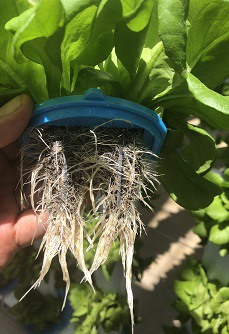 CAN-Agri germinate their own seedlings, using Enza Zaden seed (very competitively priced, he remarks) in a seedling mix consisting of peat and their own compost. Seedlings are placed into a basket of their own design and made locally (right).
Although the basket is compostable within 8 months, it is re-used to an extent. The plan is to pasteurise their recycled grow medium for a completely circular system.
A short, 21-28 day grow cycle allows them increase crop cycles and to harvest a younger plant more frequently. It guarantees a higher leaf to stem ratio for their loose-leaf product range where the stem is removed in the onsite preparation room (and composted).
“More production cycles per year makes more sense. What we lose in weight we make up with added grow cycles. The net effect is an almost 30% increase in total production and increased quality."
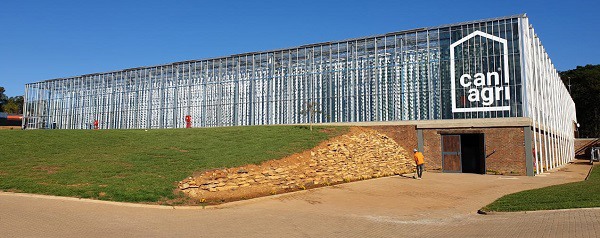
One of the factors that attracted them to this previously wattle-infested location is the availability of plentiful and very clean water, running off from the Bronberg Conservancy to their southeast.
“Everything we do has as its number one goal: to use less to grow more.”
 For more information:
Francois van der Merwe
CAN-Agri
Tel: +27 12 534 3429
Email: [email protected]
https://can-agri.com/