Wageningen UR uses 3D plant models to predict light interception, photosynthesis and plant growth. To do this, the models, also called functional-structural plant models (FSPM), use data on plant structure and photosynthetic characteristics. With these models, driving distances, assimilation light and sunlight can be calculated for all combinations of plant structure.
The model GroIMP Platform for 3D plant models, computing the effects of supplemental lighting on crop, has been expanded with a multispectral light model. Previously, the platform could compute the three colours red, green and blue (RGB), but now all wavelengths with high resolution can be simulated. Which is important to allow the simulation of effects of the far-red shift during the day, or blue / red ratio of LED light on plant growth. The expansion was achieved by Wageningen UR and Wageningen UR Biometris in cooperation with German and French modellers.
LED light in tomato crop
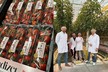
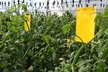
The multi-spectral model is used in the trials with LED light in a tomato crop in a greenhouse in Bleiswijk, to estimate which position, colour and brightness of LEDs is most optimal to grow both energy-efficient and cost-effective.
Left: The spectrum can be modelled: Right: LED simulation in tomato crop
Source: WageningenUR