Netherlands: Project ‘Clean and sustainable leafy crops, now and in the future’ has been concluded
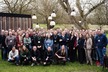
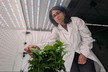
The project started on July 1, 2011 and ended after the 2014 season. In 2011, the setup was scaled up from 600 m2 to 5,400 m2 to create a more practical situation (photo 1). The system consisted of six test ponds (or incubators). The Dry Hydroponics cultivation system was launched. The same year, an automatic transfer device was developed for the cultivation panels. Cultivation panels with harvestable crops were lifted out of the water and placed into the conveyor for processing. Furthermore, a sophisticated fertilization unit was installed to fine-tune fertilization in each individual incubator.
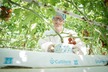
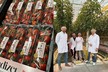
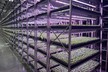
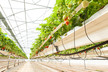
In 2012 and 2013 an attempt was made to allow a more regulated cultivation. In collaboration with suppliers and Proeftuin Zwaagdijk, specific factors were optimized. Different lettuce varieties have been tested for suitability for cultivation on water, in collaboration with seed companies. Various substrates, growing media and fertilization strategies have been tested (photo 2). Furthermore, following problems during the first two weeks after planting, a propagation system was developed (photo 3). The new cultivation system and knowledge gained from the experiments led to a similar product in relation to the open field.
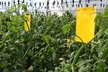
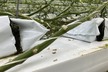
A major problem was the fungus Microdochium panattonianum (photo 4). After extensive research it was concluded that Microdochium panattonianum is caused by floaters infected with heavy rains. During heavy rain, fungus spores are able to infect the crop, leading to the decision to cover cultivation with foil.
The project was further facilitated by chain partners, customers, consumers, NGOs and local governments (photo 5). The different stakeholders all have a positive attitude towards cultivation on water. The question now, is how to market the added value of water-produced products. The aim is to create win-win situations with customers. To this end, the family Pater-Broersen has started developing market concepts in consultation with vegetable cutting companies, retail and supermarket chains.
The family Pater-Broersen decided this year to further optimize the crop with the knowledge gained from the project. The next step is to improve automation in order to further reduce the labor costs.
The project was made possible by: 'Europees Landbouwfonds voor Plattelandsontwikkeling: Europa investeert in zijn platteland'.
Source: Proeftuin Zwaagdijk