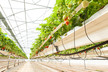
Below is some growing information regarding Redline RZ red pepper and Rookie RZ yellow pepper.
Redline RZ (35-161)
Redline is a large fruit size blocky red sweet pepper. The plant is tall and vigorous. High resistant to Tm:0-3 and shows to be strong against powdery mildew.It’s important to note that this is a vigorous growing variety, but not as vigorous as Redwing RZ. It grows with a thick stem and large leaves but has a more open habit comparing to Redwing. It is necessary as much as possible to keep a good balance in this variety, meaning trying to avoid the large flushes between high fruit load and very low fruit load. The planting density can be on the lower side of average. Always keep an active climate.
A large day - night temperature differential is needed. This can be attained by using a high and long afternoon temperature boost, when there is good sunlight. When the temperature is cold outside, the vents should not be used to lower the temperature into a pre night period. Often the best pre night temperature method is to leave the screens open as late into the afternoon as possible. The 24 hour temperature needs to be higher than most varieties, so make sure the post midnight temperature is high enough to maintain speed. Study the colour of the heads closely in the late afternoon and morning. Make sure the generative influences you are giving are having the desired effect. Excess water should be out of the developing leaves by the late afternoon, giving the leaves a slightly dull green look. By the following morning these leaves should be fresh (light coloured) green looking again.
It is important to get the first fruits on the plant and during this time you have to be especially diligent with watering and temperatures. Give the plant enough time to set the fruits. Make sure you keep a good enough differential between the day and night temperature (cooler night). We always talk about keeping the speed in Redline, but with the first fruits, this is one time that you need to make sure the setting flowers stick on the plant. During this time, do not make large changes to your watering strategy. Keep the EC high and if the light levels are low, only water when necessary. A plant given too much water at this time is more likely to drop the flowers, or even small fruits that you thought were set.
After you have the first fruits on the plant, keep the speed in the plant with a high enough 24 hour temperature. When there is enough light, Redline will set the next fruits. Slowing down will only slow the ripening of the fruits. With a good speed in the plant, you can harvest the fruits faster and make it possible to set the next fruits.
Make sure your plant is on daytime temperature well before sunrise. Redline must be grown in an active way, so the sooner you can start evaporation in the plant, the better. This also ensures a good humidity going into the afternoon, which allows you to give a good long temperature boost with good light levels. When light levels are not good, you can lower the average temperature and keep the day/ night temperature differential a bit more flat. It’s important on these days to still give some activation in the afternoon. This can mean a period of open screens and a pipe temperature boost.
In a typical early season low light Canadian planting time, the aim for setting should be to set fruits early but not allowing too many fruits on the first set. The early fruits will help bring balance to the plant, but keeping the total number of fruits on the first setting to a low moderate level will allow you to keep speed in the plant (higher temperatures). This speed will help with plant balance and will ensure the best quality at the time of harvest and post harvest of the first fruits. If you choose a large first set of fruits, then almost for sure you will have to go down with your temperatures to save energy in the plant; thereby slowing the fruit ripening down and taking longer to set the second flush of fruits.
It’s good to keep the side shoots pruned short in the early season. The large leaf size will usually provide enough coverage for sunlight protection on the fruits. Keeping the shoots pruned short will again help to keep the plant in balance. Redline will produce a lot of assimilates. It’s the job of the grower to direct these assimilates to the developing buds, flowers and fruits. The opposite being that the assimilates will more easily go to the leaves, stem and roots; possibly resulting in lower size and lesser shape of the fruits.
Use a drip EC that is higher than average in the early season. Keep it at a higher level longer than normal. Giving more water at a higher EC is better than lowering the drip EC and giving less water. In this way you ensure you’re giving enough water for growth and at the same time ensuring the EC does not rise too high in the substrate. When a variety makes a lot of assimilates, it needs more food (EC) to do so. These assimilates become your kgs in regards to production. The higher EC will also help you to build a strong celled, disease resistant plant.
After the first fruit set, Redline will continue to grow strong and even among the stems. As the light increases, the fruit setting will come naturally. As the season continues, Redline will continue to look strong and vegetative. This is ok, it’s the nature of the variety and the fruit setting will remain strong regardless.
Rookie RZ yellow sweet pepper
Rookie is a large fruit size blocky yellow sweet pepper. High resistant to Tm:0-3. This variety has smaller fruit size in comparison to 35-238 and Baselga RZ. The plant is tall and vigorous.In early season this variety is a normal (average) setting pepper variety. Meaning it will need some generative cues to get the early fruits on. A day night differential in temperature (colder night) will be needed. It is not as generative and fast setting as Baselga in the early season. More attention to fruit setting is needed with Rookie in the early season comparing to 35-238.
It is not difficult to keep a good flower quality in Rookie, it does not easily make overly large, slow flowers. You'll find the buds and flowers to be a bit smaller comparing to those on 35-238 and Baselga.
Rookie is not sensitive to low night temperatures as Baselga was. The fruits are naturally short in height (square) and have a rounded bottom, this is natural and not a result of low temperatures. Having said this however, the first two sets of fruit need good speed and proper nutrition. Especially with earlier planting dates. Make sure the nutrient solution is balanced in the bag before planting and make sure your feed has a good amount of potassium. Keep an above average drip EC. Don’t try and keep an extra high fruit count on the first sets. Better to keep fewer fruits and be able to maintain a slightly higher average temperature, especially by using a good pipe rail temperature.
Keep Rookie growing actively, with a good minimum pipe temperature and open screens as much as possible.
When the light starts to come, this variety becomes very generative in setting fruits and keeps a good plant vigour at the same time.
In the summer time we suggest keeping a good leaf coverage to protect the fruits from too high temperature.
I hope I get a chance to visit your crop this year. Please keep in touch with your questions and comments.
For more information
Rijk Zwaan Export B.V.
P.O. Box 40
2678 ZG, De Lier
The Netherlands
T: +31 (0)174 532 300
F: +31 (0)174 518 243
[email protected]
www.rijkzwaan.com
John De Vries
Advisor Greenhouse Crops
T: +1 519 324 6669
[email protected]