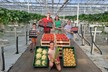
grower Gilles Le Bihan:
"France: "Cucumbers and tomatoes have the same needs"
He plants his tomatoes at the end of January in order to start harvesting towards mid-May. "My aim is to be harvesting early in the season because it is during this period that we can best capitalise on our terroir and know-how," he explains.
Gilles, who has in-depth knowledge about tomato production, says there is nothing complicated about this crop. Although, rigour and precision are essential because without them, this is a crop which can quickly become a nightmare. "The plants are grown in the soil. This means it is essential to guarantee a rotation of crops to reduce pest pressure," he explains. "From then on it's a question of surveillance and this means that knowledge about the crop is absolutely essential. Our workers, from the moment they arrive here, are trained to recognise pests and diseases. I encourage them to come to me if they have any concerns. For the most part, this surveillance and prevention through integrated biological controls is sufficient. In fact, we release beneficial insects, microscopic creatures which do battle against damaging pests.
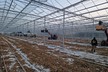
"With regard to diseases, we avoid the risks by managing the climate. Ensuring aeration of the greenhouse allows us to reduce the humidity, the temperature and, therefore, the development of diseases."
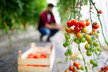
Harvesting takes place twice a week. "We harvest clusters which are ripe and pack them directly in the format chosen by the buyer," says Gilles. When tomatoes are ripe like this, careful and precise work is called for: each cluster is cut from the plant using small, sharp secateurs. The cut must be as small as possible because it could help a disease enter the plant. It's therefore a job for specialists. "In organics, the fact that the plants are grown in the soil, with no mineral fertilisers or pesticide treatments, leads to a reduction in yields compared to conventional production. This means we drop from an average of 55kg/m² to an average of 35kg/m² in organic production," says Gilles.
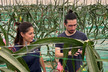
In terms of climate, cucumbers and tomatoes have the same needs. The management and pest prevention are also the same. "In contrast, though, cucumbers grow quicker," says Gilles. "We plant ours at the beginning of February and start harvesting in mid-April. Harvesting is done every two days, including the weekends. We offer three sizes, but our objective is to produce as many in the 400-500 range as possible because this best meets demand." Tomatoes and cucumbers are irrigated using clean water in a drip system. The plants are grown up and around a suspended wire to make work easier and encourage their growth.
For both cucumbers and tomatoes, producers in Prince de Bretagne's organic network have together chosen tasty varieties suited to their growing conditions. "We meet at the Pleumeur-Gautier trial station, where different varieties are tested in organic conditions," says Gilles. "The technicians give us their observations, we taste them and then we give the OK to two or three of them."
For more information please visit www.princedebretagne-pro.com