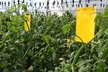
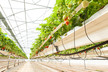
Drip micro-irrigation is the most popular technique: it supports the different growth phases of plants and provides an adequate water supply according to the need of plants, which is increasing at first and then gradually decreasing, and to the objectives of the commercial farm.
Strong points such as the uniformity of distribution, the possibility of very long draws, low flow rates and limited pressure (up until Low Volume Systems i.e. advanced micro-irrigation systems to operate on big plains with a pressure lower than 1 bar, leading to huge energy savings and efficient slow distribution-diffusion), the balanced energetic impact and fertigation have been and still are the technical cornerstones for the cultivation of tomatoes for processing.
Netafim has developed a great experience in this type of crops as regards both irrigation and fertigation by applying its own techniques and products in the most productive areas in Italy, from Puglia to Tuscany, from Campania to Emilia-Romagna, as well as in Lumbardy.
Strong points such as the uniformity of distribution, the possibility of very long draws, low flow rates and limited pressure (up until Low Volume Systems i.e. advanced micro-irrigation systems to operate on big plains with a pressure lower than 1 bar, leading to huge energy savings and efficient slow distribution-diffusion), the balanced energetic impact and fertigation have been and still are the technical cornerstones for the cultivation of tomatoes for processing.
Netafim has developed a great experience in this type of crops as regards both irrigation and fertigation by applying its own techniques and products in the most productive areas in Italy, from Puglia to Tuscany, from Campania to Emilia-Romagna, as well as in Lumbardy.
The main application of drip micro-irrigation is the laying of dripperlines on the ground, one for each row of tomato plants, with a dripping rate between 1.6 and 0.6 litres/hour and emitters every 40 cm. This enables to cover surfaces bigger than 200 m depending on the diameter of the dripperline, with noticeable benefits in the mechanisation and during the planting phase.
An alternative to this, which is used with double rows, is to place the dripperlines between the rows so as to irrigate both. In this case, depending on the characteristics of the soil, it is possible to meet the needs of both rows by adjusting the flow rate or the distance between emitters.
Another possible and frequently used application is to lay the dripperline next to the row though placing it a few centimetres below the ground: light subirrigation. This enables to take advantage of the benefits of subirrigation, usually deeper 30-40 cm deeper, such as the reduction of superficial evaporation (meaning increased efficiency), the closeness to the root system and the protection from external agents.
Suitable Netafim drippers can be chosen in the Tiran, Python and Streamline tomato product ranges, which enable the meeting of various requirements in terms of flow rates and draws.
All of these methods, products and positions can be also used to distribute nutrients through fertigation. This technique consists in dissolving the nutrients in water, which will then be distributed proportionally and evenly near the root system in a chemical form which is easily assimilated by root hairs.
This way, it is possible to check nutrient assimilation during the various phenological phases of tomatoes, from germination to ripening. Among the most important nutrients, if there are no major deficiencies, potassium has a central role in determining the quality of the product.
It regulates many functions such as the traslocation of sugar, the activation of enzyme systems, the regulation of the opening of leaf stomas, photosynthesis and cell turgor. In also operates as a key element for drought resistance, the increase of root density, the protection from physiopathologies, the increase of Brix and lycopene levels and shelf-life.
Last but not least, it must be considered that quantity, i.e. saleable quintals or tons per hectare (GSP: gross saleable production), is increased by 20% with respect to less efficient methods.
The number of drip interventions varies between 30 and 50 during the whole growing cycle, depending on chemical levels, on the soil and on the length of rotations. The most critical moments are: right after transplants, when it is essential for plants to take root, during the development of leaves and flowers to prevent dropping, the phase between setting and ripening to support fruits, up until the interruption of irrigation before harvesting. Machinery to collect the dripperlines at the end of the campaign is also available.
Each company has its own requirements which must be interpreted and it also needs precise technical answers that must comply with productive objectives. Netafim, thanks to its grow more with less policy, is always looking at the efficiency of its irrigation systems so that they can be an advanced tool in the hands of producers.
Contacts:
NETAFIM Italia Srl
Frazione Monleone
Via Pian Degli Alberi, 27C
16044 - Cicagna (GE)
Tel.: 0185 18720
Email: [email protected]
Web: www.netafim.it