US: California's immigrant farmers squeezed by Silicon Valley success
Bob and Judy Kuang’s farm begins where a cul-de-sac ends in the tiny town of San Martin, Calif.
It’s about 30 miles south of San Jose and home to some of the country’s most expensive real estate. At first glance, it might not even be recognizable as a working farm.
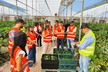
The vegetables grown there — Chinese celery (gao choy or chives) gau gei (leaves of Chinese wolfberry) and gai lan, which looks and tastes nothing like Western broccoli despite its common nickname (“Chinese broccoli”) — are hidden from sight in a greenhouse. The only thing that catches the eye is a cottage with corrugated tin panels.
That’s where the field hand lives.
Judy rises before 3:30 a.m. on delivery days, driving a truck loaded with over 300 boxes of vegetables to the Chinatowns of San Francisco and Oakland. While products like ginger, taro root and lychee can come from as far away as Japan and China, the fresh produce from these markets comes from Asian farmers in California.
Farming is in Judy’s blood. Her relatives were farmers in the fertile Pearl River Delta region of China. Almost all the Chinese growers in Silicon Valley’s farming belt can trace their roots to this region near Hong Kong.
Back in San Martin, the Kuangs continue to live the farming life of their ancestors. But this way of life is increasingly under threat — not from the manufacture of watches, toys and clothes as is the case in China, but from Internet company headquarters and the surrounding neighborhoods where its employees live. Since buying 12.9 acres here in 1998, the Kuangs have watched the price tag of surrounding land increase from $30,000 an acre to as much as $70,000 in recent years. According to the 2007 Census of Agriculture, more than half of the Asian American farmers in Santa Clara County operate on less than 10 acres of land.
Unlike their white and Latino counterparts, the number of Asians operating farms larger than 180 acres can be counted on one hand.
Of the roughly 130 Asian growers documented in the county, the majority are Chinese, and most of the Chinese growers here own land in or on the fringes of urban zones. In areas zoned for agriculture, land can be purchased at $100,000 an acre, according to Aziz Baameur, a University of California farm adviser based in Santa Clara County. However, land in the bedroom communities of Silicon Valley, such as Gilroy and Morgan Hill, could easily fetch between $300,000 and $500,000 per acre. New farmers have few prospects of buying land “unless it’s someone from Silicon Valley who is cottage farming on the weekends,” Baameur says.
Click here to read further