April is one of the most demanding months for greenhouse tomato growers in Central Europe, where rapid crop development coincides with unpredictable spring weather. Plants are under peak pressure—often with the 10th truss already flowering and the canopy expanding quickly—making precise crop steering essential. That's why the team with Cultilene provides the following cultivation tip.
Success in this phase comes down to maintaining the right vegetative–generative balance while protecting root health through a well-managed irrigation and climate strategy. As Marek Sowa of Cultilene puts it, "April is where growers set the direction of the crop—small mistakes can have long-term consequences."
In early April, the focus is on maintaining generative control. With increasing fruit load, growers should steer slightly on the dry side to prevent excessive vegetative growth. Daytime slab moisture is typically kept around 55–60%, while irrigation start should be delayed until sufficient radiation or light intensity is reached. Drainage levels around 30–35% help maintain balance without over-irrigating.
 © Cultilene
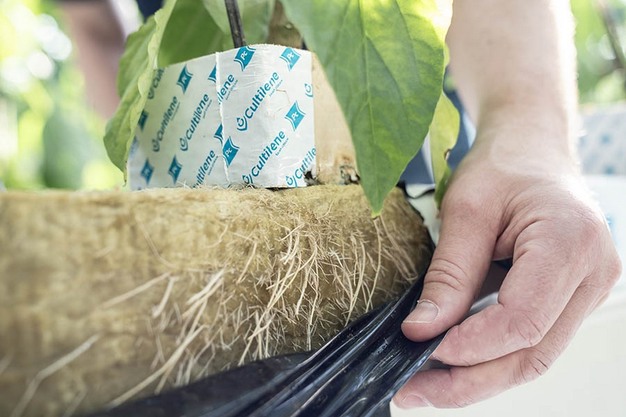
Equally important is EC management. If drainage is reduced, feed EC can be lowered slightly, especially on sunny days. Any overnight EC increase in the slab should be corrected with additional or slightly larger irrigation doses. "Stable EC is key to keeping roots active and healthy," says Sowa.
The overnight drop in slab moisture remains the most powerful steering tool. From the last irrigation of the day to the first the next morning, slab moisture should decrease by around 8–10%, with a small buffer after sunrise before irrigation resumes. If this drop is insufficient, the plant will shift toward vegetative growth, negatively affecting truss development. "What happens overnight defines how the plant behaves the next day," Sowa explains.
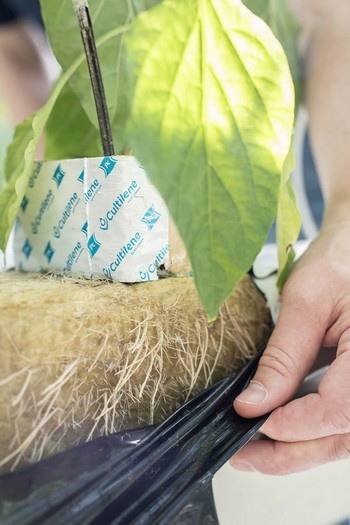 © CultileneIn the second half of April, as higher trusses begin flowering, the strategy shifts toward building a water buffer for the warmer conditions ahead. Slab moisture is gradually increased to around 70–75%, and irrigation frequency becomes more closely aligned with incoming radiation. The overnight drop should still be maintained, adjusted slightly depending on whether days are sunny or cloudy. A consistent difference between feed EC and slab EC is essential, as excessive EC can compromise root health over time.
In cases where late-day sunlight causes rapid drying after irrigation stops, a night cycle may be necessary. This involves a small, non-drainage irrigation applied a few hours before midnight to stabilize slab moisture and prevent EC spikes. It also helps avoid early-morning irrigation, which can lead to excessive root pressure and increase the risk of fruit cracking. "A night cycle should support the plant, not stimulate it," Sowa notes.
Timing remains critical throughout the month. Irrigation should only begin once the right conditions are met and should stop well before sunset to allow for the desired overnight moisture drop. Climate settings must support this strategy, with night temperatures around 16.5–17°C and daytime temperatures adjusted to external conditions.
"Well-managed irrigation is not just about water—it's about steering plant physiology," concludes Sowa. "And in April, that steering determines the success of the entire season."
For more information:
Saint-Gobain Cultilene
Email: [email protected]
cultilene.com