Greenhouse growers are working in conditions where crop performance and energy use must be managed at the same time. According to Timo Spruit, Chief Customer Officer of RED Horticulture, this requires a shift from fixed lighting schedules to approaches based on plant responses to light.
"Lighting is moving from static control to measured and predictable strategies," Timo says. "That starts with understanding how plants react to light and translating that into daily decisions."
 © RED Horticulture
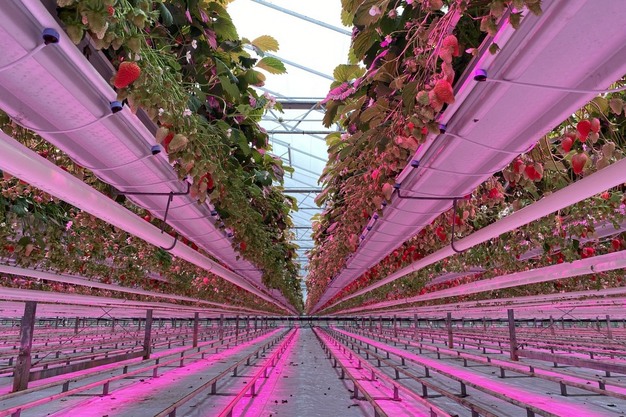
This approach is based on photobiology, which links plant development to light conditions. Two parameters are central: intensity and spectrum. Light intensity affects photosynthesis, biomass accumulation, and yield, while spectrum influences morphology, flowering, rooting, and nutritional composition. Paul Vailhen, photobiologist at RED notes that these factors need to be managed together. "Focusing on one parameter without the other limits how plants use light. The interaction between intensity and spectrum determines photon efficiency."
He explains that growers can use this knowledge to steer crops more precisely. "When photobiology is applied in practice, lighting becomes a management tool rather than a fixed input."
Three areas
To support this, RED Horticulture organizes its offering around three areas: luminaires, a control platform, and agronomic guidance. These components are intended to respond to changes during the day and across crop stages. "Plant needs are not constant," Timo says. "Lighting strategies need to follow those variations."
The MyRED platform is used to translate greenhouse data into lighting decisions. Growers can monitor performance and adjust light strategies through a dashboard. "The platform allows growers to define and modify their own light recipes and evaluate the results," Timo explains. "It connects crop data with energy use."
He adds that implementation goes beyond software. "Support continues after installation. We work with growers to set targets, apply strategies, and adjust them over time."
Energy use
Energy use is a central factor in greenhouse operations. Timo links lighting strategies directly to consumption. "Understanding how intensity and spectrum affect power use helps growers manage their energy input," he says. "This can lead to changes in how lighting is applied during the day."
Automation is also part of current greenhouse practices. The system can adjust lighting throughout the day based on predefined strategies. "Automation reduces manual adjustments and keeps light levels consistent," Timo says. "It also supports control over total light output."
He notes that automated control can contribute to additional energy savings beyond the performance of the luminaires themselves. "When strategies are applied dynamically, further reductions in energy use are possible."
Research
Research is another part of the approach. Through the Photobiology and Agronomy Research Center (PARC), RED Horticulture conducts trials under controlled conditions. Timo explains how this connects to commercial production. "Trials allow strategies to be tested before implementation. Growers can then apply these results with a clearer view of expected outcomes."
The aim is to make photobiology applicable across different crops and growing environments. "The same principles can be adapted to different varieties and production systems," Timo says. He concludes by returning to the role of knowledge in greenhouse management. "Understanding photobiology is the starting point. From there, growers can build lighting strategies that align with crop requirements and energy constraints."
For more information:
RED Horticulture
World Horti Center
Europa 1
2672 ZX Naaldwijk
+31 174 705 617
horticulture.red/