Peru continues to lead the global blueberry export market, and recent technological shifts in commercial cultivation are enabling growers to meet ever-growing demand for high-quality fruit. Doris Zhang of NatureHydro, a professional provider of Ag-Tech hardware solutions, explains that "the rapid expansion of Peru's blueberry industry is driven by large-scale export orientation and an increasing demand for environmental control."
Traditional soil-based cultivation, while historically common, presents several challenges at commercial scales. "Soil-borne diseases, irregular drainage, and the inability to precisely control the root zone environment limit fruit consistency and yield stability," she notes. In response, many large-scale operations are adopting substrate-based cultivation systems. These systems allow growers to standardize water, nutrient, and oxygen supply, ensuring stable yields and high-quality fruit for export markets.
 © NatureHydro
Engineering the root zone: Air pruning and root guidance
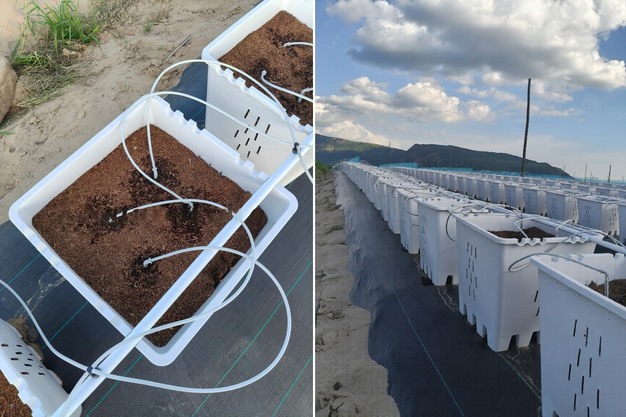
NatureHydro recently completed a large-scale installation in Peru using their 33L Commercial Grow Pot System, designed for high-density blueberry cultivation. "The core advantage of the 33L container system lies in its ability to guide root structure." Unlike traditional containers, where roots often form circular loops along the walls, these precision-engineered pots feature lateral and bottom ventilation structures that promote "air pruning."
When root tips encounter air, growth is naturally redirected into lateral roots, creating a denser, more uniform root network. The benefits, Doris explains, include "no more root entanglement, significantly increased absorption area, and more stable plant vitality," ultimately supporting uniform fruit development.
Raised-base design reduces disease risk
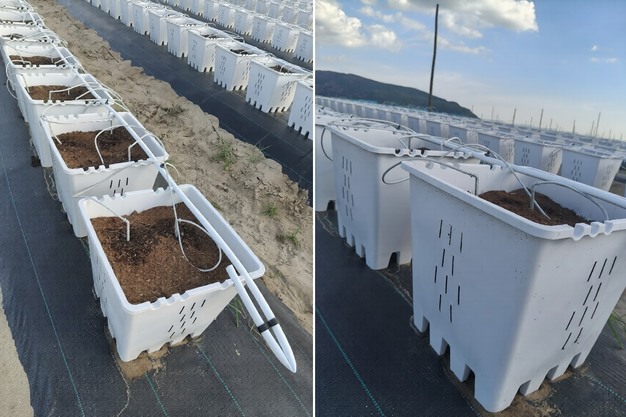
Disease management is another critical consideration at scale. In high-density systems, pathogen transmission is often linked to waterlogging and root-to-root contact. The raised-base design of the 33L containers addresses this problem by providing "isolation and rapid drainage."
By elevating the container bottom, a continuous air layer promotes quick water drainage and prevents roots from remaining in overly damp conditions. "This reduces the incidence of soil-borne diseases such as root rot and lowers overall plant protection costs," she adds, making large-scale production more reliable and cost-effective.
 © NatureHydro
Resource efficiency in arid cultivation
Water and nutrient efficiency are additional drivers behind this technology adoption. According to her, growers typically see improved irrigation efficiency, reduced nutrient leaching, lower water use per unit of yield, and increased marketable yield ratios.
In arid or resource-limited regions, such precision input combined with optimized drainage ensures that yields remain stable despite environmental constraints.
Operational scalability and standardization
Operational scalability is also enhanced by these modular containers. "For large greenhouse or commercial sites, consistent unit design enables standardized replication across the entire operation," she explains.
Unified irrigation and fertilization control, combined with easier integration with automated systems, allow growers to expand production like an industrial assembly line while maintaining quality consistency.
The future of hardware-driven berry production
Doris sees agricultural technology shaping greenhouse berry production in three main directions: systemization, digital farming, and global replication.
"We are moving from cultivation techniques to holistic environmental system management, where containers, irrigation, and growing media form a unified design," she says. Sensors and automation will further enable real-time monitoring of root zone conditions, while standardized container systems will support consistent yields across diverse geographies. These innovations are transforming berry cultivation from traditional experience-based practices into a precise, industrial-scale system capable of engineered replication.
For more information:
NatureHydro
Doris Zhang
[email protected]
https://www.naturehydro.com/