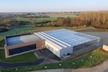
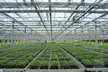
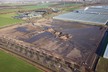
A central question for many growers is whether conventional glass greenhouse models remain aligned with current cost structures and risk exposure. "Is the traditional glass greenhouse model still the most secure investment, given the scale of capital required?" Victoire voices. Last year, she became COO of family-owned company Filclair, founded by her great-grandfather. Now, she is bringing a new perspective and modern tools to improve efficiency and performance within the company and the sector. "My ambition is to transform the company while preserving its family DNA. We're combining 60 years of expertise with forward-looking leadership. The goal is clear: to deliver smarter, faster, and more sustainable solutions for every grower we serve. I think this balance between innovation and continuity is the biggest challenge we face every day."
 © Marta del Moral Arroyo | HortiDaily.com
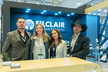
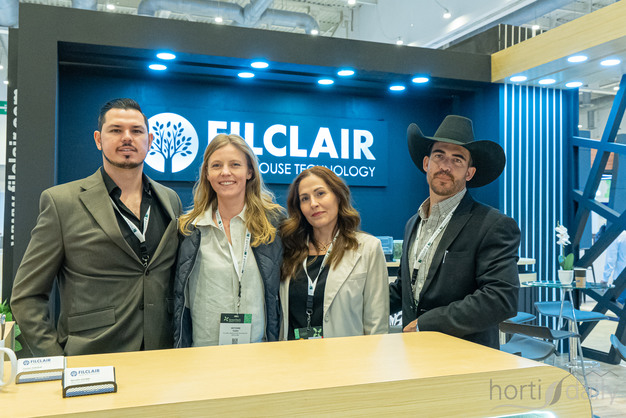
Samuel Chavez, Victoire Thery, Carmen González, and Nematini Aguirre, Filclair, at Greentech Americas 2026
Growers managing
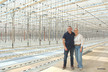
Her appointment comes at a time when growers are managing energy costs, climate variability, and long-term investment decisions. "We live in a world marked by economic, energy, and climate uncertainty. Yet greenhouse projects are long-term investments, designed to operate over decades," Victoire explains. Filclair's response has been to develop greenhouse systems that address energy use, crop protection, and financial exposure. "This is precisely why Filclair is developing more resilient technological alternatives, capable of combining agronomic performance, energy efficiency, and financial security for growers," she says. © FilClair
One of the company's development directions is defined internally as "green safety," combining climate control, plant protection, and energy management. "Safety is at the heart of our product development," Victoire notes. "First, there is climatic and phytosanitary safety: ensuring crops grow in a fully controlled environment, particularly in terms of light, ventilation, and climate management."
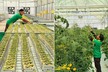
This includes greenhouse designs aimed at limiting pest entry and supporting low-residue or organic production. "Modern greenhouses are increasingly becoming agricultural 'clean rooms', completely sealed against insects," she says. "The goal is to enable zero-residue crops."
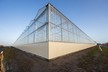
Energy remains a constraint for greenhouse operations, particularly in regions with high energy prices. "Today, being highly carbon-dependent also means being exposed to very high energy costs," Victoire explains. To address this, Filclair develops inflated double-layer greenhouse systems. "These structures are 30% more thermally efficient than traditional glass greenhouses, while also offering higher light transmission," she says, referring to ETFE films with a lifespan of over 20 years.
Filclair operates in a global market for flexible plastic-covered greenhouse systems and turnkey projects. The company has delivered more than 5,000 hectares of greenhouses across five continents and in more than 65 countries. Around half of its turnover comes from France and nearby European markets, with the remainder from regions including Latin America, the United States, and Asia.
The company's current position builds on earlier developments in plastic greenhouse design. In the 1960s, Filclair introduced flexible plastic coverings, and it continues to invest in research and development, supported by a portfolio of patents.
Filclair is a family business, with Victoire representing the fourth generation involved. Founded in 1963 by Yvon Dalle and Benoit Bonduelle, the company continues to build on its history in flexible greenhouse design while adapting its systems to current production conditions.
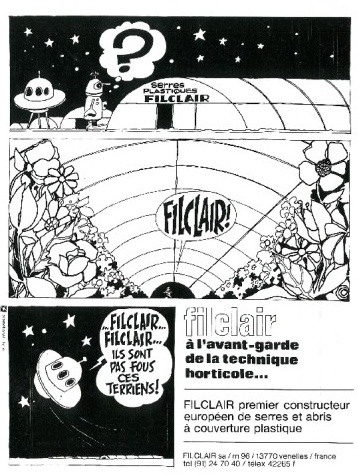 © FilClair
This advertisement, published in horticultural magazines in 1967, perfectly illustrates the company's early spirit of innovation in protecting horticultural and vegetable crops in challenging environments. "Filclair, Filclair — these earthlings must be crazy!" "Filclair — at the forefront of horticultural technology… Filclair, Europe's leading manufacturer of plastic-covered greenhouses and crop shelters."
Victoire's background prior to joining the company was outside horticulture. She worked in a Paris-based start-up, where she supported the company's growth from an early stage to several hundred employees and its acquisition by Sodexo. "Looking back, I realize that this experience was an accelerated training ground. It gave me the tools, instincts, and energy I needed to join Filclair," she says.
Her role now focuses on integrating that experience into a company with an established industrial history. "My role is to bring a new perspective and modern tools to improve efficiency and performance," she explains.
Filclair's stated objective is to provide greenhouse systems aligned with current agricultural and environmental conditions. "Filclair's objective remains constant: to provide growers with technological greenhouse solutions that are sustainable, profitable, and adapted to today's agro-environmental challenges," Victoire says.
Looking ahead, the company is focused on expanding the deployment of its technologies across different regions. "I am convinced that Filclair has the technical solutions to support sustainable agriculture. The next step is to scale up," she states, adding that, on a personal level, she links her role to broader sector developments. "I would be very proud if I can contribute in building the agriculture of tomorrow together with our growers."