The countdown is on to strawberry season with farmers working hard to protect the emerging blossoms and berries from cold nights that always follow what has come to be known as "false spring" in North Carolina.
Jonathan Godfrey, who grows over a half-acre of organic strawberries with his dad and brother at Olde Carthage Farm in Moore County, anticipates berries being ready for first picking around the first full week of April. The farm also offers organic cut flowers, blueberries and grapes seasonally during the year.
But right now it's about to be strawberry season, so nestled under rows of protective low plastic tunnels, plants are already heavy with green strawberries and the white blooms of strawberries to come.
But right now it's about to be strawberry season, so nestled under rows of protective low plastic tunnels, plants are already heavy with green strawberries and the white blooms of strawberries to come.
Lost blooms and berries are missed opportunities for customers and missed sales potential in a season that is fleetingly short.
Godfrey's organic bare root strawberry varieties went in the ground in late October. After a short growing period, they go dormant to survive the coldest winter months.
With temperatures recently dropping into the high-20s to low-30s several nights in a row, the Olde Carthage Farm team has had to focus on covering each row with blankets to give them protection from the below-freezing temperatures.
"You want the plant to grow a little bit when you plant them in the fall. A lot of your decisions about numbers of berries are decided the fall before. For example, the amount of crown set is made with that initial growth," Godfrey said. "Once it warms up a bit, they wake up. And once they wake up, there's no going back to sleep. Once they wake up and start pushing new growth, if it gets really cold, then you start doing damage to the plant.
"At that point it's all about the blooms and the berries. The blooms are susceptible, depending on humidity a bit, but we look at 32 to 30 degrees – 30 degrees being a scary point for blooms. Pollinated blooms, flowers and fruit, maybe even up to 32 is scary for them," he said. "I want some way to protect them from the cold so that's part of covering them up in the spring."
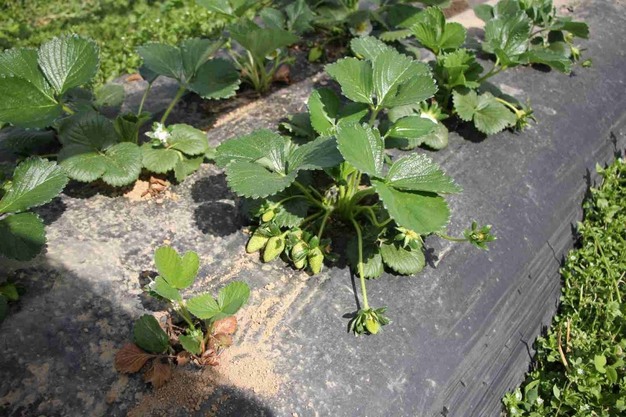 © North Carolina State GovernmentGreen strawberries will soon be red strawberries if growers can protect the delicate blooms and berries from freezing or below freezing temperatures.
The word blanket brings to mind a thick, warm material to snuggle under on a cold day. But for Godfrey, the blanket he is talking about is geotextile product that weighs around an ounce to an ounce and a quarter per yard.
"It's not real heavy, but it is trying to hold some of that thermal mass/heat that builds in the ground during the day in at night when temperatures drop," Godfrey said. "Each blanket is 250 feet long and goes over four rows. On a cold night my brother and I pull them over the rows and secure them with bags of rock to hold them down. In about an hour, we can get the field covered up."
For NCDA&CS regional agronomist Brad Thompson, it is also a busy time as he works with strawberry growers to fine tune the nutrient needs for their crops. This time of year, that means taking plant tissue samples every few weeks to be analyzed.
Taking tissue samples and having them analyzed helps head off problems before they arise and keep plants producing efficiently through the season, Thompson said.
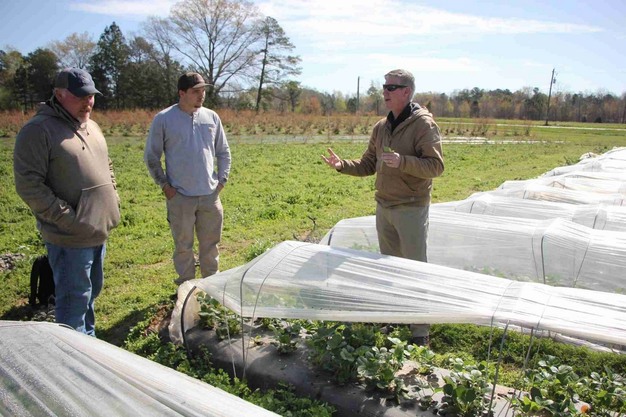
On a recent visit to his farm, Thompson showed Godfrey and neighboring strawberry grower Nolan Smith what to look for when taking a tissue sample.
"You take the most recent mature leaf. So, you look for the leaves that aren't glossy. That's too young, and you don't want them too dull looking either. That's the oldest leaves," Thompson said. "You are looking for those in between. You will take the whole leave and the petiole or stem, too. Take everything because we're going to analyze the petiole nitrate as well as the leaf nitrate.
"The petiole nitrate will tell us how much nitrogen is in the plant and much is going to continue. So, if you are too high, you can back off. If it's too low, you need a bump."
Thompson advises taking around 25 representative leaf samples from around the field or from an area of concern if you suspect a problem. Cut the leaf from each stem and place all the leaves in one brown paper bag. The petioles removed from the leaf will go together in a separate paper bag.
 © North Carolina State Government
Growers can mail those into the lab or take them to their local cooperative extension office to be transported to the NCDA&CS Agronomic Services lab or get them to their regional agronomist. Lab results are typically ready in about two days and recommendations are emailed to growers.
As an organic producer, working with Thompson has been especially helpful for Godfrey.
"He's come out and helped us on the strawberry tissue samples. We've looked at blueberries and blackberries when we had those and had issues with them," Godfrey said. "It has been beneficial for us to be able to bounce ideas off him and to be able to say, 'Hey, is this crazy?' Because we've thought crazy thoughts.
"But as an organic grower in this area, I don't have a lot of other people to ask. I don't have neighbors to bounce ideas off.
Thompson agreed.
"They keep me on my toes because there is a whole different set of challenges. It's a completely different ball game," Thompson said.
Source: North Carolina Government