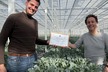
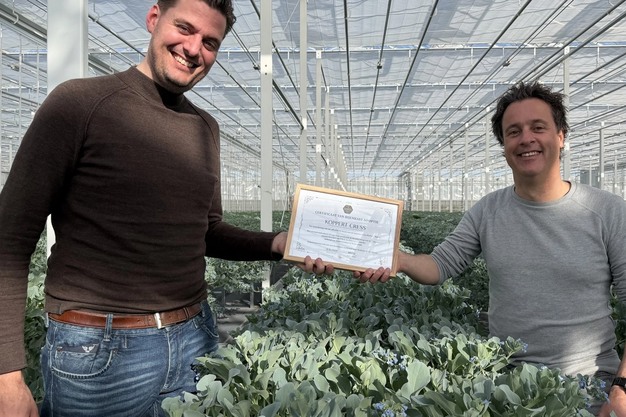
During the festive opening of the new greenhouse of Koppert Cress in Monster on Saturday, March 7, collaboration took center stage. KUBO built this new greenhouse and marked the special occasion with a sustainable gift: the adoption of a beehive for Koppert Cress.
With this so-called "Adoption with Honey," Koppert Cress will receive honey regularly for two years. The gift includes a certificate, updates about the bees, and two jars of honey per month during the active season.
 © Kubo
Honey from Holland Bijen
The honey comes from a beehive that KUBO has adopted at Holland Bijen in Gouda. The hive is located at the Holland Bijen site and is professionally managed there.
This hive produces the honey that Koppert Cress receives during the season. In this way, a tangible and tasteful way is created to mark the opening of the new greenhouse.
Generations of collaboration
The collaboration between Koppert Cress and KUBO goes back generations. Both family businesses share a strong focus on innovation, quality, and sustainable food production.
The new greenhouse in Monster is another step in this long-standing relationship. With the construction of this greenhouse, KUBO once again contributes to a modern and efficient growing environment for Koppert Cress. It is a symbolic gift that aligns with the sustainable ambitions of both companies.
From innovation to impact in practice
While technology and energy efficiency come together in the new greenhouse, sustainability at Koppert Cress also takes shape in another way. In addition to large-scale innovations and system integration, impact is also found in small, tangible initiatives. This connection between high-tech solutions and natural ecosystems highlights how broadly the sustainability ambition is interpreted.
New fossil-free greenhouse for Koppert Cress
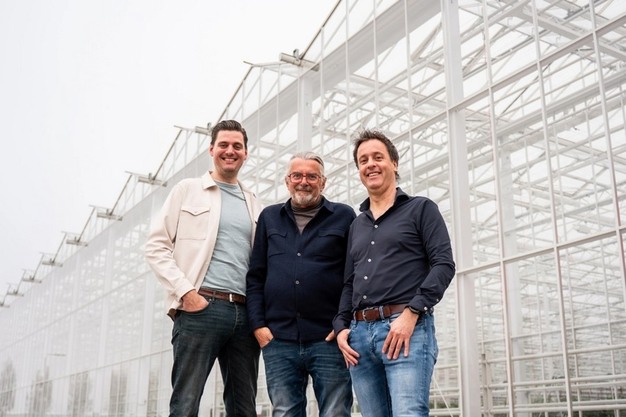
With the commissioning of a new, hyper-modern greenhouse, Koppert Cress is taking another major step toward fossil-free cultivation. The greenhouse, where specialty products are grown, was developed in close collaboration with Division Q and various partners. The result is an integrated energy system in which technologies focused on insulation, climate, heat, and CO₂ come together intelligently. With this new greenhouse and the recent connection to geothermal energy, Koppert Cress strengthens its position as a frontrunner in future-proof, sustainable greenhouse horticulture.
The new greenhouse aligns with the ambition from the covenant between greenhouse horticulture and the government to achieve fossil-free cultivation by 2040. The greenhouse supports an extremely stable and precisely controlled cultivation process, where quality, uniformity, and continuity are central.
 © Kubo
"Sustainability is not a project for us, but a direction. This greenhouse shows that with a clear vision, collaboration, and courage, you can take steps that make sense both ecologically and economically. Fossil-free cultivation requires choices you make today, with tomorrow in mind," said Koppert Cress Director Stijn Baan.
Collaboration as a foundation
The development of the greenhouse is the result of intensive collaboration between Koppert Cress, Division Q, and a broad network of technology suppliers, construction partners, knowledge institutions, and governments in the Westland region.
Bart van Meurs, director of Division Q: "Our role was to make the ambitions of Koppert Cress technically and practically achievable. Not by stacking separate solutions, but by designing one integrated system together with all partners."
One greenhouse, one integrated system
The greenhouse, covering approximately 1.2 hectares, has been designed as a fully integrated system where each component contributes to overall performance. While some of the innovations are still being developed or tested, ongoing adjustments ensure the design stays focused on its core goals of reducing energy use and minimizing emissions. The concept brings together several key elements, including Low-E glass to limit heat loss through the structure, drones to support mechanical crop protection, and an airflow floor system that handles heating, dehumidification, and air circulation. It also incorporates insulated facades to improve energy efficiency, uses low-grade heat sources that can work with geothermal energy, and applies Direct Air Capture technology to extract CO₂ directly from the outside air.
"The realization of this sustainable greenhouse full of innovations is only possible through strong collaboration. Our thanks go to all partners, customers, and involved teams who contributed to this result with their knowledge, commitment, and enthusiasm," concluded Stijn.
For more information:
KUBO Group
Vlotlaan 710
2681 TX Monster, the Netherlands
T: +31 174 286 161
[email protected]
www.kubogroup.nl
Koppert Cress
[email protected]
www.koppertcress.com