At Ammerlaan The Green Innovator, a large pot plant nursery in Pijnacker in the Netherlands, the effect of a photocatalytic greenhouse roof coating is clearly visible. On sections of greenhouse facade treated with the coating around four years ago, algae growth has been eliminated. The best results are seen where the surface was first cleaned and then coated: the glass is crystal clear and free of algae, despite the warm, humid greenhouse climate that typically encourages algae development.
The nursery plans to have significantly more sections of its greenhouse coated in the coming period. Owner Leon Ammerlaan is convinced of the technology, and it was partly his encouragement that prompted the team behind the coating to raise its profile in the market. That move has paid off. Following the publication of an earlier article (link in Dutch), Koos Evenblij of Multi-Cover received enquiries from interested parties both in the Netherlands and abroad. With chemical algae removers facing increasing restrictions, and with light transmission, energy savings and other benefits on offer, market interest is growing.
No longer a test, but a demonstration
Koos Evenblij and inventor Jaap van der Spek visited Ammerlaan The Green Innovator in Pijnacker on a sunny Thursday in mid-March to coat a new section of greenhouse. "We are here to demonstrate the unique performance of the product, not to run tests," Koos emphasises. "Testing has been done extensively. The technology has been thoroughly described in scientific literature."
For the job, Jaap brought several 20-litre cans of the coating. Multi-Cover has the product manufactured in the Netherlands. The coating consists of water and titanium dioxide (TiO₂). It is transparent and fully inert. "The active process begins as soon as daylight or artificial UV-A LED light is present. After that, you simply let nature do its work."
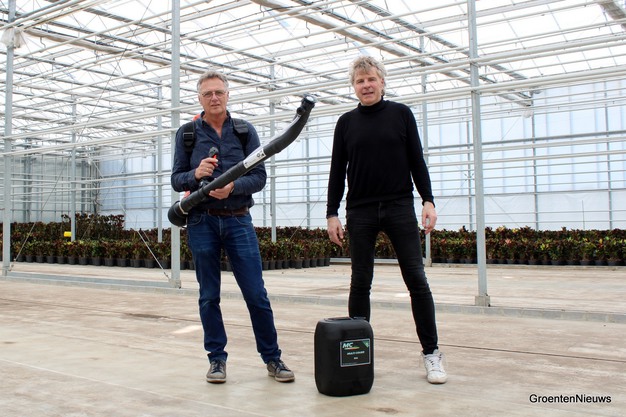 © Thijmen Tiersma | HortiDaily.comJaap van der Spek and Koos Evenblij in the greenhouse at Ammerlaan The Green Innovator
Applying the coating
At the Pijnacker site, the greenhouse roof is coated from a platform lift. Finding a clear stretch of floor at Ammerlaan The Green Innovator is a challenge in itself, the pot plant greenhouse is never empty. The situation is different for vegetable growers, where Multi-Cover also has experience. In that context, crop changeovers offer a convenient window for application, although Koos notes that coating can also be carried out during a growing cycle if needed.
Before starting, Jaap measures the section to be coated and loads a backpack sprayer. Getting the dosage right is important: one litre of coating covers 100 square metres of glass. Because the greenhouse roof consists of ridges, Jaap adds approximately 23% to ensure full coverage.
The glass surface must be dry before application, both for the coating to adhere properly and to allow it to dry quickly. Once the quantities are calculated, the can is shaken to ensure the coating is well mixed, and spraying can begin. The process is straightforward: the greenhouse compartment roof was fully coated in around fifteen minutes.
Application in greenhouse, cold store, or processing area
At Ammerlaan The Green Innovator, keeping the greenhouse roof free of algae is the primary motivation for using the coating. Koos points to additional benefits arising from the natural photocatalytic process: improved light transmission, energy savings, and the breakdown of nitrogen oxides, bacteria, viruses and fungi.
The light transmission gain is a direct result of photocatalysis eliminating algae. Once the coating is applied, UV-A from sunlight keeps the roof clean. Photocatalysis works in combination with UV-A from natural sunlight or artificial UV-A LED lighting. The coating enhances the effect of the sun, or of artificial UV-A light. This makes it possible to coat processing halls, storage rooms and cold stores as well, an application Multi-Cover is already active in. In those settings, the coating helps prevent mould growth and reduces ethylene accumulation, Koos explains. This prevents unintended acceleration of the ripening process in stored fruit or vegetables.
In vegetable greenhouse growing, condensation on the roof is a well-known issue, Jaap explains. The Multi-Cover coating reduces the surface tension of the glass, causing condensation to run off more readily into the gutters rather than remaining on the surface. Growers typically use heating or ventilation to manage excess humidity, both of which consume energy, or result in heat loss when vents are opened. By reducing condensation, the coating contributes to energy savings.
Practical results to follow
On the website www.kern-kas.nl, the coated greenhouse of Ammerlaan The Green Innovator will soon be available to follow. The website offers access to results from a greenhouse in practice until 30 May.
In addition, all safety data sheets for the fully organic water-based coating can also be viewed at www.kern-kas.nl. The coating has been tested on many materials, including outdoors. After application, annual cleaning with water only is sufficient.
For more information:
Koos Evenblij
Multi-Cover
Tel.: +31 (0)6 2349 3353
[email protected]
www.multi-cover.nl
www.kern-kas.nl