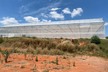
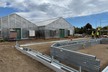
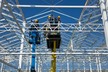
Students of José Martí Technical High School in St. Catherine are now learning the science and technology behind modern agriculture alongside traditional planting and harvesting methods. At the heart of this change is a smart greenhouse, a pilot initiative that is altering how agriculture is taught in Jamaican classrooms.
Established under the Ministry of Education, Skills, Youth and Information's Technical and Vocational Education and Training (TVET) expansion plan, the greenhouse is part of a broader national shift in technical education.
 © Dave Reid
Designed to serve not only its host institution but also as a satellite hub for schools in and around Spanish Town, the greenhouse provides access to agricultural technologies that were previously uncommon in classroom settings.
For Senior Education Officer in the Ministry, Okemo Dukie, the project has been a long-term undertaking.
"The future of agriculture lies at the intersection of innovation and cultivation," he argued while delivering an overview at the recent handover of the project, held at the school.
Describing the greenhouse as a cornerstone of the Ministry's mission to modernise education, he said there was a careful selection of José Martí Technical High as the flagship institution. The school's strong agricultural science programme, history of collaboration, and the capacity to sustain advanced initiatives made it the ideal incubator for what is now Jamaica's first school-based smart greenhouse of its kind.
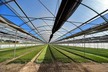
The greenhouse is a seamless fusion of automation, precision agriculture, and renewable energy. A sophisticated computer system, supported by cloud-based storage and analytics, receives continuous streams of data from an intricate network of sensors. These sensors monitor key environmental variables such as soil and air humidity, temperature, pH levels, and electrical conductivity. Automated controls respond in real time, adjusting irrigation, ventilation, and nutrient delivery to ensure optimal plant growth.
Most impressive is the facility's energy independence. Powered by a 12-kilowatt solar system, the greenhouse operates entirely on clean, renewable energy. During the passage of Hurricane Melissa, when many systems faltered, the greenhouse remained operational, a powerful demonstration of resilience and sustainability.
In an era increasingly defined by climate uncertainty, such features are not luxuries; they are necessities.
What makes the greenhouse truly transformative is not just its technology but how it integrates science, technology, engineering, and mathematics (STEM) into everyday learning, and the facility is not theoretical STEM; it is experiential, immersive, and deeply practical.
Technology serves as the engine driving these discoveries. Through Internet of Things (IoT) devices and advanced sensors, students collect and analyse real-time data on soil moisture, nutrient levels, and air quality. Interactive dashboards allow them to visualise trends, make informed decisions, and adjust variables to improve outcomes.
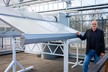
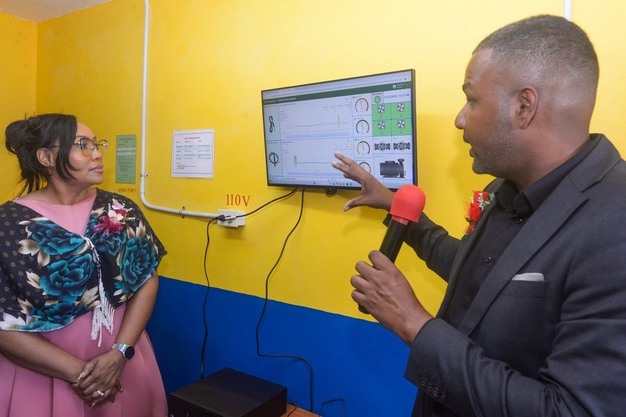 © Dave ReidSenior Education Officer at the Ministry of Education, Skills, Youth and Information, Okemo Dukie (right), in discussion with Technical Support Officer at the Ministry, Dr. Nahema Daniels-Heath, during the recent handover ceremony for a state-of-the-art smart greenhouse, gifted to the school by the Ministry.
With mobile connectivity, they can even monitor and control systems remotely, gaining exposure to the kinds of tools used in modern, high-tech farming operations around the world.
Engineering principles are equally embedded in the greenhouse's design and operation. Students are not mere users of the system – they are active problem-solvers. They plan irrigation layouts, design ventilation systems, and explore solar configurations.
When faults arise, whether in sensors, pumps, or valves, they apply diagnostic reasoning to identify and resolve issues. Through construction and maintenance activities, they gain hands-on experience with piping, wiring, and calibration, aligning their learning with real-world engineering practices.
The greenhouse aligns seamlessly with Jamaica's Vision 2030 development agenda, reinforcing national goals around innovation, sustainability, and economic growth. It serves as a living laboratory for experiential learning, offering capacity-building opportunities not only for students but also for teachers across multiple institutions. By supporting surrounding schools in adopting agricultural technology, it extends its impact far beyond its physical boundaries.
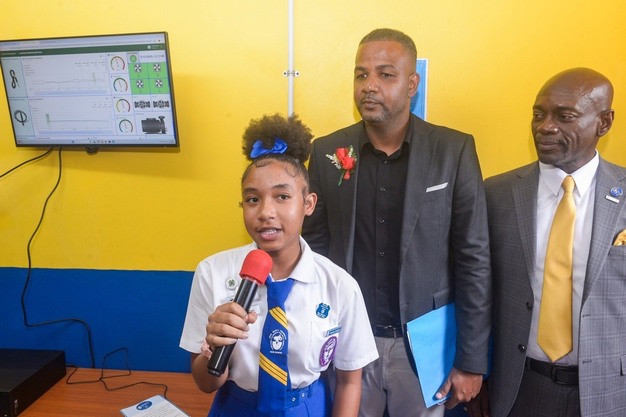
For student, Yanisha Daley, the significance of the greenhouse is both personal and profound. She described it as "more than a structure, it is an opportunity. An opportunity to learn, to innovate, and to contribute to sustainable development".
Her comment reflects a deep appreciation for the Ministry's investment and a recognition of the responsibility that comes with it.
"Let us commit to taking good care of it, and use it to promote sustainability, technology, and agricultural excellence," she told the audience.
That sense of responsibility is echoed by former Principal, Dr. Austin Wright, who sees the greenhouse as a defining moment for the institution.
He described it as a "symbol of possibility", one that will equip students with the skills needed to navigate an increasingly complex global landscape. Beyond academics, he emphasised its role in building discipline, fostering curiosity, and shaping well-rounded individuals in keeping with the school's ethos of developing "the total man".
Meanwhile, Technical Support Officer at the Ministry, Dr. Nahema Daniels-Heath, described the greenhouse as a "living classroom powered by innovation".
She said it represents the future of agricultural education, one where precision farming, automation, and renewable energy converge to create a seamless learning environment.
"Here, students engage with real-time data and hands-on experiences that mirror modern agricultural practices, preparing them for careers in fields ranging from agronomy to engineering," she added.
The implications of the project extend far beyond the school gates. By integrating IoT-enabled systems, renewable energy, and advanced data analytics, the greenhouse introduces students to industries that are rapidly evolving. It opens pathways to careers in agricultural technology, environmental science, and renewable energy fields that are critical to Jamaica's long-term development.
Equally important is the project's emphasis on inclusion and empowerment. By encouraging participation across disciplines, including both agriculture and engineering, it breaks down traditional barriers and invites a diverse range of students to engage with STEM. This inclusive approach fosters innovation, ensuring that the next generation of problem-solvers reflects the full diversity of Jamaican society.
Looking ahead, the Ministry has expressed its intention to replicate the model in schools across the island. If realised, this expansion could mark a significant step towards a more modern, resilient, and technology-driven agricultural sector. It would also reinforce the role of education as a catalyst for national development, bridging the gap between classroom learning and real-world application.
Source: Jamaica Information Service