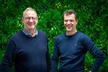
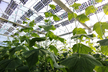
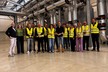
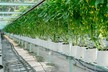
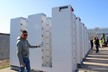
The first VersPodium session of 2026, organized by Wilma van den Oever and Maurice Wubben, brought together around twenty participants from across the Dutch greenhouse sector, including marketing consultants, energy advisors, and retail specialists. The half-day program, held in the Westland region of the Netherlands, focused on energy in horticulture, combining site visits with technical presentations and sector-wide discussion.
Learning by seeing and asking
VersPodium is built around knowledge exchange and on-the-ground experience. Organizer Maurice Wubben explained the format: "We don't just want to talk about developments, we want to show them. Being on location is where the best conversations happen." The program moved from a geothermal project visit to technical deep-dives and a forward-looking look at the sector's energy future.
 © VersPodium
Geothermal energy as a foundation for sustainability
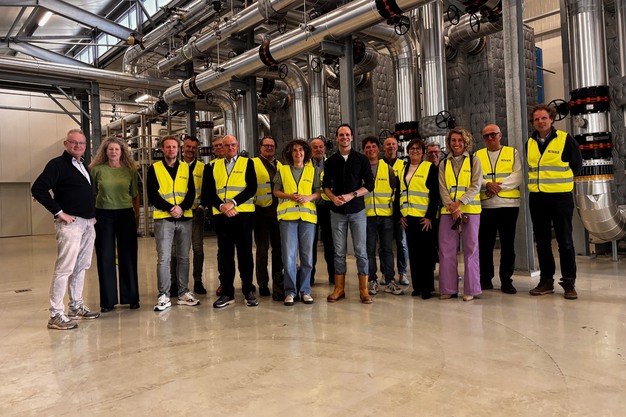
The session opened at Aardwarmte Vogelaer in Poeldijk, one of the larger geothermal projects in the Westland. Peet van 't Zet of Yeager Energy set the tone: "The greenhouse industry put geothermal energy on the map. Without this sector, it would never have developed so quickly."
Aardwarmte Vogelaer started in 2016 with seven growers and has since grown into a network of 32 greenhouse businesses. Today, 140 hectares of greenhouse is heated via a 26-kilometer heat network. Danny van den Berg elaborated: "For most businesses, we replace 60 to 70 percent of their energy consumption. In some cases, we cover it entirely."
The project achieves a CO₂ reduction of 47 kilotons per year, equivalent to the energy consumption of approximately 23,600 homes. Since 2025, it has also supplied geothermal heat to more than 400 households.
The technology is straightforward: water at around 85 degrees Celsius is pumped from deep underground, the heat is transferred via a heat exchanger to distribution water, and then carried through the heat network to end users. "We are currently operating at around 30 megawatts and still have capacity to expand," said Van den Berg. "But distance remains a key factor, heat needs to be applied locally and intelligently."
 © VersPodium
Regional heat network collaboration
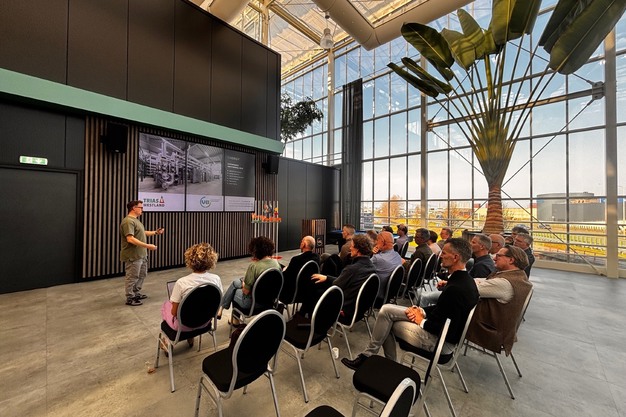
The next step involves connecting projects across the region. "We are working toward a single, interconnected heat network in the Westland," Van den Berg said. "By linking projects together, you make better use of capacity and increase overall impact." The ambition is to connect to a larger regional heat ring, Warmte Netwerk Westland, by around 2027.
Technology and scale at VB
In Naaldwijk, technology company VB offered a look at the engineering side of these projects. Director Nanne Bentvelzen outlined the company's development as it marks its 60th anniversary. "We sit at the intersection of horticulture, climate, and energy, and those worlds are converging."
VB has completed hundreds of projects worldwide. "The scale is increasing," Bentvelzen said. "We are no longer building standalone installations, but complete energy systems." The company is globally active in high-tech greenhouse construction, with a particular focus on the United States and Canada, where growing investor interest is driving larger-scale projects.
Maurice Schouman spoke about the execution of geothermal projects: "We handle everything that happens above ground. VB is the market leader in above-ground geothermal installations in the Netherlands. Success depends on coordination across the entire chain, from drilling to the end user." Applications extend beyond horticulture: VB has also worked on pitch heating systems for sports stadiums, including at Barcelona's famous Camp Nou.
 © VersPodium
Toward a climate-neutral sector
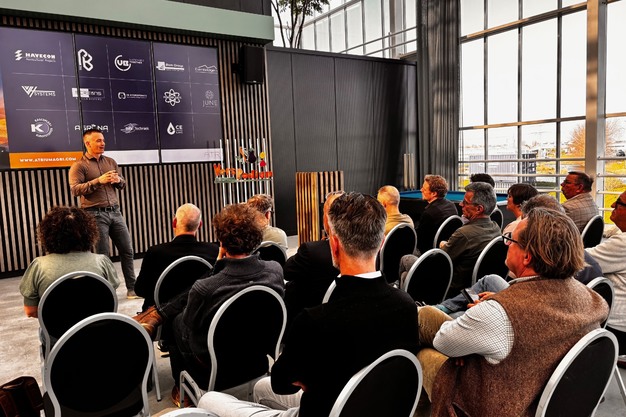
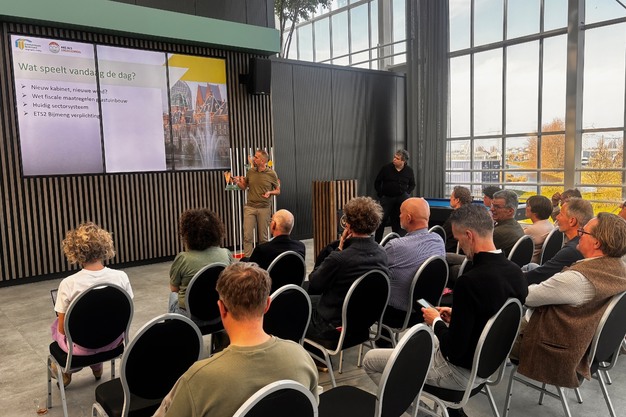
The program concluded with presentations by Robert Solleveld of Kas als Energiebron and Bart van Meurs of Division Q. Solleveld outlined the shared ambition of the sector and government: "The goal is clear: a climate-neutral horticulture sector by 2040." He noted that the energy transition is reshaping the sector at every level: "It affects everything, from energy use to cultivation strategy and the greenhouse climate." Innovation in heat, electricity, and CO₂ management will be central to achieving that goal.
The greenhouse as an energy hub
Van Meurs presented a broader vision for the sector's role in the wider energy system. "We need to think differently, not just about using energy, but about supplying and storing it." He sees significant opportunities for horticulture to function as part of the energy grid: "In summer, we have surplus heat. If we can store that, we solve part of the winter supply problem."
Van Meurs also stressed that innovation must move beyond pilot projects: "Experimental projects inspire, but impact comes from scaling up to the mainstream." He addressed the sector's public image as well: "Horticulture has a story to tell. The innovation and sustainability are already there, it just needs to be communicated more effectively."
 © VersPodium
Continuing the conversation over a vegetable-rich buffet
Reflecting on the session, Maurice Wubben noted that the energy transition in the Dutch greenhouse industry has moved firmly from aspiration to daily practice. The sector is not waiting for the future, it is actively building it.
For more information
VersPodium www.verspodium.nl