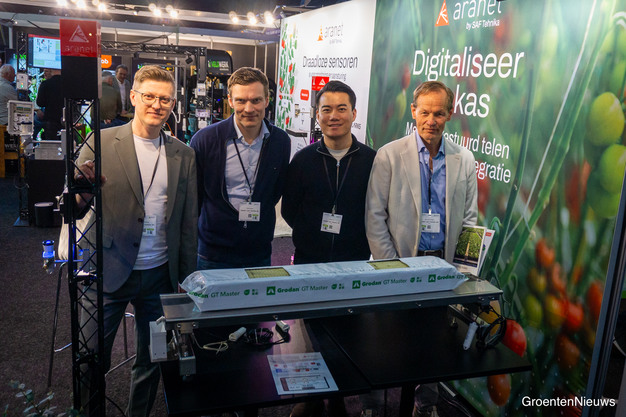
Dutch sensor specialist Aranet is expanding its range of substrate weighing systems to serve a broader range of growing methods. Following requests from growers across different crop sectors, the company has developed new variants for trays, pots, containers, growing mats, and soil-based cultivation. The systems were presented at HortiContact, with a wider rollout planned for GreenTech.
 © Arlette Sijmonsma | HortiDaily.com
Expansion within the existing weighing concept
Substrate weighing has been applied in horticulture for some time. Aranet, known for its wireless sensor solutions, already offered systems for weighing trays, pots, and growing mats. That range is now being extended, explains Erik van der Made.
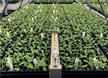
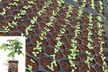
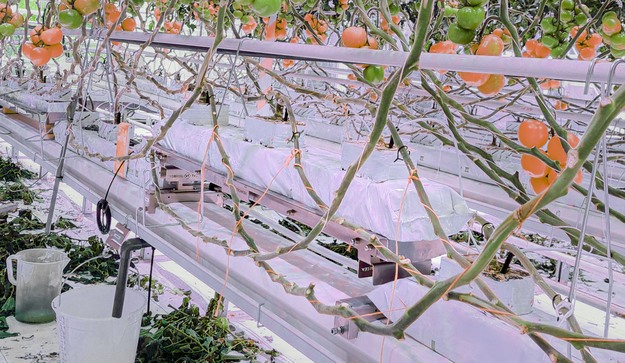
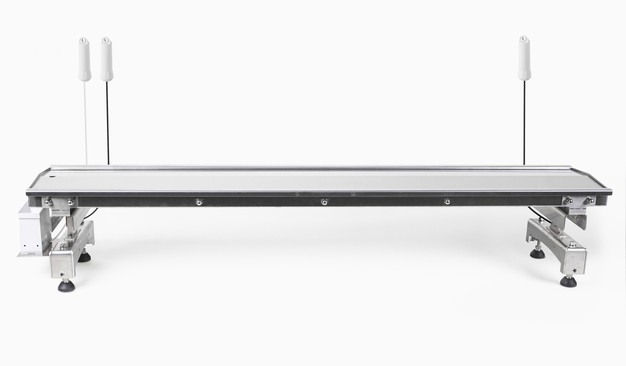
The company has developed a new design in the 40 × 60 cm format, intended for larger trays. "Although many growers work with 30 or 40 cm trays, some companies indicated they use different sizes," says Erik. For growing mats, systems are now available for 2-metre mats, in addition to the existing 1-metre and 1.33-metre versions. This builds on the existing design for measuring multiple mats, for example in tomato cultivation.
 © Aranet
 © Aranet / SAF Tehnika JSC
Container cultivation
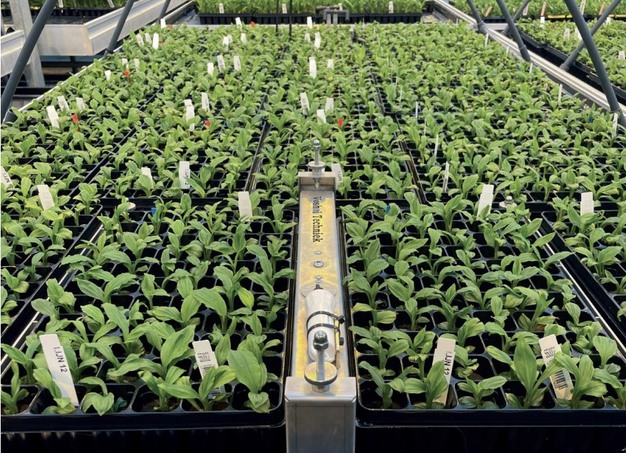
Another addition addresses the weighing of containers. Aranet developed a frame-based construction in which the container is suspended so that it sits at the same height as the other containers on the gutter.
"If you place this system on a gutter, the container ends up sitting higher than the rest," Erik explains. "But you want a representative measurement. That is why we developed a construction in which the container hangs in a frame."
Demand for this solution came primarily from strawberry growers, where container cultivation is widely used and where irrigation strategies are being refined further.
 © Aranet / SAF Tehnika JSC
Soil-based cultivation
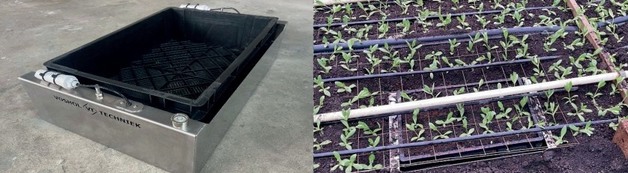
For soil-based crops such as cut flowers, chrysanthemums, lisianthus, and lilies, Aranet developed a built-in solution. A crate is placed into the weighing system and buried in the ground.
 © Aranet / SAF Tehnika JSC
"By weighing that crate, the moisture content is determined based on the rate of drying out," says Erik. The system is available in depths of 21 and 26 centimetres. For measurements at greater depths, Erik advises using sensors that measure at multiple levels.
Aranet sensors in practice
The interpretation of weight data varies by crop. In tomato cultivation, where plants are supported by a wire, most of the plant weight is not resting on the mat. In that case, the mat weight primarily reflects the substrate and the water it contains. In other crops, the weight of the plant itself may also be a factor. "As a crop grows larger, you need to determine exactly what you are measuring," says Erik. "Is it the growth of the biomass, the weight of the fruit, or the moisture in the substrate?"
By combining weight measurements with climate data, growers can analyse crop responses to changing conditions and refine their irrigation strategies.
Weighing is measuring
Aranet's range is focused on collecting data through a wireless measurement network. The systems can record water supply, drain weight, and biomass increase. Combined with climate measurements, the relationship with factors such as Vapour Pressure Deficit (VPD) can also be monitored.
"In many crops, capacitive moisture sensors are used to measure the water content in the substrate. These sensors work with pins that are inserted into, for example, a mat," Erik explains. However, the interpretation of such measurements can vary depending on where the sensor is positioned.
"The distribution of moisture may not be entirely uniform," he says. "As a result, the conclusion drawn from such a measurement may differ from what it would be if moisture were evenly distributed throughout."
Substrate weighing can provide supplementary information, as it tracks the total weight of the mat, substrate, and water. This makes it possible to see how much water is being added and how much is leaving the system through drainage.
Weight and drain in one analysis
Irrigation management often involves monitoring multiple variables simultaneously. In addition to substrate weight, the volume of drain water also plays a role. Combining both measurements provides insight into water uptake by the plant and the moisture content of the substrate.
"Often the question lies in the combination of weighing the substrate and weighing the drain," says Erik. "Those are two variables you get within one system."
Alongside water supply and drain, EC and pH measurements are used to monitor the composition of the nutrient solution. According to Erik, this combination of measurements is applied across various crop sectors, particularly among growers looking to further optimise their irrigation strategy.
For more information: Aranet | Saftehnika
Mobile: +34 6 92121527
Mobile: +31 6 42312633
[email protected]
aranet.com