Every greenhouse grower knows the challenge. Good decisions depend on good crop data. But collecting plant measurements and observations across thousands of plants has always required significant labour and time.
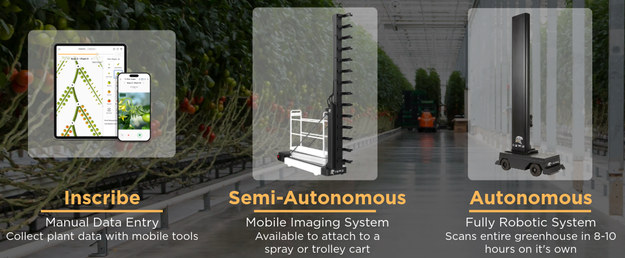
IUNU is announcing an expanded product lineup designed to make large-scale plant data collection possible for more greenhouse operations. The new systems allow growers to collect plant data manually, through semi-autonomous imaging on spray carts or other mobility platforms, or with fully autonomous robots.
 © iUNU Inc
Across its global customer base, IUNU is already measuring between one and two million plants every day across 23 countries. The company says the goal of the expanded lineup is simple: help growers measure more plants and reduce uncertainty in crop forecasting and steering. There is a solution for every grower in this product suite, from low and mid tech all the way up to the highest tech enabled greenhouse grower.
"Growers make important decisions every day about labour, harvest, and sales," said Ethan Takla, CTO of IUNU. "Those decisions are much easier when you have reliable data across the crop. The data collection method may change, but the intelligence behind the forecasts doesn't. That's what makes this a real expansion and not just a new product line."
Three ways to collect plant data
Greenhouses vary widely in labour costs, infrastructure, and technology levels. IUNU says the new lineup allows growers to choose the level of automation that fits their operation today and expand later if needed.
Inscribe
Inscribe is designed for operations where labour is available and capital investment is limited. Workers record crop measurements using mobile tools that feed directly into the LUNA AI platform.
Even without automated hardware, growers receive analytics, yield forecasting, and crop planning tools based on the collected plant data.
Semi-autonomous scanning
Semi-autonomous systems collect plant data while workers perform normal greenhouse tasks. The imaging system can be mounted onto equipment already used in the greenhouse, including trolleys, spray carts, or scissor lifts. As workers move through the rows, the system automatically captures images and measures plants. This approach allows growers to gather large amounts of plant data without adding workers assigned specifically to crop scouting.
Autonomous robots
For operations focused on reducing labour requirements, IUNU also offers fully autonomous crop-scanning robots. These robots move independently through greenhouse rows and collect plant measurements without human operation. With battery life of 8 to 10 hours, the robots can scan large areas of the greenhouse overnight. When growers arrive in the morning, updated crop measurements and yield forecasts are already available.
From plant measurements to operational decisions
All three data collection methods connect to the LUNA AI platform, which turns plant measurements into operational insights. The system tracks crop development and produces rolling yield forecasts six to eight weeks in advance. Semi-autonomous and autonomous systems achieve 99% accurate crop registration, allowing forecasts to be built from real plant measurements rather than estimates.
Earlier visibility helps greenhouse teams plan staffing, packaging, shipping, and sales commitments before problems affect supply. And for IUNU, crop monitoring and yield forecasting are only part of the picture.
Building the operating system for greenhouses
The expanded lineup reflects IUNU's broader vision to become the operating system for greenhouse operations. The platform already supports crop monitoring and yield forecasting. New modules extend that visibility into supply and demand planning, labour quality, and crop scouting workflows, giving growers a single platform to drive profitable outcomes.
"The bare minimum an AI company should provide is a yield forecasting model," Adam Greenberg, CEO of IUNU, said. "We did two forecasts in parallel: one comparing manually collected data from 0.001% of the crop and the other from accurate data collected automatically using computer vision data from over 10% of the crop. When comparing these two simulations, the forecasting model using computer vision came out 11% more accurate 4+ weeks in advance."
Regardless of how the data is collected, the goal remains the same: measure more plants, reduce uncertainty, and give growers clearer visibility into what is happening across the crop.
For more information:
IUNU
[email protected]
iunu.com