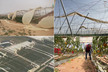
Uzbekistan plans to restrict the establishment of new greenhouse complexes in Tashkent and its surrounding areas starting October 1, 2026. The initiative involves relocating production to regions with milder climates to reduce production costs and minimize environmental impact.
Data indicates that a significant concentration of greenhouses in the Tashkent region currently utilizes coal and fuel oil. The emissions of pollutants such as NO₂, SO₂ and PM2,5 have significantly affected air quality. In 2024, reports indicated that 60% of greenhouses in the area relied on coal as their primary heating source.
The region also faces lower solar insolation levels compared to southern provinces, which increases operational expenses. For instance, the average January temperature in Tashkent is approximately +6°C, whereas in Termez it reaches +10.8°C. Consequently, the production cost of 1 tonne of greenhouse produce in the Tashkent region is 11.9 million UZS (€861), while in the Surkhandarya region, it is 4.9 million UZS (€354).
To optimize efficiency and stabilize domestic market prices, the government is promoting the transition to areas with higher solar activity. A dedicated agropark of at least 940 hectares is planned for the Sherabad district of the Surkhandarya region, characterized by milder winters and lower heating requirements. Additional agro-clusters of at least 200 hectares will also be established in the Surkhandarya region to accommodate relocated facilities.
Under the 2026 state program, 6,517 greenhouse enterprises in the Tashkent area will be required to either install filtration systems or relocate. Entities that move to the designated clusters will be eligible for subsidies of at least 1 BCA, or 412,000 UZS (€30) per 100 square meters, alongside incentives related to infrastructure, credit, and logistics.
Source: www.gazeta.uz