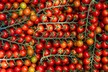
Looye is learning how Sera's Greenhouse Intelligence platform can help growers interpret complex crop data more easily and maintain the consistently excellent flavour that makes Honeytomatoes exceptional.
"High-tech cherry tomato cultivation is among the most demanding disciplines in protected horticulture. Achieving the intense sweetness that consumers love requires pushing the plant to its limits: high EC irrigation strategies, precise climate control, and a deep understanding of how dozens of interconnected variables interact across the growing cycle", says Sera co-founder & CRO Florin Munteanu. "The challenge is that the very conditions that produce exceptional flavour also make the crop incredibly sensitive. Small deviations in climate, irrigation timing, or nutrient balance can trigger quality losses that only become visible weeks later. By the time a grower spots the issue, the window for correction has often already passed."
He explains that for Looye Kwekers, one of Europe's leading premium tomato producers and the grower behind the beloved Looye Honeytomatoes, maintaining that exceptional flavour season after season is both the defining goal and the central challenge. "With decades of expertise and state-of-the-art facilities, the team has built an outstanding reputation; yet the sheer complexity of the interactions involved makes it difficult to catch every developing risk pattern in time."
The complexity behind flavor
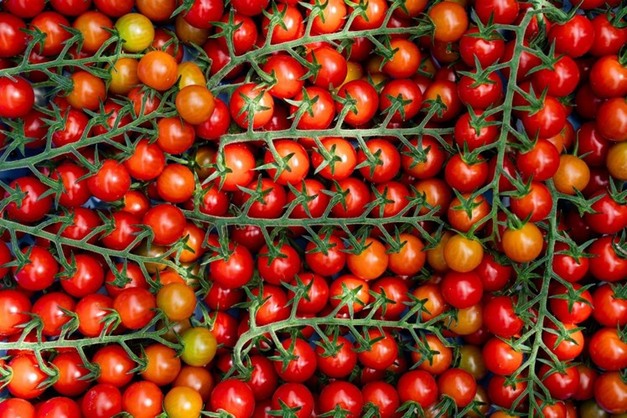
Producing consistently flavourful cherry tomatoes is a balancing act. High sugar content (Brix) means the fruit is under constant osmotic pressure. The skin is naturally thinner and more delicate. Environmental shifts that would be harmless in a standard tomato crop can compromise quality in a high-Brix variety.
"The real difficulty is that the factors involved don't act in isolation. Irrigation timing, substrate moisture dynamics, transpiration rates, light intensity (natural and artificial), temperature transitions, and nutrient uptake all interact. A decision made at 5 :00 in the morning can have consequences that only manifest three to four weeks later. Traditional monitoring tools show each variable independently, but they don't reveal the causal chains connecting them," Florin explains.
This is especially true during LED-lit winter periods, when the relationship between light, heat, and transpiration behaves differently than under natural sunlight. Conventional dashboards may show all parameters within normal ranges while the crop is silently accumulating stress.
 © Sera Intellegence
At Naaldwijk
Rather than adding more sensors or more manual review cycles, Looye started working with Sera's Greenhouse Intelligence platform at their Naaldwijk location. The goal was to explore how structured data analysis can support daily crop management, and deepen the grower's understanding of the complex interactions that shape crop quality.
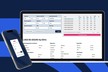
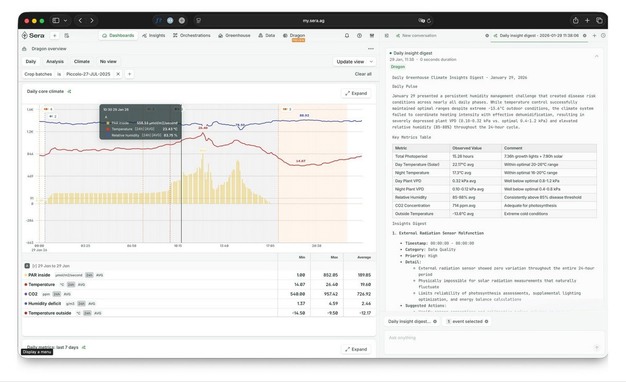
The system brings together climate data, irrigation patterns, substrate dynamics, drain analysis, and crop development records, making it far easier to interpret all available information in one place. Because the data is drawn from the previous day's measurements, it provides a structured, retrospective view of what happened across the growing system and what patterns may be forming.
"Instead of showing individual parameters in isolation, the system helps trace how different factors relate to one another over time. Patterns that might otherwise require hours of cross-referencing across spreadsheets and dashboards become quicker to recognise. When the system identifies a developing risk pattern, it generates specific, actionable recommendations (e.g. adjust irrigation timing, modify volumes, change climate set points) each connected to a measured causal factor," Florin says.
 © Sera Intellegence
Supporting the grower's expertise
"The value of Greenhouse Intelligence lies not in replacing expertise, but in making it easier to apply. The grower remains at the centre of every decision. What the platform provides is clearer insight into the available information, faster recognition of developing patterns, and stronger decision support at the moments it matters most," says Florin.
Rather than representing a broad shift in how the operation runs, the platform complements the existing way of working. The grower's knowledge, experience, and intuition remain the foundation; Greenhouse Intelligence adds a layer of structured analytical support on top of that.
What is already clear is that working with the platform builds a richer understanding of how the crop responds to complex combinations of conditions.
What this means for the industry
The premium segment of fresh produce is growing. Consumers are willing to pay more for flavour, and retailers are responding with differentiated product lines. But delivering on that promise consistently, week after week, season after season, requires a level of precision that exceeds what conventional tools can provide.
The shift from dashboard monitoring to Greenhouse Intelligence represents a new direction for protected horticulture. When growers can identify quality risks at the physiological level and act on them with greater confidence, the entire value chain benefits: less uncertainty, stronger decision support, and a better chance of delivering the highest-quality product to the consumer.
"For premium growers, the question is no longer whether intelligence technology has a role in the greenhouse. It is how to integrate it effectively and how to build the experience and understanding needed to make the most of what it offers."
For more information:
SERA
Florin Munteanu
Co-founder & CRO
[email protected]
+40722674911
www.SERA.ag
LinkedIN SERA
Looye Kwekers
Tel.: +31 (0)174 520 060
E: [email protected]
www.looye.com