A Dutch company based in Wateringen, in the Netherlands' greenhouse region, is scaling up its CO₂ capture technology across multiple industries while continuing to develop applications for the greenhouse sector.
Verkade Carbon Capture, a spin-off of Verkade Klimaat, first encountered CO₂ capture technology through a Canadian grower who had begun experimenting with it. This eventually led to the construction of a demonstration unit at the company's home base in Wateringen, where CO₂ capture from a wide range of gas streams has been tested.
Two projects are now underway at aluminium smelters abroad, where CO₂ is captured as a byproduct of the production process. Closer to home, a related application is being deployed at two Dutch livestock farms, a dairy operation and a combined cattle and pig farm, where CO₂ is stripped from biogas and the remaining methane is upgraded for injection into the natural gas grid.
Proven technology
"We were early movers, certainly at this scale," says Managing Director Pieter Kruijt. The underlying technology, using a solvent to absorb CO₂ from a gas stream, then applying heat to release and recover it, has existed for decades. However, its use outside the gas industry has until recently remained very limited. For the large industrial players active in that sector, the greenhouse industry represents too small a scale to be commercially interesting.
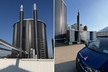
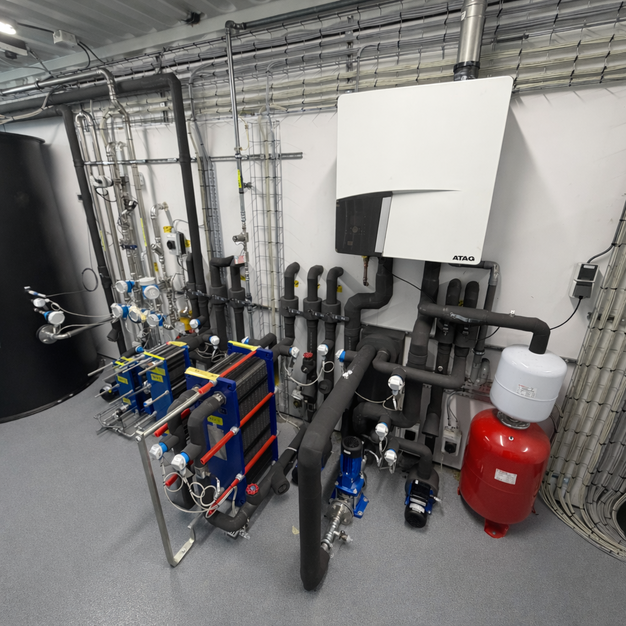
In 2019, Verkade Klimaat built a demonstration unit in a 20-foot container. "We ran all kinds of tests and captured CO₂ from various gas types," Kruijt explains.
 © Verkade Carbon CaptureAdding horticultural expertise
What sets Verkade Carbon Capture apart, according to Kruijt, is its combination of CO₂ capture technology with specific knowledge of greenhouse installation systems and the ability to calculate viable business cases for protected horticulture projects.
"We have developed our technology so that it integrates well with the systems of a greenhouse operation. We also manage to recover the heat generated during the CO₂ capture process and feed it back into the greenhouse. That way, the energy required for CO₂ capture is no longer a cost. Integrating heat flows into existing heating systems, that is where our strength lies."
CO₂ cost price
The financial calculation remains a hurdle in the greenhouse sector. According to Kruijt, the current cost of purchasing CO₂ in the Netherlands is broadly comparable to the cost of capturing it on-site. The business case becomes stronger as CO₂ prices rise.
That is expected to happen as sustainability pressures mount. There is also a potential supply risk, as significant volumes of CO₂ are set to be pumped into the North Sea seabed with government support, reducing availability for greenhouse growers. "We are currently working through business cases for clients. We may be just slightly ahead of the market, but the interest is certainly there."
New projects in 2026
At the aluminium facilities, the CO₂ concentration in flue gases is relatively low despite the large volumes produced, a combination that demands a carefully matched solvent and energy level. "These projects will help us determine which combination works best. After that, we can scale up to capturing 20 to 80 tonnes of CO₂ per hour," Kruijt says.
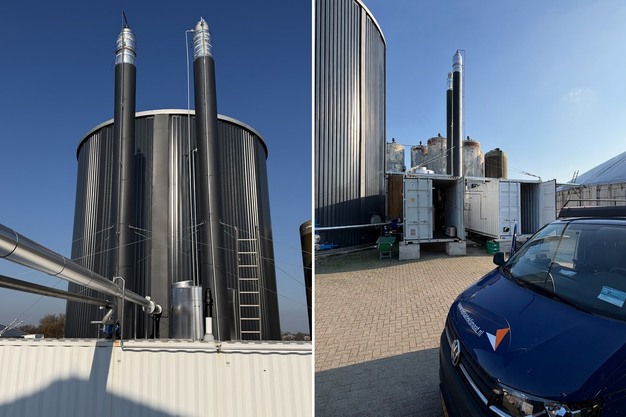
The two Dutch biogas projects illustrate another potential route to supplying green CO₂ to the greenhouse sector. By capturing emissions from cattle digestion and upgrading the resulting biogas, the process yields both biomethane, usable as green fuel, and CO₂ that could eventually be supplied to greenhouses. "This CO₂ from biodigestion is green CO₂," Kruijt notes.
 © Verkade Carbon Capture
Upgrading biogas
The aim of Verkade Carbon Capture was and is to make CO₂ available for horticulture. In the long run, two projects in the Netherlands, in another agricultural sector, may contribute to this. Due to political choices, the livestock population in the Netherlands is under pressure. By capturing the gases emitted by cows after eating grass, biomethane can be created as green gas for fuel and CO₂ that can be used in greenhouses. "This CO₂ from biogas production is then green CO₂."
We are not there yet. For the two Dutch projects, they are still awaiting the signal from the grid operator in mid-February that upgraded methane can be fed back into the gas grid. The installation provided by Verkade Carbon Capture is ready to operate.
"The drive to become more sustainable is opening up opportunities across different sectors," Kruijt concludes. With its roots firmly in horticulture, the company is looking forward to its first greenhouse projects. "Everything we needed to test, we have already tested with our demonstration unit in Wateringen."
For more information:
Verkade Carbon Capture
Turfschipper 2
2292 JA Wateringen
[email protected]
www.carboncapture.nl