Every summer, various greenhouse tomato growers encounter a familiar and costly issue: Blossom End Rot (BER). What begins as a small, dark lesion at the blossom end of the fruit often develops into a sunken, necrotic area, rendering fruit unmarketable and reducing overall yield. The standard diagnosis has long been straightforward — calcium deficiency. However, as Remzi Çakmak, Greenhouse Manager at Turkish Yücel Eko Tarım, explains, this assumption may be misleading.
"For decades, BER has been directly linked to calcium deficiency," he shares. "It's one of the first things growers learn, and one of the hardest assumptions to challenge." In response, growers typically increase calcium concentrations in the nutrient solution. While this strategy can sometimes mitigate the issue, it frequently fails to resolve it entirely.
According to Remzi, the real issue in many cases is not calcium deficiency, but nutrient imbalance, specifically, excess potassium. "This is not a deficiency problem. It's an imbalance problem," he notes. "And the difference matters enormously when it comes to making the right correction."
 © Yücel Eko Tarım
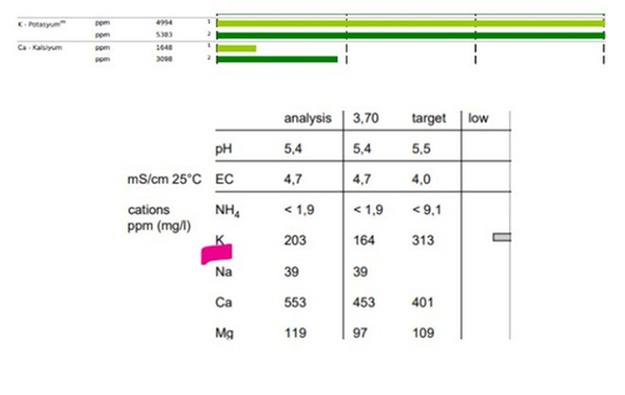
Their drainage and SAP analysis results — note the K (potassium) row showing the discrepancy between drainage readings and actual plant status
Potassium–calcium antagonism
Potassium (K) and calcium (Ca) are both positively charged ions (cations) that compete for uptake through the plant's root system. When potassium levels are elevated in the root zone or within plant tissues, they can inhibit calcium absorption. "Even if there is plenty of calcium available in the nutrient solution, the plant physically struggles to take it up because potassium is dominating the transport channels," he explains.
This competitive interaction can lead to calcium transport deficiencies within the plant, particularly in rapidly developing tissues such as fruit. Since calcium is essential for cell wall integrity, insufficient delivery results in tissue breakdown — the hallmark of BER.
Contradictory data: Drainage vs. SAP analysis
A recent case at Yücel Eko Tarım highlighted the limitations of relying solely on conventional monitoring methods. Routine drainage analysis indicated low potassium levels in the root zone — typically interpreted as a need to increase potassium supply. However, concurrent SAP (plant sap) analysis revealed a contrasting reality.
"The plant's internal sap was already loaded with potassium, well above optimal levels. The plant wasn't hungry for K at all. It was saturated."
This discrepancy underscores a critical point: drainage analysis reflects what remains in the root zone, not what has been absorbed by the plant. "The low reading in the drainage wasn't a sign of deficiency but a sign of efficient uptake," he explains.
Had the team relied solely on drainage data, additional potassium would have been applied, exacerbating the imbalance. "If we had relied on drainage alone, we would have added more potassium — pushing the plant further into imbalance, blocking calcium uptake even more, and making BER worse."
The "empty plate" misinterpretation
Remzi illustrates this concept with a practical analogy: "Adding potassium just because drainage looks low is like serving more food to someone who's already full." He elaborates, "The plate is empty because the food has already been consumed, not because more is needed."
This misinterpretation can lead to over-fertilization, particularly in high-efficiency systems where plants rapidly absorb available nutrients. Excess potassium accumulation then intensifies competition with calcium, directly contributing to BER development.
Limitations of single-source monitoring
While drainage analysis remains a valuable tool, Çakmak emphasizes its limitations. "Drainage tells us what's happening around the roots — the nutrients the plant hasn't used. But it cannot tell us what's happening inside the plant."
A low nutrient concentration in drainage can indicate either insufficient supply or highly efficient uptake. Without additional context, distinguishing between these scenarios is not possible. "Without looking inside the plant, we have no way of knowing which scenario we're dealing with," he says.
The potassium trap cycle
This misinterpretation can trigger a self-reinforcing cycle. Elevated internal potassium reduces uptake demand, leading to lower concentrations in drainage. Growers interpret this as deficiency and increase potassium supply. The resulting excess further suppresses calcium uptake, ultimately leading to BER.
"This is the potassium trap," he remarks. "A self-reinforcing cycle where misreading drainage data leads to actions that make the situation progressively worse."
Toward integrated nutrient management
To avoid such scenarios, Remzi advocates for a more integrated approach to nutrient monitoring. "Modern greenhouse production demands more than single-source decision making," he states. "The interaction between nutrients, particularly the K-Ca antagonism, is too nuanced to be captured by one measurement."
Combining drainage analysis with SAP analysis provides a more complete understanding of plant nutrition. "Drainage tells you what's around the roots. SAP tells you what's happening inside the plant. Only by reading both together can we truly understand what the plant actually needs."
For more information:
Yücel Eko Tarım
Remzi Çakmak
[email protected]
yucelekotarim.com.tr