For decades, much of agricultural innovation has focused on genetics, plant nutrition, and irrigation systems. Yet one fundamental element of crop production has often remained in the background: the soil itself. New agronomic technologies are now seeking to bring this resource back to the center of production systems by improving soil structure and its capacity to support intensive agriculture.
One company working in this direction is Ground Improver, which has developed a technology aimed at restoring the physical functionality of soils and supporting root development. "In many intensive agricultural systems the soil has largely been treated as a simple physical support," the company explains. "This approach worked for a long time, but the consequences are now becoming visible: compaction, loss of structure, reduced infiltration capacity, and a gradual decline in biological activity."
 © Sarayut Thaneerat | Dreamstime
According to the company, improving soil structure helps promote the formation of stable aggregates and restore a more granular structure. This change has direct implications for root system performance. "It improves the circulation of water and air in the soil profile, reduces compaction, and allows roots to explore a larger soil volume. From an agronomic perspective, this means the crop can use available resources more efficiently."
Greenhouse trials show more uniform crop development
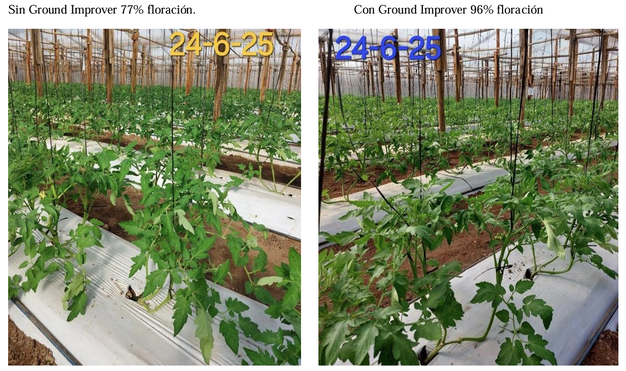
Several agronomic trials indicate that optimizing soil structure can lead to more uniform plant development. In a pilot trial carried out in 2025 in greenhouse tomato production, treated plots were compared with untreated control areas. Differences in plant behavior were already visible during the early stages of the crop.
At the stage of the first flowering cluster, 96% of plants in the treated plots had reached flowering, compared with 77% in the untreated area. Later, during the fruit set stage of the first cluster, 91% of treated plants had developed the cluster, compared with 78% in the control plot. "These results indicate more homogeneous vegetative development in areas where the soil structure had been improved, which may translate into greater production stability throughout the crop cycle."
 © Ground improver
Yield increases in several crops
Trials conducted in other production systems show similar trends. In greenhouse trials in Mexico involving crops such as zucchini and strawberries, notable production increases were recorded. In zucchini, the application of 10 kg per hectare increased total yield from 3.23 t per hectare in the control plots to 4.75 t per hectare, representing an increase of 47%.
In strawberry trials, yield rose from 10,289 kg per hectare to 14,536 kg per hectare, an increase of 41%. The results were also accompanied by a higher number of fruits per plant and a greater average fruit weight.
Positive results have also been observed in open field crops. Trials in maize fields recorded yield increases together with higher soil moisture levels in treated plots, suggesting that improved soil structure may influence both water availability and crop development.
Water and fertilizer savings
Another important aspect is resource efficiency. In a field trial in potato production, water savings of 15% were recorded during the early stages of the crop, together with an 11.7% increase in the field capacity of the treated soil.
From an economic perspective, the use of the soil conditioner also allowed a reduction in fertilizer use, with estimated savings of €438.25 per hectare, pointing to improved efficiency within the production system.
 © Ground improver
Applications in intensive systems and light soils
In many intensive farming systems, particularly those based on light or sandy soils, nutrient leaching represents one of the main agronomic challenges.
"When soil structure is poor, water can move quickly into deeper layers, carrying nitrates and other nutrients away from the root zone," the company explains. "Improving soil structure promotes a more balanced distribution of water in the soil profile and increases the time water remains available to the roots, allowing plants to absorb nutrients before they are lost through deep drainage."
According to the company, the product acts exclusively on the physical properties of the soil rather than directly on the plant. Due to the size of the polymer molecules, they cannot penetrate plant tissues, meaning the effect takes place only in the root environment.
High value greenhouse crops are another important application area. In these systems, maintaining the right balance of water, oxygen, and nutrients in the root zone is particularly delicate, and even small improvements in soil structure can have a direct impact on root development and crop stability.
In a context marked by climate change and increasing water scarcity, soils with stronger physical properties could become a key factor in the resilience of agricultural systems.
Bringing soil management back to the center
In countries with highly intensive and technologically advanced agriculture such as Spain, interest in these solutions is gradually increasing. For many years, however, soil management has often taken a back seat to more immediate agronomic tools such as fertilization or crop protection.
Field experience is gradually changing that perception. As growers observe how small improvements in soil structure influence crop performance, interest in these technologies continues to grow.
"There is increasing awareness that long term production stability depends to a large extent on the physical and biological condition of the soil," the company concludes. "In the end, everything begins and ends in the soil. When farmers succeed in getting their soil to function well again, many of the agronomic decisions that follow become easier."
 © Ground improverFor more information:
Ground Improver
Calle Eros, 1 C.C. Arenal Golf
29631 Benalmádena (Málaga)
[email protected]
www.groundimprover.es