Marc Groenewegen of South West Growers in the Netherlands describes himself as a grower driven by cost price and production efficiency. Tomato cultivation is his passion. Following a merger with a fellow grower, he now operates across multiple sites in Lepelstraat and Sirjansland, in the province of Noord-Brabant and Zeeland respectively. Alongside his work as a grower, Marc also works as a consultant and visits operations in Australia and New Zealand, trips that have given him new insights into CO₂ management.
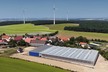
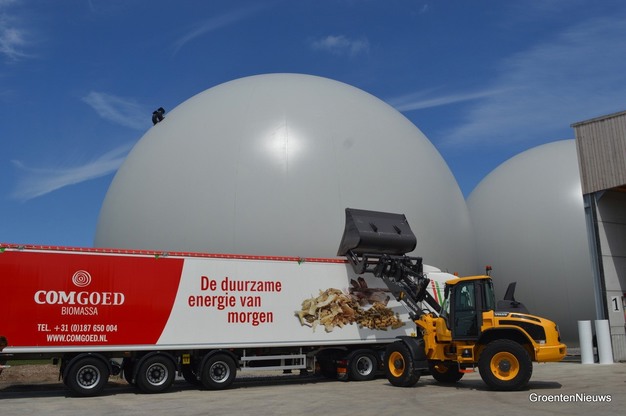
Visitors arriving at the greenhouse site in Sirjansland are greeted by two large storage tanks. The balloon-style vessels are filled with CO₂ captured from an on-site biomass plant.
Marc initiated the project together with his brother Arnold and colleagues from DT van Noord Tomaten and aubergine propagator Van Duijn. In 2017, the group established Duurzame Energie Sirjansland (DES). The facility was officially opened in June 2019.
 © Thijmen Tiersma | HortiDaily.com
Image from the opening of DES in June 2019
The project originated from a need for heat. The growers wanted to reduce their dependence on natural gas and saw biomass heat as a viable path. The potential for on-site CO₂ production emerged later as an added benefit.
"When we started, we were not yet aware of the CO₂ capture option," Marc says. The group ultimately chose a technology developed by Frames, now continued by Green Gas & Liquids. "At the time, Frames was already capturing CO₂ for customers such as soft drink manufacturers."
Production gains from higher CO₂ levels
Marc's reconnection with Green Gas & Liquids came not through DES, but during his travels to Australia and New Zealand. One grower he visited was exploring ways to move away from natural gas. Geothermal energy proved a strong option. "They also have a very favourable growing climate there, with high levels of natural light even in winter," he notes.
CO₂, however, presented a challenge. "Production levels there were lower than I would have expected, given how favourable the growing conditions are." To increase yields, growers in New Zealand were importing liquid CO₂ from Asia. "That is extremely expensive," Marc observes. This prompted the growers to investigate producing their own CO₂.
The New Zealand operation now uses anaerobic digestion combined with CO₂ capture, dosing a blend of biologically sourced CO₂ and CO₂ drawn from outdoor air. This keeps greenhouse CO₂ levels at least at ambient outdoor concentrations, something that had not previously been guaranteed. "Bringing CO₂ up to outdoor levels gives the biggest single jump in production," Marc notes.
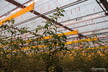
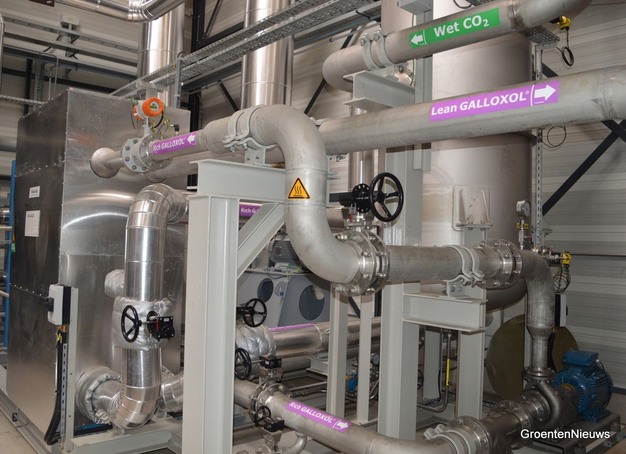 © Thijmen Tiersma | HortiDaily.comA look inside DES during 'Kom in de Kas' 2023
Various CO₂ sources
South West Growers also draws on several CO₂ sources in the Netherlands. At Sirjansland, DES is the primary supply. The growers supplement this with CO₂ from combined heat and power (CHP) units, and on occasion use liquid CO₂ from a tank, a legacy of the period before DES was operational. This liquid CO₂ is used to top up supply during brief intervals when drawing from DES is not practical.
At Lepelstraat, CO₂ comes from CHP units and is also delivered by road tanker to fill an on-site storage tank. "When I first visited this site, the cost of the tanker-delivered liquid CO₂ came as something of a shock," Marc admits.
To make optimal use of DES, the participating growers developed a shared management system. Each grower can draw CO₂ according to need, with surplus stored in buffer vessels. The installation started with two balloon-style tanks; a third has since been added. The newest tank is less prominent, it lies horizontally, screened by a green border planting.
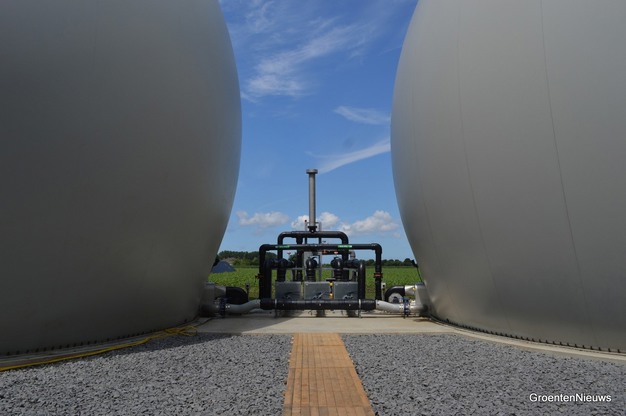 © Thijmen Tiersma | HortiDaily.comTwo of the three balloons for CO₂ storage. A third has been added and is hidden in a green belt.
Benefits in cultivation
"The value of DES CO₂ is enormous. In hindsight, it was the right decision," Marc says, while acknowledging that it has also required substantial investment. The expectation is that returns will materialise over the long term, though patience is required.
"The number of profitable operating hours for CHP units is falling," he notes. Industrial CO₂ supplies are also under pressure, with plans to store CO₂ beneath the North Sea reducing availability. Liquid CO₂ is becoming scarcer and is expected to become significantly more expensive. "That makes DES increasingly important for us."
In the greenhouse, Marc sees clear advantages from using biomass-captured CO₂. Monitoring data from an in-house air quality sensor, which measures concentrations of harmful combustion gases — consistently shows lower NOx and ethylene values with DES CO₂ than with CHP-sourced CO₂, even as CHP technology has become cleaner. "DES CO₂ is very clean."
The cleaner supply allows him to apply higher CO₂ concentrations with confidence. In the past, NOx levels sometimes climbed too high during CHP operation, a particular concern for young plants. "With DES, we can dose more CO₂ more easily."
Flexibility is another advantage. The buffer system allows CO₂ to be dosed at the optimal moment, with modulating control, something not possible with CHP units, which operate on an all-or-nothing basis. "With DES, we can supply exactly the right amount of CO₂ in response to light levels or temperature, precisely matched to the plant's needs," Marc explains. He primarily doses on light but also monitors vapour pressure deficit (VPD). Working with their climate computer supplier, South West Growers has refined the system further. "We now continue dosing CO₂ even at high temperatures, provided VPD and relative humidity are within range."
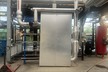
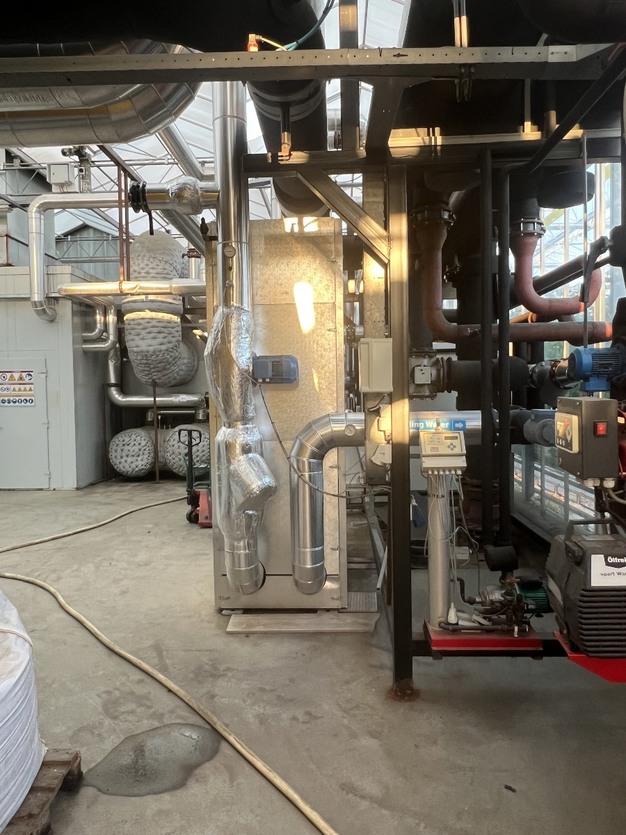
 © South West GrowersThe heat exchanger at South West Growers
Unique product
At Sirjansland, CO₂ availability is not a constraint — yet Marc remains deliberate in its use. High-volume dosing is not an end in itself, he emphasises. On overcast days with very low solar radiation, dosing large amounts of CO₂ makes little agronomic sense, and the buffer absorbs the surplus.
The biomass plant also runs at reduced capacity in summer, when heat demand falls. Output is similarly reduced when connected growers are between cropping cycles, or during periods of high electricity prices when CHP units are running to help stabilise the grid.
All growers connected to DES also operate CHP units. This proves particularly useful for Marc's neighbour Van Noord Growers, who runs a lit winter crop. "He needs electricity and runs his CHP accordingly. The heat produced is buffered and can also be used by us. Energy management has become quite dynamic," Marc remarks with understatement.
 © South West Growers
At the core of it, though, Marc is simply passionate about tomatoes. He regularly observes significant production differences between neighbouring growers, differences he partly attributes to CO₂ strategy. He also notices variation between his own two sites, which use different CO₂ sources. "My father put some of it down to wind, there is always more air movement in Sirjansland than in Lepelstraat. The crop at Sirjansland always looks more vigorous, more upright and more generative. My own view is that CO₂ plays a significant role in that."
Photo right: Heat exchanger at South West Growers
His experiences in Australasia have reinforced this conviction. "CO₂ has a major impact on crop performance." Sensor data from the Trutina system by Gremon Systems, which Marc has been using to optimise irrigation, showed a stronger and faster increase in biomass and dry matter accumulation compared with benchmarked peers. "DES CO₂ is clean, always available, and can be dosed with precision. That makes it a genuinely unique product." And, not insignificantly: "It is also considerably cheaper than liquid CO₂ delivered by tanker."
For more information:
Marc Groenewegen
South West Growers
[email protected]
www.southwestgrowers.nl
Green Gas & Liquids
[email protected]
www.greengasliquids.com