At a tomato grower event in the Netherlands, one grower's comment that he was currently experiencing no problems with the predatory bug Nesidiocoris tenuis (commonly known as Nesi) immediately drew the full attention of everyone in the room. What was he doing differently?
The question arose shortly after specialists from Biobest and Koppert had concluded their joint session by stating that managing Nesi represents an enormous challenge. Putting it plainly, crop protection specialists described the situation as "simply a disaster."
The most that growers can realistically achieve is keeping Nesi populations under control. Complete eradication is not possible with current strategies. That said, work on new approaches is ongoing, and out-of-the-box thinking is actively encouraged.
 © Thijmen Tiersma | HortiDaily.com
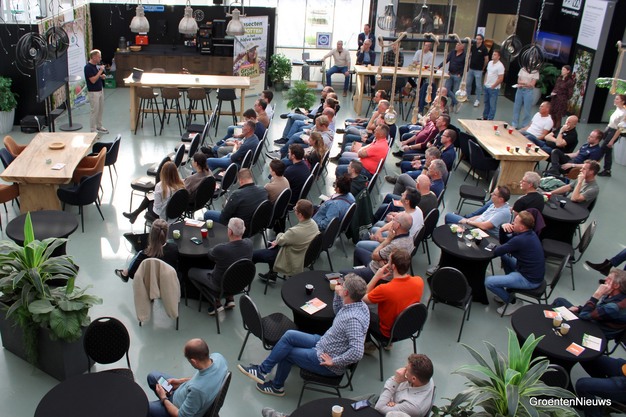
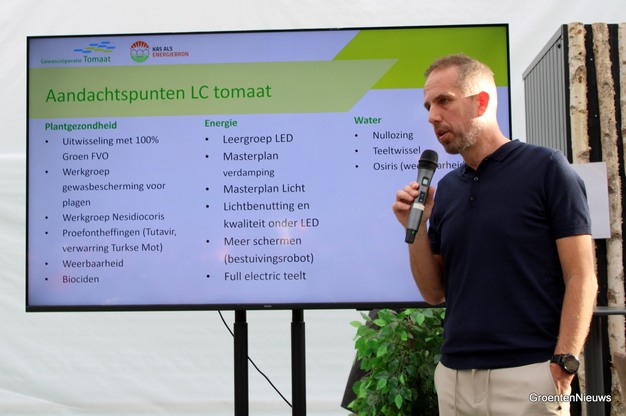
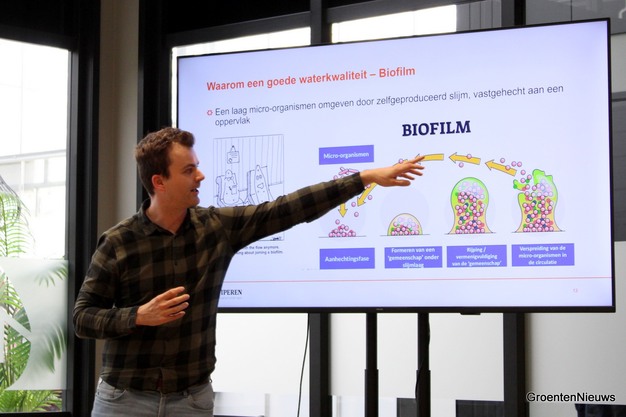
At the invitation of Van Iperen, tomato growers had come to HortiTech in Honselersdijk for a Tomato Day. Growers were updated on crop protection developments, received a presentation on the use of biocides, and during the plenary session, there was a presentation by Robert Solleveld on behalf of Glastuinbouw Nederland and Kas als Energiebron. He discussed energy developments, Kas als Energiebron, and what the industry organization is working on with tomato growers when it comes to tomato cultivation specifically.
 © Thijmen Tiersma | HortiDaily.com
Robert Solleveld spoke on behalf of Glastuinbouw Nederland about Kas als Energiebron, among other things
An unwanted vegetarian
The event was organised by Van Iperen and took place at HortiTech in Honselersdijk. Both Biobest and Koppert addressed the challenge Nesi poses in tomato cultivation. While the predatory bug is used as a biological control agent in North Africa, the same species behaves primarily as a plant feeder in Dutch greenhouses. When populations grow too large, crop damage follows.
Growers are trying every available method to prevent Nesi damage. The range of approved crop protection products is shrinking. As a result, growers are increasingly turning to mechanical control methods — including manually crushing the bugs or using a fan mounted on a pipe rail trolley to blow Nesi out of the crop in one row onto sticky tape in the adjacent row.
 © Thijmen Tiersma | HortiDaily.com
Bas Vriend from Van Iperen spoke at the event
Lighting makes control harder
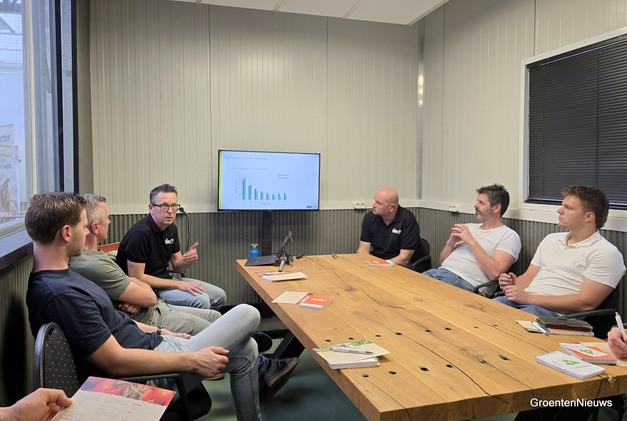
Jeffrey van den Akker and Marcel Verbeek of Biobest focused their presentation on keeping Nesi populations manageable. Thorough monitoring is essential, though this is complicated by the fact that Nesi nymphs in early developmental stages are difficult to distinguish from the beneficial predator Macrolophus. A further complication is that at high greenhouse temperatures, Nesi develops faster than Macrolophus populations that growers have deliberately introduced.
In unlit cultivation, growers are currently achieving better control of Nesi than in lit production. The Biobest specialists noted that growers sometimes inadvertently become Nesi propagators themselves. Even screening greenhouses with insect netting does not always help: if a greenhouse is not completely clean, Nesi populations will naturally recover once conditions are favourable. The most severe problems are seen in areas with a high concentration of tomato nurseries, although Nesi also occurs in other fruiting vegetables and is capable of surviving outdoors.
 © Thijmen Tiersma | HortiDaily.com
Jeffrey van den Akker and Marcel Verbeek from Biobest address a group of growers about controlling Nesi.
Research into alternative control
Some chemical intervention products remain available to combat Nesi, but Biobest specialists are clear that these no longer provide full control, partly because the products effective against Nesi also affect Macrolophus, which is widely used to control whitefly.
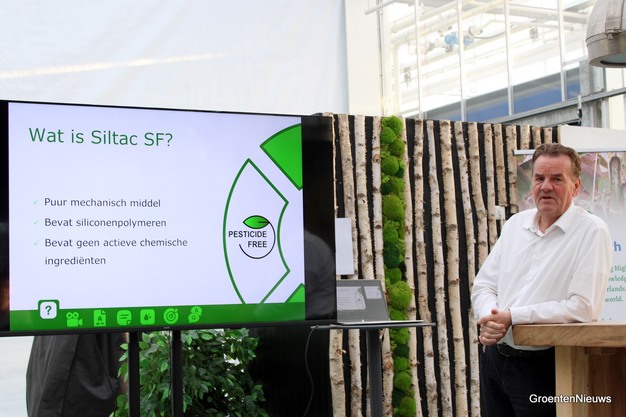 © Thijmen Tiersma | HortiDaily.com
Harry Schouten spoke on behalf of ISA CropCare
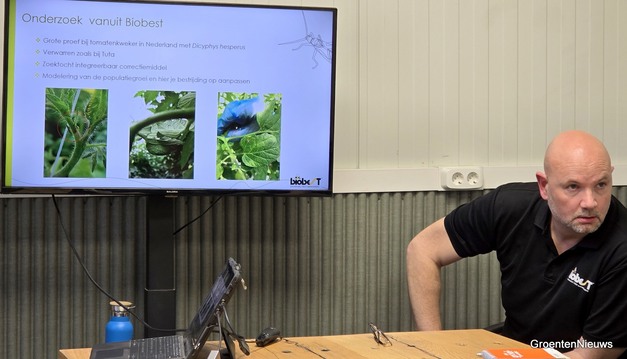
Biobest is currently investigating whether Dicyphus, a predatory bug that has proven effective in other crops, could also be deployed against Nesi in tomatoes. Additional research is focusing on pheromone-based mating disruption.
 © Thijmen Tiersma | HortiDaily.com
Biobest conducted a trial at a Dutch tomato grower with the predatory bug Dicyphus, looking for alternative control methods for Nesi.
Koppert, as presented in a separate session, is exploring the use of nematodes as part of the solution. The nematode product Capsanem is being used for this purpose. The scale of the problem means growers are willing to consider any viable option. "Removing bugs by hand as fast as possible? That's an enormous amount of work," one grower remarked. "But if that's what it takes…"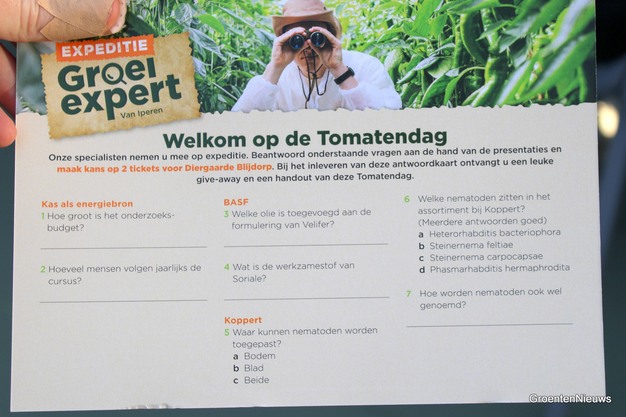 © Thijmen Tiersma | HortiDaily.comTo keep the attending growers sharp, they were challenged to join an expedition. By answering questions about the presentations, they had a chance to win two tickets to Diergaarde Blijdorp.
For more information:
Van Iperen
Smidsweg 24
3273 LK Westmaas
Tel: +31 (0)186 57 88 88
[email protected]
www.iperen.com