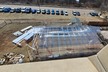
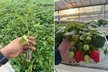
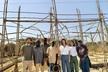
With the commissioning of a new, state-of-the-art greenhouse, Koppert Cress is once again taking a major step forward in fossil-free cultivation. The greenhouse, where specialty products are grown, was developed in collaboration with various partners.
The result is an integrated energy system that intelligently combines technologies focused on insulation, climate, heat, and CO₂. With this new greenhouse and the recent connection to geothermal energy, Koppert Cress is strengthening its position as a pioneer in future-proof, sustainable greenhouse horticulture.
 © Koppert Cress
Fossil-free as a conscious choice
The new greenhouse is in line with the ambition set out in the covenant between greenhouse horticulture and the government to achieve fossil-free cultivation by 2040. The greenhouse supports extremely stable and precisely controlled cultivation, with a focus on quality, uniformity, and continuity.
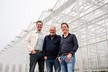
Stijn Baan, director of Koppert Cress: "For us, sustainability is not a project, but a direction. This greenhouse shows that with a clear vision, cooperation, and courage, you can take steps that make sense both ecologically and economically. Fossil-free cultivation requires choices that you make today, with an eye to tomorrow."
Collaboration as a foundation
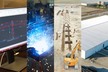
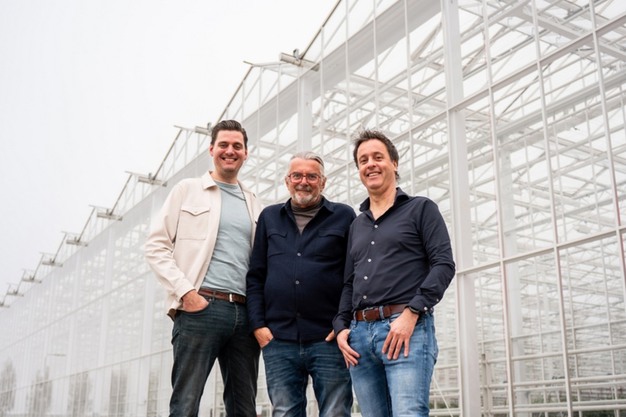
The development of the greenhouse is the result of intensive collaboration between Koppert Cress, Division Q, and a broad network of technology suppliers, construction partners, knowledge institutions, and government agencies in the Westland region.
Bart van Meurs, director of Division Q: "Our role was to make Koppert Cress' ambitions technically and practically feasible. Not by stacking separate solutions, but by designing a single integrated system together with all partners."
One greenhouse, one integrated system
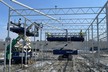
The greenhouse, covering approximately 1.2 hectares, has been designed as a coherent whole. Some of the innovations are still under development or validation. Through continuous testing and adjustment, the greenhouse remains aligned with its objective: achieving maximum energy savings and minimum emissions.
The concept integrates several key technologies and approaches. Low-E glass is used to reduce structural heat loss, while drones are deployed for mechanical crop protection. An airflow floor system supports heating, dehumidification, and air movement throughout the greenhouse. Insulated façades further enhance energy efficiency, and the system is designed to use low-grade heat, making it suitable for geothermal energy. In addition, Direct Air Capture technology is applied to extract CO₂ from the outside air.
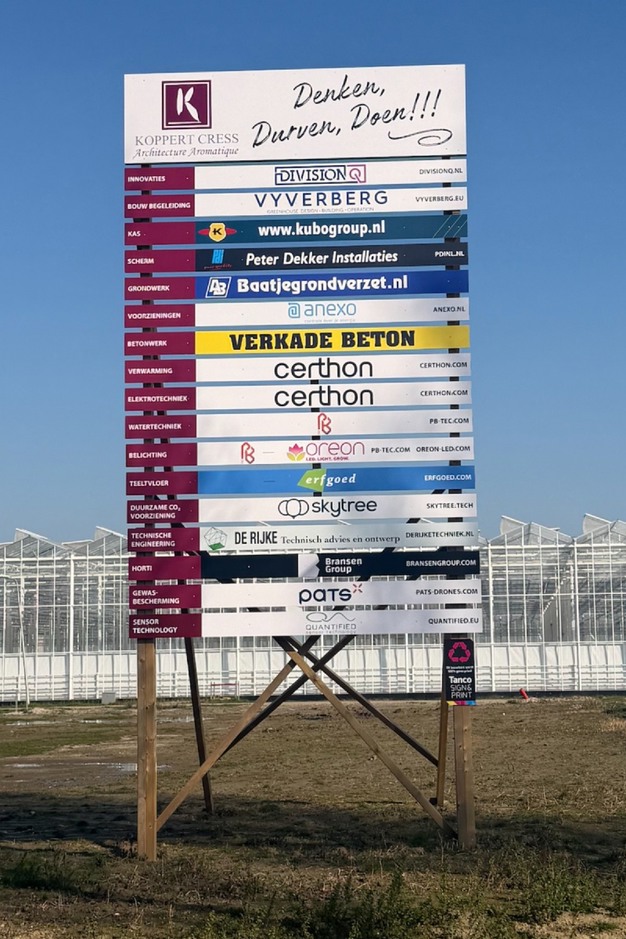
Stijn Baan explains that the realization of this sustainable greenhouse, filled with innovations, is only possible through strong collaboration. He expresses gratitude to all partners, customers, and teams who contributed their knowledge, dedication, and enthusiasm to the project. These partners include Division Q (innovations), Vyverberg (construction supervision), Kubo Group (greenhouse), AGC (glass), Peter Dekker Installaties (screen systems), Baatje Grondverzet (groundwork), Anexo (facilities), Verkade Beton (concrete work), Certhon (heating and electrical engineering), PB (water technology and lighting), Oreon (lighting), Erfgoed (cultivation floor), Skytree (sustainable CO₂ supply), De Rijke (technical engineering), Bransen Group (horticulture), Pats (mechanical crop protection), and Quantified (sensor technology). Together, they will continue working on innovative solutions and a more sustainable future for gastronomy and the broader food chain.
 © Koppert Cress
Koppert Cress
[email protected]
www.koppertcress.com