The Federation of Fruit Vegetable Organizations (FVO), which represents around ninety percent of the Dutch fruit vegetable growing area, has long maintained a low profile. That is changing. With the greenhouse horticulture sector facing increasing political and societal pressure, FVO is making a deliberate push to raise its voice. A recent symposium at HortiContact in Gorinchem, held under the provocative title ASML, let op! (ASML, take note!) The high-tech horticulture cluster is on its way, was a visible expression of that new ambition..
Big ambition with 100% Green Cultivation
FVO board member and Harvest House general manager Jelte van Kammen opened the symposium by presenting the organisation's Vision High-Tech Cultivation 2040, with innovation and sustainability at its core. He pointed to the 100% Green Cultivation project as a concrete example of the sector's direction (link in Dutch). "We are undergoing a transition without tools," he said, acknowledging the difficulty of moving toward fully pesticide-free production while the regulatory toolkit continues to shrink.
FVO also commissioned a True-Value study from CE Delft, which calculated the costs and benefits of the high-tech greenhouse vegetable sector. Against 688 million euros in costs, the study identified 1.4 billion euros in benefits (link in Dutch). Environmental costs are expected to decrease further, supported by long-term investment plans from growers using SIG&F subsidies, which already give FVO insight into the sector's sustainability trajectory.
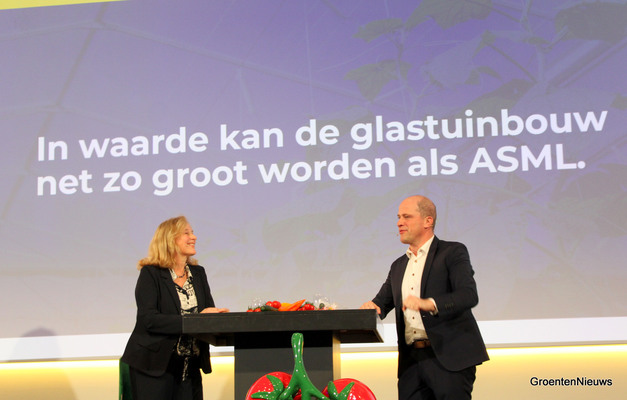 © Thijmen Tiersma | HortiDaily.comAdri Bom-Lemstra (Glastuinbouw Nederland) and podcast maker, former politician, and former Greenpeace activist Diederik Samsom discuss the statement on the screen
Comparison with ASML
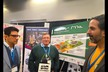
A central element of the symposium was a live podcast recording featuring former European Green Deal Commissioner Diederik Samsom and economist Mathijs Bouman. Samsom, who had toured the HortiContact trade fair earlier that day, said he was impressed by the technical developments on display. Yet both men offered pointed observations on FVO's ambitions.
ASML is currently the Netherlands' favourite company, they noted — but achieving a similar status will be a challenge for greenhouse horticulture, not least because of the sector's continued reliance on low-skilled labour, which stands in stark contrast to the high-tech workforce in Veldhoven. Interestingly, ASML faces comparable pressures on energy use and employee housing, yet those issues attract far less public criticism. "The greenhouse horticulture sector quickly finds itself in the problem category," Samsom observed. He pointed to the recent Dutch coalition agreement, in which the sector was barely mentioned — and when it was, the reference concerned crop protection problems. "As a sector, you want to be in the innovation paragraph," he argued.
Samsom also cautioned against taking ASML as a role model too literally. In his view, ASML has lost touch with society. For greenhouse horticulture, maintaining that social connection is essential.
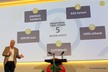
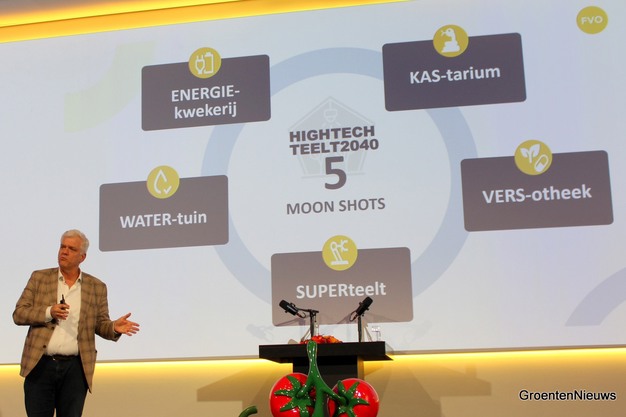 © Thijmen Tiersma | HortiDaily.comJelte van Kammen (Harvest House/FVO) kicks off the symposium with 5 moonshots
Moonshots
The Vision 2040 includes five so-called moonshots: ambitious new concepts for the sector's future (link in Dutch). These include the ENERGY nursery, the FRESH-otheque, and SUPERcultivation. Samsom warned that the ENERGY nursery concept risks placing the sector alongside data centres in the public perception, as an energy consumer rather than an energy solution. The sector must position itself as part of the answer to energy challenges, not as part of the problem.
The SUPERcultivation concept, a greenhouse driven by AI and robotics, drew a wry response from Bouman. "This is the greenhouse that was promised to us ten years ago," he said, pointing to the slow pace of robotics development in practice. He did acknowledge that the current labour shortage could accelerate automation. However, the investment hurdle remains high. "A robot wants its full salary for its entire career right on day one," he summarised. High upfront costs could nonetheless drive further scaling up, he suggested.
Despite their critical notes, both men were broadly positive. "High-tech food production is not a choice. It is the only way forward," they concluded. Bouman added: "Many sectors can take this ambition as an example."
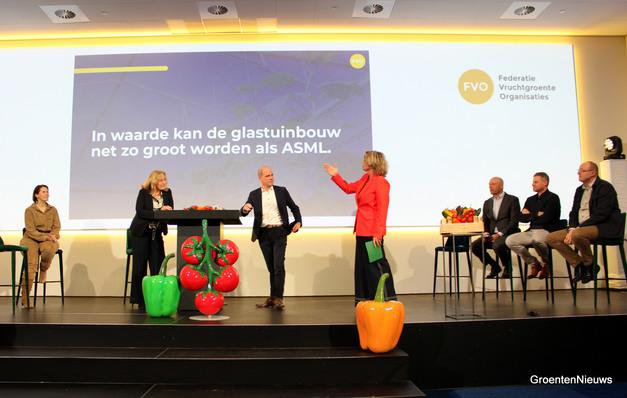 © Thijmen Tiersma | HortiDaily.comInge Bergsma-De Vries (Drenthe Growers), Adri Bom-Lemstra (Glastuinbouw Nederland), Diederik Samsom, day chair Inge Diepman, economist Mathijs Bouman, Korneel van der Plas (Albert Heijn) and Laurens Sloot (EFMI)
Another moonshot
The symposium closed with a panel discussion involving Adri Bom-Lemstra of Glastuinbouw Nederland, retailer Albert Heijn, Rijksuniversiteit Groningen, and a grower from Drenthe. The panel addressed the scale question: how much growing area is needed to keep the cluster viable while using the Jenga analogy: remove too many blocks from the base and the whole structure collapses.
One additional moonshot was raised during the discussion: the possibility of developing greenhouse horticulture on a future Maasvlakte 3, with active research already underway into expansion on new land reclaimed from the sea.
FVO is continuing to refine its vision. "You have to get to work, your story must be even better," symposium chair Inge Bergsma-De Vries told Van Kammen after the event. He closed by quoting a tomato grower who, when confronted with the ToBRFV virus crisis, expressed confidence that the sector would emerge stronger. "That's always the case in horticulture."
What is new is that FVO is now stepping forward publicly to help make that case — and ensuring that people outside the sector start to see it too.
For more information:
FVO
[email protected]
https://www.vruchtgroente.nl/