There is an ever-growing labour shortage in the global horticulture sector, especially for physically demanding and repetitive work. Mechanisation is no longer just a matter of efficiency, but is also becoming increasingly important for business continuity. That is why Rijk Zwaan is continuously conducting research to develop plants that save labour and are aligned with new cultivation techniques. One way to do this is by looking closely at the plant structure. This is producing wide-ranging solutions.
Florian Müller is a pre-breeder for cucumbers and melons at Rijk Zwaan. "Pre-breeding is focused on understanding the mechanism behind each trait. A cucumber plant has seven different chromosomes and 30,000 genes. At our Research & Development location in the Netherlands, we and researchers map these traits. In other words, we investigate which gene variation causes a particular trait, and which cucumber plants have that variation and trait. This knowledge enables breeders to select more efficiently and develop cucumber plants with new trait combinations," explains Florian.
 © Rijk Zwaan
Different plant architecture
"Sometimes, we look at the whole 'plant architecture', in other words the physical structure of the plant. This is necessary because one change can trigger a domino effect requiring many other changes. For example, breeding a plant with smaller leaves – which is more labour-friendly – often makes everything else smaller, including the fruits. So we find a way to solve that," says Florian.
Plants with smaller leaves offer additional advantages. "They often have shorter leaf stems and the leaves are angled more horizontally on the plant. This means they catch more light, plus the fruits are more easily visible. Moreover, there's better air circulation which reduces susceptibility to mould. So it's a win-win-win. All our latest varieties now have this leaf positioning."
Smaller leaves
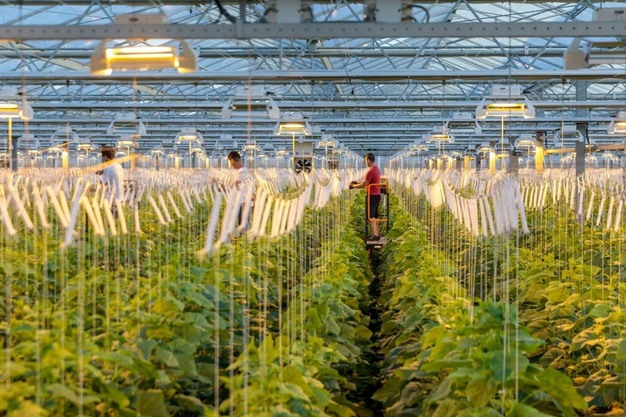
Rijk Zwaan develops labour-saving varieties for both systems commonly used in cucumber cultivation: low-wire and high-wire systems. For low-wire cultivation, for example, Rijk Zwaan introduced Proloog RZ, which has been the main variety in Northern Europe for 18 years. "When it was launched, Proloog was the first cucumber variety with significantly smaller leaves. The openness of the plant makes the fruits easy to spot and reduces crop maintenance. That saves a lot of labour. We now have similar varieties for other regions and seasons," says Tolis Spyropoulos, Cucumber Breeder at Rijk Zwaan.
Controlled growth
"Growers with new greenhouses are increasingly choosing high-wire cultivation systems because of better steerability, better fruit quality and higher production. But high-wire cultivation requires more crop maintenance: lowering the plants twice a week, thinning the fruits, removing leaves and picking flowers to prevent mould. Labour savings are therefore a very important aspect in this cultivation system," continues Tolis.
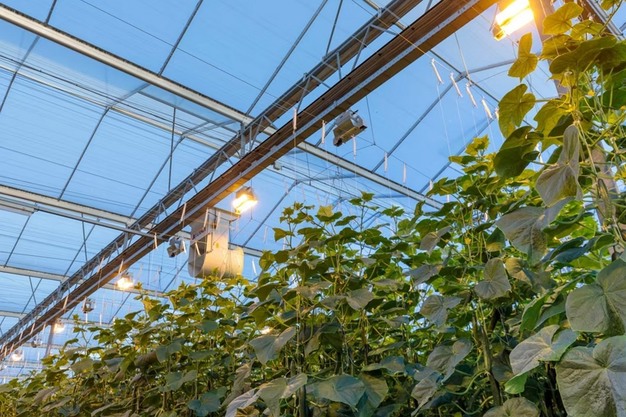
Florian: "That's why we have developed commercial varieties that produce fruits through parthenocarpy, without pollination. These plants naturally have a slower rate of growth. For high-wire cultivation, we've developed a labour-saving variety called Skyteam RZ. This has compact plants that grow more slowly and need to be lowered less often."
 © Rijk Zwaan
One fruit per axil
A cucumber plant can have one, two or even more fruits per leaf axil. In the case of long cucumber varieties, one fruit per axil is often sufficient, so growers remove any additional fruits. A variety that naturally produces only one fruit per axil can save a lot of labour, which is why the Rijk Zwaan breeding team worked on this aspect too. "Skyteam is a good example of a single-fruit variety. Compared to other cucumber varieties, thinning takes much less time with Skyteam."
Rijk Zwaan is the first breeding company to have developed such a single-fruit variety. Seeds of this variety have been commercially available since 2024, and it has already become the most important variety for summer high-wire cultivation in the Netherlands. Since then, the company has also introduced similar varieties for other regions, such as Blueray RZ for Canada and the USA. Tolis: "Besides producing single fruits, this variety also has compact growth and smaller leaves, making it very open and easy to see the fruits – just like Proloog."
Getting ready for the picking robot
Additionally, it is beneficial to reduce the labour requirement during harvesting and post-harvesting. That is why Rijk Zwaan selects varieties that produce uniform cucumbers suitable for automated sorting and processing, for example, and also uniformly sized gherkins that fit well into jars.
"Robotised picking is in the development phase," says Florian. "But we are thinking ahead. An open crop will help future harvesting robots to identify fruits better, and traits such as a long fruit stalk will become important for easier cutting."
How resistances save labour
Another solution to the labour shortage is disease resistance. Almost all of Rijk Zwaan's cucumber varieties are resistant to powdery mildew. Cucumbers can be susceptible to this disease, but chemical-based fungicides are largely prohibited. Florian: "Resistance-focused breeding not only reduces the use of chemicals but also saves labour. This is because cucumber growers need to spray less – if at all – and pick fewer flowers, which high-wire companies remove because they are a gateway for the Didymella bryoniae (Mycosphaerella) fungus."
Gene bank
Florian: "Rijk Zwaan has a gene bank – which also contains wild cucumbers – where we regularly find a trait we are looking for, such as single fruiting. Then our task is to make sure the trait can be crossed into our breeding material – preferably without other wild-cucumber traits such as spines or bitterness. We collaborate a lot with colleagues from other crops that are similar to cucumber, such as melons or squashes. We also do projects with third parties, such as universities. They can often conduct more fundamental research into genetic interactions. This gives us a better understanding of the gene network that results in a particular trait, enabling us to take a more targeted approach to crossbreeding and combining the desired traits."
For more information:
Rijk Zwaan
Burgemeester Crezéelaan 40
2678 ZG, De Lier
www.rijkzwaan.com