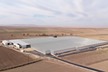
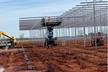
The European LIFE Aclimate project has reached a major milestone with the official start of plantings in its three pilot greenhouses, located in Almería at Grupo Cajamar and UAL AgroConnect, and in Garaia.
This new phase marks the beginning of real world validation of the technologies developed to improve the resilience, sustainability and efficiency of greenhouse agriculture in the face of climate change. With tomato as the model crop, the pilots will assess the technical, economic and environmental impact of the solutions being deployed.
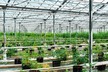
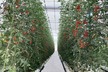
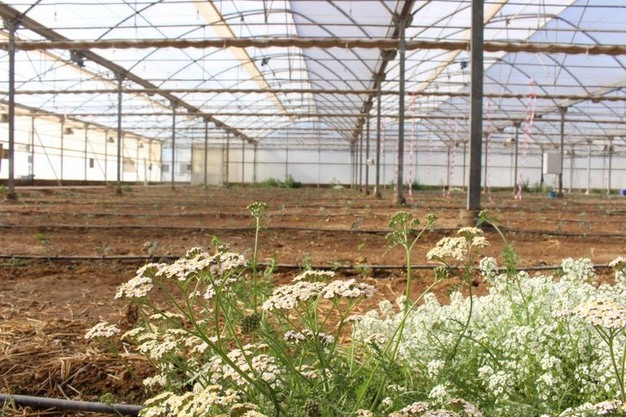
At the Fundación Grupo Cajamar pilot greenhouse, the first tomato crop is already underway. The main objective is to demonstrate the practical implementation of the project's technologies, evaluating their effectiveness and adaptability under real production conditions.
 © LIFE Aclimate
In the coming weeks, missions involving advanced robotic systems will begin, focusing on automated agronomic data capture, multispectral imaging, intelligent greenhouse segmentation, and the generation of information for calibrating artificial intelligence models. This deployment will feed predictive models designed to anticipate climate stress situations and optimize crop management.
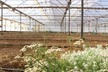
On 26 January 2026, tomato Vivalto RZ was planted at the UAL AgroConnect pilot greenhouse, marking the start of a new experimental cycle aimed at strengthening the sustainability and resilience of the production system.
This campaign will be crucial to validating advanced decision support models designed to optimize water use efficiency, improve greenhouse climate management, fine tune agronomic practices, reduce inputs, and minimize environmental impact.
In addition, the pilot will integrate robotic systems for continuous monitoring, enabling detailed tracking of phenological development, early detection of pests and diseases, anticipation of production risks, and more precise and efficient interventions. This approach represents a decisive step toward smarter, more autonomous and adaptive greenhouses.
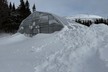
On 6 February, the first tomato planting took place at the Garaia pilot greenhouse, officially launching the demonstration phase under real conditions. Throughout the production cycle, key data will be collected to detect and anticipate water and heat stress, optimize energy and water use, reduce the crop's environmental footprint, and evaluate the technical and economic profitability of the solutions.
The results will allow for a comprehensive assessment of the impact of the developed technologies and support their replication across other crops, regions and European production models.
The simultaneous start of all three pilots represents a strategic advance for the project. Beyond technology validation, the goal is to generate scientific and technical evidence that enables the scaling of climate smart agriculture solutions across the European horticultural sector.
Each site offers distinct agroclimatic conditions, making it possible to compare production scenarios, analyze model adaptability, generate transferable knowledge, and strengthen the robustness of the solutions.
Against a backdrop of rising temperatures, water scarcity and increasing pest pressure, initiatives like this are essential to safeguarding food security and maintaining sector competitiveness.
In the months ahead, the project will intensify large scale agronomic and climate data collection, the calibration of AI based predictive models, performance evaluation, and environmental and economic impact analysis. The ultimate goal is to deliver practical, replicable tools that allow growers to adapt to climate change without compromising productivity or sustainability.
The launch of plantings in Almería and Garaia marks the start of the most strategic phase of LIFE Aclimate, the field demonstration of technological solutions designed to transform greenhouse agriculture. With real data, advanced robotics and applied artificial intelligence, the project is moving toward a more resilient, efficient production model prepared for today's and tomorrow's climate challenges.
For more information:
LIFE Acclimate
www.life-acclimate.eu