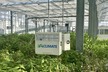
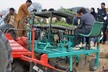
Dramatically reducing the use of chemical fungicides in horticulture is not only a regulatory ambition in Europe, but an economic and productive necessity. With this objective in mind, Agrikola AI was founded, a technology startup based in Catalonia that has developed an autonomous robot capable of protecting crops using ultraviolet C radiation, without leaving residues and without generating resistance.
From agricultural robotics to energy based biocontrol
The company was formally established in March 2024, although the project had begun several months earlier, explains Ricard Pardell, CEO and founder of the company. Pardell brings previous experience in autonomous systems applied to agriculture, including drones and robotic solutions for crop protection.
 © Agrikola AI
"I have been working in this field since 2018. I was very familiar with the real problems farmers face and with the capabilities of available technology. We knew that UVC radiation has germicidal and fungicidal effects and can inactivate bacteria, viruses and fungal spores, as supported by scientific literature for many years," he explains.
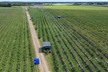
While UVC applications already existed in permanent crops such as vineyards or berries, Agrikola AI identified a clear opportunity in open field horticulture. "The innovation was developing a system that allows UVC to be applied in vegetable production with full safety for people and animals. For this, we hold a patent that enables outdoor operation without risk," Pardell stresses.
Wagus and Nimbus, an autonomous robot connected to the cloud
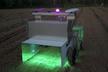
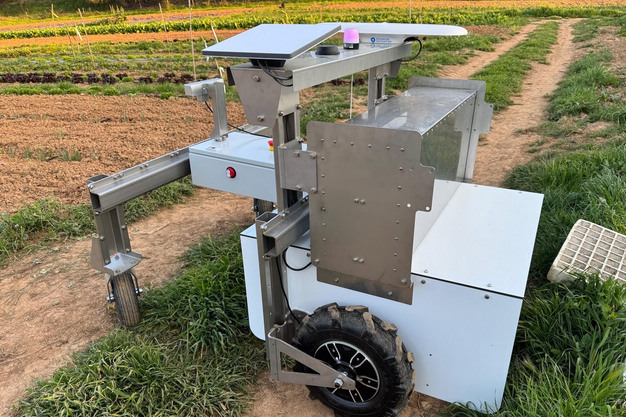
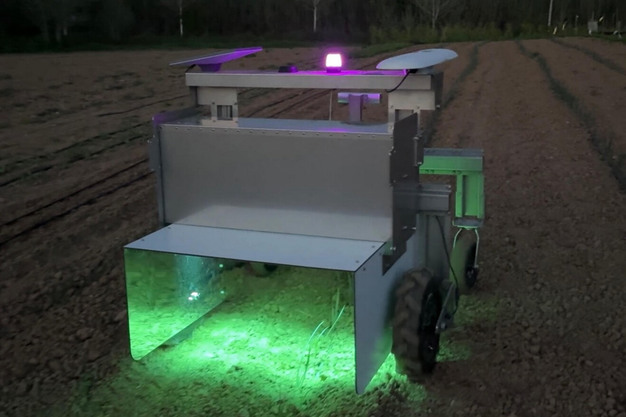
The robot, called Wagus, operates autonomously but under the direction of a cloud platform called Nimbus, one of the system's most distinctive elements.
"The robot is autonomous, but it is guided by the cloud platform. The farmer inputs the farm maps, crop planning and row layout into Nimbus. From there, the system generates missions that the robot executes automatically," explains the CEO.
 © Agrikola AI
The grower only needs to perform an initial setup, after which the process is fully automated. This architecture also allows the system to scale towards predictive models.
"In the future, we want to integrate high resolution cameras and advanced sensors to detect diseases and pests. That information will be uploaded to the cloud, where predictive models can be developed to help decide when to intervene or even when to harvest," he adds.
Protection against powdery mildew and downy mildew in vegetables
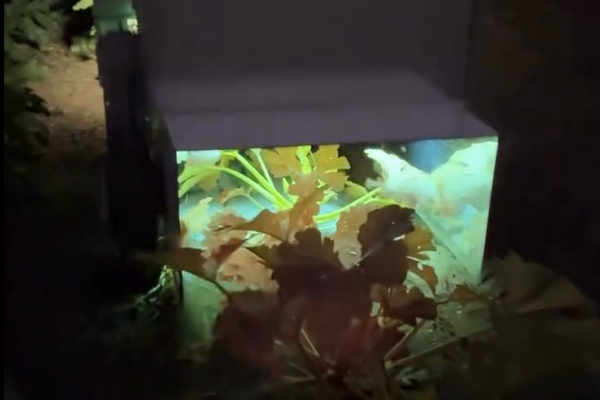
The system targets foliar fungal diseases such as powdery mildew, downy mildew and alternaria. "We have validated the system in courgette, lettuce and onion, and in principle it is designed for any horticultural crop," says Pardell.
The first commercial pilots have been carried out in the Delta del Llobregat and in Maresme, both in organic and conventional farming systems.
"In summer we demonstrated its effectiveness against powdery mildew in courgette, and in winter we validated results in lettuce and onions against downy mildew, with very positive trial outcomes."
 © Agrikola AI
One of the most relevant aspects is that the system not only eliminates the use of chemical fungicides, including copper in organic production, but also reduces costs. "In this way, it is not only a more sustainable solution, it is also more economical," he highlights.
Agrikola AI currently offers three robot models with interchangeable electric batteries, providing up to 32 hours of autonomy.
First international sale, De Groot en Slot
After entering its commercial phase, Agrikola AI has already closed its first sale with the Dutch multinational De Groot en Slot, a global reference in onion seeds. "Onion is a crop that is very sensitive to downy mildew and alternaria, and we are pleased to see that such an important company has recognised that our solution can be highly effective," Pardell notes.
"Our goal is that in a few years Agrikola AI will be able to offer complete crop protection without chemicals, based on energy and technology, especially in a context of decreasing labour availability and continuous reductions in authorised plant protection products. We are convinced that the future of crop protection will be technological, autonomous and residue free, and we want to be leading that change," Pardell concludes.
 © Agrikola AIFor more information:
Ricard Pardell
CEO and Founder
Agrikola AI
http://agrikola.ai/