Controlled environment agriculture (CEA) in the United States has more than doubled since 2010, driving a shift in how greenhouse and indoor facilities approach irrigation and nutrient management. As greenhouse vegetable production, hydroponic operations and vertical farms expand in size and complexity, fertigation systems are operating under tighter technical constraints than ever before.
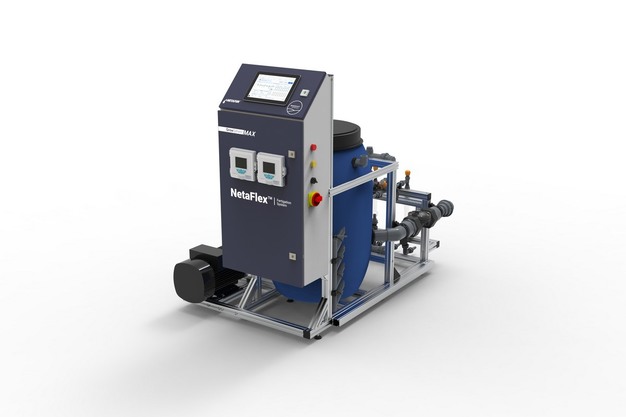
 © NETAFIMIn response to these demands, Netafim introduced the NetaFlex 5G in February this year, revealing it as a next-generation dosing platform for large-scale CEA environments. Melissa Lilje, Senior Vice President of Netafim North America, says the system was developed specifically to address the tighter precision margins emerging across the greenhouse sector.
"When operations were smaller, minor fluctuations in nutrient delivery were generally easier to manage," she explains. "But in today's multi-hectare greenhouses or large indoor facilities, those same fluctuations affect crop uniformity and labor requirements."
Expansion brings new technical requirements
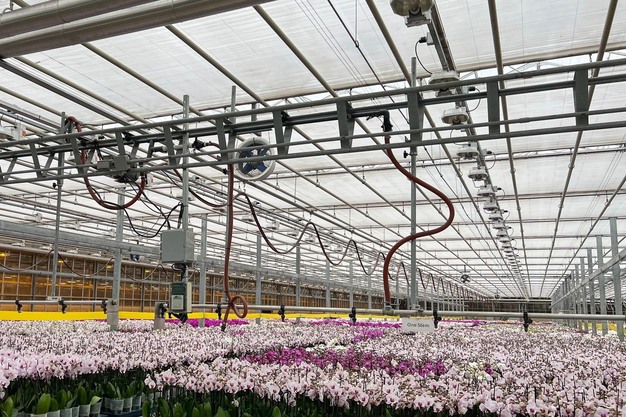
Melissa adds that the growth of CEA operations has changed what growers expect from fertigation systems. "Larger hydraulic zones, more irrigation events per day, and shorter crop cycles mean systems must reach target EC and pH levels quickly, and maintain them consistently."
"As production cycles shorten, stabilization time becomes even more important," she shares. "If the solution does not reach the target EC fast, that deviation is going to end up repeating across every irrigation event."
She notes that higher energy costs, labor shortages, and stricter quality standards are compounding these pressures. "Systems originally designed for smaller or less complex environments may struggle to deliver the response speed and dosing precision now required in large greenhouse facilities."
 © NETAFIM
Precision without soil buffering
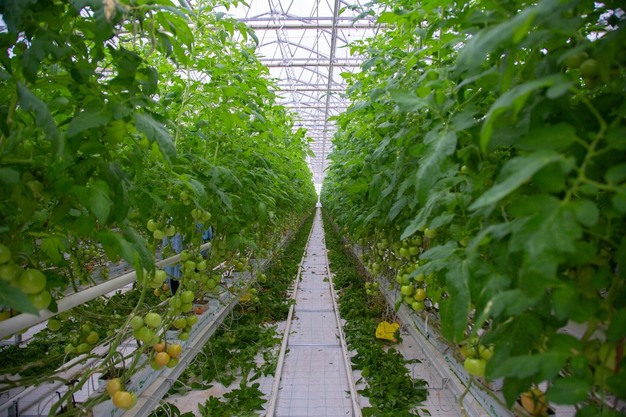
Unlike open-field production, greenhouse and hydroponic systems do not benefit from soil buffering. Nutrient availability is determined entirely by the irrigation solution, making uniformity and rapid stabilization critical.
"In CEA, EC is directly linked to nutrient availability," Melissa says. "Without soil buffering, small changes in concentration are inevitably going to affect uptake and uniformity."
One of the primary technical challenges in large-scale operations is ensuring consistent nutrient distribution across expansive irrigation networks. "Legacy pulsed dosing systems may create short instability periods before reaching target setpoints. In high-frequency irrigation schedules, even seconds of deviation can affect overall crop consistency."
 © NETAFIM
Engineering for stabilization and uniformity
She shares that the NetaFlex 5G builds on previous hydraulic designs with an open-tank pre-mixing configuration and analog, continuous-variable dosing channels. "This architecture is intended to reduce fluctuation during injection and improve stabilization speed."
"Continuous dosing allows smoother adjustments compared to simple on-off pulsing. That helps the dosing hardware reach EC and pH targets faster and maintain the consistent nutrient concentration needed across the irrigation network."
The system utilizes a Venturi-based hydraulic design with no moving parts, minimizing mechanical wear and routine maintenance in high-demand greenhouse environments. Combined with digital monitoring capabilities, the platform supports centralized oversight and calibration control during fertigation cycles, reducing manual intervention.
 © NETAFIM
Integrating with existing infrastructure
"Many facilities already have established control platforms," Melissa notes. "They know that improved stabilization and precision will pay off, but they do not want to have to undergo a whole redesign of their irrigation layout."
To accommodate this concern, the NetaFlex 5G is designed as a modular, CE-compliant system compatible with a range of third-party control platforms. The objective is to enhance precision and stability without disrupting ongoing production.
"In any-sized CEA operation, irrigation decisions are integral aspects of the broader management systems. To improve yield and manage expenses, the dosing equipment and the digital control environment have to work together smoothly."
For more information:
Netafim USA
netafimusa/contact-us
www.netafimusa.com